Science versus instinct…


I subscribe to an excellent blog about writing. (Several, in fact, but I’m talking about a particular one for the time being.)  It is humorous, colorful, lots of photos, and some very good sense.  To use a phrase I don’t generally like, I can validate the blogger’s comments from my own experience.  The blogger is right on point.

A recent series of posts, however, had to do with characters – heroes, villains, miscellaneous.  What makes them tick, what makes them admirable or despicable, or whatever.    Nothing new, nothing that hasn’t been said before, but reading the blog post made me raise my eyebrows.

The post said, essentially:

  So, you have this fabulous protagonist.  He is handsome and smart and you just love him to death.  You want to read about him all the time and writing about him is a wonderful experience.  He’s the best thing since toothbrushes were invented… the problem is that your hero needs a conflict.

It went on to give examples of conflicts: love life, past crime, past wrong, inherited problem, illness, money… 

“Well, yeah,” I said, propping my feet on my footstool and shooing my cat away from my mouse as I clicked away from the post and opened one of my two WIPs. “Of course.”
<span style="font-family: Georgia, "Times
I polished and tweaked and as I was doing this, almost on autopilot, my mind was clicking away with that blog post and others like it.  Why did they sit oddly for me?  Others were snapping them up.

I figured it out, finally. 

It was like reading a ‘how to’ manual.

Step 1.  Get a character
Step 2   Give the character a conflict.  Some obstacle he has to overcome.
Step 3   Do whatever else is in the works…

I had a mental picture of someone, the target audience of the blog, if you will, saying “I want to be a writer.  OK, so I get a character and give him a conflict. Now what?”


The next step is to formulate an antagonist.  Why is he opposed to the protagonist?

These are good step-by-step explanations of what goes into making a story, but for me, at least, they are…well, not useless, but beside the point. 

I don’t start out by saying, “I am going to tell a story.  Let me see…  I need a hero.  What is he going to do?  Hm.  And who is he facing?” 

For me, I can see a situation.  Using a very old example that may never be put into print, how about one of the officers of a troop of mercenaries who is in the middle of a very slow summer and wondering how they are going to make ends meet.  (This is in a universe similar to late medieval Europe.)  They have received a lucrative offer from a notorious pirate-prince who needs top quality maritime troops and is willing to pay for them.  This would be excellent pay, but a somewhat elevated probability of disaster.  They have also received an offer from a local prince who needs a force to fight fires in his bailiwick while he trains a fire-fighting group and gets it in place.  This involves low pay, relatively speaking, and a somewhat unexciting locale, but minimizes the chance of a messy death for the members of the troop.  That’s the snapshot as it popped into my mind.  I didn’t have to go down a checklist and populate things.  There they were, and everything fell together.

The story moved from there.  It did not write itself.  Some happenings were ruled out as not in keeping with the characters I was dealing with (even though the events themselves were as funny as all get-out).  Some were ruled out because they were utterly stupid, some because I had come up with a better way of handling things.  It was all pretty instinctive.

After some thought I concluded that the series of posts read like recipes.  Do this, add that, follow up with this and you will have a novel.

Utterly ridiculous!

…or was it?

Think about it: read the words to this song and you’ll find all of the ingredients they talk about:

Come listen to a story ‘bout a man named Jed,
 A poor mountaineer, barely kept his family fed.
 And then one day he was shootin’ at some food,
When up through the ground came a-bubbling crude.
(Oil, that is. Black gold. Texas tea.)


Well, the first thing you know old Jed’s a millionaire.
 His kinfolk said “Jed, move away from there!”
Said, “Californy is the place we oughta be!”
So they loaded up the truck and moved to Beverly.
               (Hills, that is. Swimming pools. Movie stars.)

With a little imagination you can see the hero, understand the conflicts and, possibly, have an inkling about the antagonists.

The Latke Revelation

When I was in college, I went into the student union of a group of which I was Vice President.  We allowed a couple other groups to use the space when they needed to, since they had no digs of their own and we were a hospitable bunch.  On the evening in question, I walked into the most delicious smells imaginable.  One of the other groups – the Hillel Society, as it happens – was having its Chanukah festivities with traditional foods.  I had a lot of friends in the Hillel Society, and they snagged me and urged me to eat their delicious food.  Which I did.  Gladly.

They had latke there.  I’d had potato pancakes, but never latke.  I got the recipe from a beaming friend and over the next many years made latke at the drop of a hat.  At some point in one or another of the nine moves since then, I lost the recipe.  So what?  I made latke as I always made latke and everyone loved it.   …then I found the recipe.

What?  HOW much flour?  Baking powder?  I don’t remember that!  Is this the—no, it is.  There’s the oil spot.  What HAPPENED???

Well, what happened is that I grew familiar with the recipe and added my own touches over time.  The latke is, and always was, delicious.  But I had to start with a recipe.  I don’t consult the original one any more because I don’t need to.  I work by instinct now.  How many times have you tried to duplicate something done superbly by a friend or family member, following  the recipe to the letter, and fallen short of the other’s perfection.  …and then discovered that they did things by eye or left out a step there? Or something?

So it is with those passages of instruction in the various blogs.  From time immemorial stories have had rules.  There’s a character with a conflict (or quest or desire – however you wish to put it) and he’s up against something that may make it difficult to achieve his aim.  There are twists and turns.


The bottom line, for me, is this:

I guess we all have to start with a recipe (people tend to read those more than they do assembly instructions), but at some point you have to trust your own instincts.  …and your beta readers and editors.

(If anyone wants the latke recipe – my permutation – say so in the comments…)

A Piece of Croc…


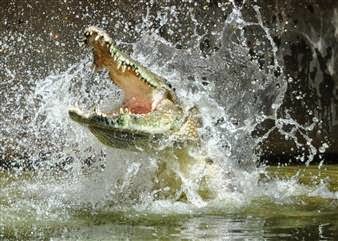
I have had crocodiles on the brain for the past month or so.  It all started with an idea that I had about some poor fellow poling his boat back home after a hard night fishing when a roar splits the dawn and  – ker-SPLASH!! – his boat is nearly swamped by a wall of water.  The man straightens to see a huge crocodile floundering in the river beside his boat.

It gathers itself and surges straight upward, falls back and bellows again as the man clutches his chest and tries not to hyperventilate, faint and fall into the water.

And then the crocodile looks at him for a moment with the rising sun right behind its head…

The story takes off from there.  The thing is thirty cubits long (which makes it between 45 and 60 feet in length)  with a head wider than the man’s height.  It follows him home and things start happening.

Who the crocodile is, how it got there, and what happens next in various ways to various people, grownups and children, is the story.  It is shaping up to be rather amusing, but it is also requiring a lot of research into crocodilians.  There is a lot I didn’t know.

For example, did you know that they can gallop?  Here’s a video of a freshwater crocodile doing just that.  (Pity they didn’t set it to the William Tell Overture, as Paul Serano the Paleontologist did in ‘Supercroc’):

The man gets quite a turn when he comes home from a long day fishing and finds the crocodile basking in the sun with the man’s  two children napping between his front legs.

It isn’t quite like the other crocs in the river, being more than three times their size, but like some regular specimens, it does like to chase the man’s fowl.


It also takes a rather dim view of rude people and tax collectors.

There is a lot to research (and, to be honest, I’m learning more about crocodiles than I ever really wanted to know) but I can’t do any actual composing until November 1, since this is going to be my NaNoWriMo project for 2013.

What audience would I target?  Well, that’s a good question.  It isn’t really a children’s book, though I think slightly older children (of an age to read chapter books) might enjoy it.  It is a bit of a fable and a bit of a fantasy, especially when you discover who and what the crocodile is, and how he got there and why there is a huge, dark patch in the night sky, and why the river sparkles so brightly when he is in it.

Heck, I even have a cover design well on the way to being finished.  

I think I’ll enjoy it.

And now one final video that should leave you laughing deliciously.  No blood, nothing to startle you even if a croc does appear in it.  Enjoy it!

An Interview with Thomas A Knight, Author (well worth celebrating)


Thomas A Knight

While I usually participate in the Celebration blog hop started by VikLit, I am putting in a bit of a twist this week.  We celebrate many things – meals, the coming weekend, a vacation.  Today I am going to celebrate someone who, in addition to being an excellent writer, is generous almost to a fault, and has helped many, many people reach for a dream.

Thomas A. Knight is preparing to publish the third book in his Time Weaver Chronicles, a heroic fantasy trilogy that begins with a bang with The Time Weaver, proceeds through Legacy, and leaves you wanting to read the final volume, Reprisal, which will be coming out early next year.

A reluctant hero must come to terms with a new world, new powers, and a family history buried deep in the folds of time.
     Learning to accept and control his powers is the hardest thing Seth has ever had to do, but the longer he spends in Galadir, the more he grows to love this new world and the female warrior accompanying him. When a much more ancient and dangerous wizard awakens and threatens to destroy Galadir, Seth is the key to defeating him. Now he must save a world he never knew existed with magic he never knew he could wield, if only he could learn to control it in time.

The Time Weaver

 Once upon a time…

…a warrior of light defeated an insane wizard, but behind every heroic story lies a truth never told.
     A man washes ashore on the island of Arda after a terrible storm, remembering nothing but his name: Krycin. The blue wizard Gladius finds him, takes him in, and is determined to help Krycin regain what he’s lost.
     The Fates have other plans. Krycin’s presence on Galadir is disrupting the fabric of the universe. The solution? Eliminate him, by any means necessary.
     When Gladius sides with the council, his efforts to destroy Krycin spark a war that threatens all life on Galadir.
                Legacy

Coming 2014:

 
* * * * * * * * * * * * * * * *


A couple years ago I first participated in the Amazon Breakthrough Novel Award Contest sponsored by Amazon.  This contest is open to authors who own their works, published or not (meaning that the work is owned by the author, free and clear).  The entries (one per person) must be fiction, no graphics, and novel length.  The books fall into different categories:  Young Adult, Mystery, Romance…  The process of elimination begins with submitting a short ‘pitch’ that must ‘grab’ the reviewers and make them say “This is a book I want to read!”  Since your entry is one out of 10,000, and 8,000 of those entries will be eliminated based on that ‘pitch’, the odds are very low that you will make it. 
 
Every year Thomas presides over a group that coaches contestants, gives feedback and suggestions on the pitches, encourages, and builds up confidence.  There is no reward given him, except for the knowledge that he has been truly helpful. 
 
In the course of all this, I had a chance to read his work, and I found it enjoyable.  The stories are well worth reading, and Mr. Knight is well worth listening to:

* * * * * * * * * *
Give us a brief summary of your book and its place in your trilogy. (Note: ‘It’s the last one’ is not an acceptable answer.)
Reprisal is the third and final installment in The Time Weaver Chroncles and marks a huge milestone for me as an author. It’s a finale, so all loose ends must be tied up, for better or for worse. I can’t promise a happy ending, but it will be an ending, and it will be fabulous.
Can you share a passage that you really like, and tell us why? (Note: if you want to clarify the passage, where it is, what it is that made you happy – good writing, caught the mood, made you proud, no spelling errors – just kidding – put it in)
This excerpt is from Chapter 1. I was looking for something to set the tone of the book, and I tend to write a lot of action scenes. I wanted to excite the reader, get their blood pumping, and give them a little something that fans have been asking for. This is what happens next, a direct continuation of the action at the end of The Time Weaver. Without further ado, here is the excerpt:
The bridge drew closer by the second, but Malia held back enough to ensure that every one of her remaining soldiers made it before her. When the last one had begun to cross, she slowed, stepped onto the bridge and turned to face the army that had begun its advance again. Walking backward, she watched Morganath make several more passes over the silent army. It didn’t matter how many he torched, the remaining wretches continued, some of them burning as they walked. Malia was half-way across when the first of them stepped onto it with her.
A voice behind her startled her. “What are you planning?” Ceridan asked. “You’re not going to take them on by yourself.”
“I will slay each and every one if I have to,” Malia said, her voice tainted with anger. “They have taken everything from us, and I intend to make them pay.”
Ceridan’s hand grasped her shoulder. “Easy, general. It’s Grian we want, not those poor wretches. Stick with the plan. We will get help from Caldoor and regain our kingdom.”
The undead approached fast, but Malia turned away from them anyway to face Ceridan. “Do not speak that name in my presence. He is the defiler, the usurper, a vile maggot in the corpse of a once great kingdom.” Ceridan backed up from her tirade, trying to direct her attention to the undead approaching behind her, but she ignored him. “He has taken our homes, our people, and our kingdom, and all we can do is run. We keep running or die and become one of them.” A tear ran down her left cheek as she lost control of her emotions. “I just want them to go away,” she said, and turned back to face the approaching creatures. Drawing all the magical energy she could muster, she ran through the first of the undead with her sword and screamed a single word. “Incendras.”
A massive column of fire burst from her hands and the sword, spreading out and flowing down the length of the bridge. Any undead in its path were vaporized, and still it continued as the sword took over and lapped up the energy. She felt its greed as she fed it, but didn’t stop. The bridge caught fire, the ancient iron wood fueling the flames, and still she continued, ignoring the frantic voice behind her. The sword felt good in her hand, and rage fueled the spell as it extended beyond the bridge and into the horde gathering on the other side. When she could take it no more, she ended the spell, raised the sword into the air with the blade pointing down, and drove it into the bridge up to the hilt.
The wood exploded, starting at the sword and spreading out before her, tearing the bridge apart. Flaming chunks flew into the air and fell into the canyon as the eastern half of the bridge crumbled. Supports split and fell, the railings gave out, and the entire structure sank as only the western half remained. The only thing holding it up was stone and chains in the ground on the other side. Malia gripped the sword and used it to keep herself from falling into the canyon, but Ceridan wasn’t so lucky. He slid down the surface of the bridge and fell off the end, catching one hand on a stray piece of wood. It was all that kept him from falling into the canyon below.

You have done a tremendous amount of worldbuilding with this series. Will you have any further stories set in this universe?
Oh yes. I’m already planning a new trilogy based on a favorite character of mine. He made an appearance in Legacy, but it was just a cameo. My next book, The Spell Breaker, will be all about Taraxle. His life started as an assassin, but he turns into a magic absorbing force to be reckoned with. I hope my fans will stick around to read his story.
So let’s talk about you:
What got you started writing?
I started writing The Time Weaver in November of 2010 when I took part in National Novel Writing Month. Before that, I spent almost twenty years creating plots and characters for role playing games. I knew nothing about creative writing, spelling or grammar when I began, but I’ve spent countless hours learning from my mistakes. I’m entirely self-taught, and still participate in NaNoWriMo every year.
How did this idea come to you? Did it just pop into your head, or did it come on slowly as details began to be set?
Inspiration comes from many places. I’m inspired by the people I meet, the books I read, the places I go, and the games I play. But in the end, what really got me writing was an intersection near where I work, and a question: What would happen if time stopped?
What is your process? Plotter? Pantser? Hybrid? (note: feel free to preach. 😉
Pantser, all the way. I come up with an ending, and a beginning, and then let my hands and my subconscious mind figure out a way to get me there. Sometimes things don’t go the way I expect, and I have to adjust my ending, but that’s okay, so long as the story keeps moving forward. I’ve found myself talking to my wife about the story I’m working on as though it were real events taking place. She’s even asked me: “You have no idea what’s going to happen, do you?” Truth is, I don’t.
Do you have any favorite tools, techniques or gimmics that keep you focused?
Not really. I’m a burst writer, so I’ll put down like thirty to forty thousand words in a very short time, and then let it rest for a while and do other stuff. Staying focused isn’t too hard when you work like that. As a software developer in a busy office, I’m used to distractions, so its easy for me to switch modes from one task to another. When I sit down with the intention of writing, I write.
Quickly now: you’re in the middle of a crowded place with lots of bustling people. You suddenly get a (mental) thunderbolt that illuminates a problem you had been having with your story. All is revealed, or the way out of the dilemma occurs to you or an insight comes to you. How do you preserve it?
I have a notoriously bad memory, so the answer may surprise you. I rely on my memory. Over the years, I’ve adopted a technique to help me remember things like this. I have compartments in my mind, like filing cabinets, where I store various thoughts and ideas. When I have an epiphany like this, I store it away in it’s appropriate cabinet or drawer, and pull it back up later. I have lots of ideas, all the time, and I rely on this system to keep myself organized. The important stuff sticks, and the less important stuff fades away and stops distracting me.
Who are your helpers? (Does your family go glassy-eyed and turn the talk away? Do your friends ask you for the next installment? Do you keep it all to yourself and only hand it out when you’re ready for it to be looked at?)
My wife, first and foremost. She is my best editor, and my last line of defense. She reads everything I write, gives me honest feedback, and makes it better. We work together on my final drafts, and when we’re done, there is very little wrong with my books. I also rely on a hired editor for the first run through, and a small group of beta readers who I trust to give me honest feedback.
You wake up one morning, open the door, step outside – and realize that you are in Galadir. The door, which you closed behind you, vanishes and you can’t go back. What do you do? Who would you be? What challenges would you face? Would you be pleased, or would you hide under a rock?
That depends on where on Galadir I end up. If I land in one of the more civilized regions of Galadir, I would look for the nearest magic academy and sign myself up. The deserts of Astara are brutal and unforgiving, which would probably be a death sentence if I wasn’t near a town or village. If it was the Eastern Badlands? Run. Run and hide.
What is next?
Another book of course, and the beginning of another trilogy. The Spell Breaker Chronicles is all I can think about right now. It’s burning in my head, and needs to come out. I tried writing it a while back, but it wasn’t time. Now it’s time. This November, I plan on putting down the first fifty thousand words.
Where do your names come from? (Some people like to know. Since I pull my fantasy names out of thin air, for the most part, I’m a little curious, too…)
I’m not ashamed to say that I use a name generator for the vast majority of my names. It’s a program called Ebon, which allows me to use a different dictionary of name roots for each region of my world. That way, I can generate semi-random names that all sound similar in style for a region. Some of my names come from existing characters from campaigns I’ve run, or are borrowed from friend’s characters. Krycin for instance was a name created by my best friend, and was used as a nod to him. A few other names were taken from real people (with their permission, of course). Those people know who they are. Still, a few of my names, like Seth and Malia came out of thin air. They just sounded right. I think in these cases, it wasn’t me who named the character, but the character who told me their name.
I know you have a crowdfunding site to help defray some of the costs – with some truly nifty goods on offer.  I am placing the link HERE – check it out!

Say something to those reading this. Anything you want, on any subject.
Balance. Life is all about balance. Don’t obsess, don’t work too hard, don’t play too much, and never forget the people who make you who you are.
I can’t think of any way to top that sentiment, Thomas, so I will close this interview with a suggestion to the readers that they look into your work, starting with your website:


Progress on my WIP


From my latest WIP, due to come out February 2014, God willing and the creek don’t rise.  ( © 2013 by Diana Wilder)  Good Day’s work.  Now to fiddle with it…

     ——  ***  ——

The main character, Hori, has spent four years as an acolyte at a temple.  As Crown Prince, he has been summoned back to court by his father, who is planning a campaign that will lead to the first international treaty in history. The scene opens with him leaving the army barracks (he is a general) and returning to his quarters to prepare for a state feast. 
Hori could hear the roar of the feast in the distance.  Drums, flutes…   Laughter….
He spared a thought for the silences at Opet, the calm courtyards at the Temple of Ptah.  Or the ringing, clear skies on the coast of Byblos…  The stillness was still there, somewhere, if only within himself.
**   **   **
     “That is much better,” Neter said. Hori was wearing the lion-head pendant Gold of Honor his grandsire had awarded him after that difficult fight on the Libyan border. A cylindrical necklace awarded by General Djedi during Hori’s second campaign sat at the base of his throat.  He shook his head at the broad collar.  Too heavy, too ornate. 
     He slid a pair of plain gold armlets up either arm as Neter clasped two bracelets on his wrists. 
     Neter was frowning around the room.  “Your diadem, My Prince—  I don’t see it.”
     “I will go bare-headed,” Hori said.  He had tucked the jewel away in one of his chests just that morning.  “It is late.  There will be other feasts – and the wind can stir my hair tonight.  There will be precious little wind in that throng otherwise!”
     Neter smiled and shook his head.  “There will be wind of another sort,” he said.  “Your Royal Highness is wise.” 
     He is growing old, Hori thought, remembering how he had seen Neter serving his grandsire during the years Hori had been trained by King Seti.  He had some wealth of his own.  He could settle Neter in comfortable retirement when the man wanted it…
     Neter unstoppered the small carnelian flask of kohl and inserted the rounded stick.  “It will take a moment to refresh the kohl around your eyes.  Do hold still this time, Highness: I don’t wish to have to explain to His Majesty why his eldest son has to wear a patch over his eye!”
     Hori closed his eyes and raised his eyebrows.  “It would tend to skew my archery,” he said through his teeth.
     “Indeed it would.”  Neter put the flask away.  “You are ready, My Prince, although others will no doubt be wearing tunics of royal linen.”
     “The more fool they.  They think layers of cloth hides flabby stomachs.  I have nothing to hide.” He grinned at Neter’s suppressed smile. “Thank you. Get some rest, yourself. I’ll put myself to bed when I return. And do you go to the master of the feast and tell him I have requested that you be given food and drink.” He took the small ring from his finger and gave it to Neter, then waited as the man swung the door open for him.
     He seemed for a moment to be facing a long path that arrowed before him into the distance.  He had not yet set foot upon it and at that moment he had the sense that once he took the step forward that would set him on that path, he would have no way to turn back, then or ever.
     Behind him lay the aftermath of a tiring, satisfying day.  Before him lay…  He did not know, and it was for him to bring it into being.  And yet—
     He could turn back.  Remain in his rooms, plead fatigue, plead—what? The press of duty?  Where did his duty lie? 
     Did he truly have to ask?
     He drew a deep breath and stepped into the dim hallway.  The door closed softly behind him.
**   **   **
     His Majesty had set the feast in the palace’s western gardens, to catch the last glint of the sun upon Imhotep’s masterpiece. Hori moved softly along the dim walkway, his bare feet thudding upon the sand-cushioned ground.  The afternoon breeze had risen and he could see the whirl and sweep of swallows chasing insects.  One passed so close, he could feel the light breeze from its wings.
     He could see the doorway in the distance.  Dark wood doors firmly closed upon intruders, even as the Temple of Ptahwas giving a gala dole to those who were in need. 
     No doubt, Hori thought, remembering the years that he had been present at the dole in Opet. 
     The cool of the evening was yielding to increasing warmth.  Hori could feel it building as he drew near the door, like the strengthening current of an unseen river.  Warmth from the press of bodies, the air passing in and out of active lungs, the warmth rising from movement, from the blood pulsing through their veins.
     What had seemed a murmur when he stepped into the hallway had grown to a rising hum.  He could see a thread of light through the closed doors.
     He hesitated.  The air would be hot and stale, full of the fumes of beer and souring wine…
     He took a step, another, and in his mind he could see himself turning away, moving down the hallway toward increasing brightness and his own rooms.
     A thread of incense touched him and he could hear the wheedling of a flute beyond the doors.  He paused, biting his lip.  He suddenly knew that if he went through that door, it would be to step into a changed life.
     You must lead yourself, Hori.  If you do not go forward, you must go back.  An army must move or die.  His grandsire, King Seti, had said that while they were perched on the battlements of that fortress in Kush.  And, truly, the thoughts of others, the way they see you, do not depend on you.  Move on. 
     “My Prince!”
     He turned to face Neter, who was panting behind him, clutching a pair of gold-adorned sandals.
     “My prince—! Barefoot!  It will not do!”
     He took them from the man.  “Thank you, Neter,” he said. 
     The man smiled, bowed, and turned away.
     Hori frowned at the rich, chased leather and then, casting a quick glance behind him, tossed them into the dimness and faced the doors and the two guards flanking them, so silent that Hori, battle-trained as he was, had not seen them.  They dropped to their knees, hands to chest, bowed, then rose and swung the doors wide.
     The roar of the feast surged toward him in a swell of sound.  He let it eddy around him and stepped forward into sudden silence.
     A guest straightened and squared his shoulders.  Another set down his cup with a click.  Cuts of meat fell back into serving dishes.  Servants straightened and stared 
     The silence deepened.
     Ye gods!  Have I stepped on the hem of my own kilt and pulled it off?  Am I stripped to my shenti that they should gape so?
     He lifted his chin.  He would be damned if he peered down at himself and tweaked his garments.  And if I am, then so be it. 
     A murmur grew. He heard his name, repeated and repeated until it was a roar itself.
     He moved into the throng.
**   **   **
     Nefertari, smiled at the servant, shook her head at the wine, and nodded at the ewer of water, accepting a full cup a moment later. Her eyes were dry; she closed them and held the pose for a long moment. That was better.
     Her husband was watching her. “It is hot,” she said.
     He frowned and nodded to two servants bearing feather fans.
     Rai and Mayet were sitting together, both smiling, though from Mayet’s straight smile and the stiff set of Rai’s shoulders some sort of quarrel was brewing. Was it too soon after Mayet’s confinement? Iyneferti might know. But from the way Rai was ogling that dancer- She blinked as he threw another ring and watched as the girl put it down the front of her loincloth.
     She suppressed a chuckle, caught her daughter’s eye, and had to look away. The girl made her giggle like a new wife. Most embarrassing!
     “Wine, Majesty?”
     She frowned at the ewer. A sip would be wonderful. “Yes, thank you, good Tuti,” she said, and sipped. She looked up to see her husband smiling at her. The dancer was on her knees, bending back…
     A hand closed around hers. She met her husband’s smiling gaze, relinquished the cup, and watched him turn it to sip from her side and hand it back under cover of the music.
     She lowered her eyes. After five children and twenty years wed, he could still make her heart flutter even as she thought Oh, Ast, please: no more babies!
     The cup was in her hands. She turned it, sipped, and set it down.
     Movement at the doorway – a flurry among the servants, the doors swinging wide –
     A man strode into the hall, tall, broad-shouldered with sun-browned skin and back hair. Gold glinted from wrists and upper arms, warrior’s gold hung at his neck and lay flashing against the satisfying swell of his chest.
     The room was silent. He stepped forward into a sudden roarof sound, the crash of applause, a rising, wordless murmur that built to a crescendo, as palpable as a wall of water.
     The man faltered, his dark eyes beneath straight brows flashing for a moment before the shoulders squared. He moved through the throng in the sudden silence, his eyes on hers –
     Hori! Her heart leapt with delight. Her son – and such a son!
     She beamed as he approached, rose as he went to one knee, his hands at his breast, his head lowered.
     Her husband had risen and was speaking measured, warm words of greeting that she could not hear through the glad singing of her heart.
     “Welcome home, my son!” she said to him as he raised her hand to his lips.

This is scheduled to be published early 2014.  We’ll see how I do.,,   Deadlines can be exhilarating – or truly annoying,

…Music in the Night…


I spoke about a scene I wanted to write in a love story I was working on, hindered a little by exhaustion and malaise.  People were very kind and supportive, and I am showing my thanks (well, trying to do so!) by posting a rough version of the scene I mentioned.

[Copyright (C) 2013 by Diana Wilder , all rights reserved, etc and reserving the right to edit this till I’m happy with it…]

————————————————–

  It was amazing, she thought, how tiring it was to recline upon cushions and allow beasts of burden to draw you along in a cart. Where was the sense of it?   She smiled at the menservants and stepped back as they began to lead the teams away.
     One of the donkeys sidestepped, throwing its head up and then prancing.
     As though he has not spent the better part of a week pulling me along, she thought. He still full of prance, and I exhausted.
     The doors swung open and she saw her mother’s butler beaming at her.
    “Welcome home, My Princess!”
     She returned his smile. “It is good to be back Master Hefner. Is my mother awake?”
     “She retired some time ago,” H said.

AND SO ON

     In her chambers, seated in the low stool, she listened, heavy-eyed, to the murmurs about her as they braided her hair. She lifted her polished bronze mirror.   Her fatigue-smudged refection yawned back at her. Her robes were folded and set aside, she settled into her sorely-missed bed to the sound of murmured good-nights. Someone’s kiss warmed her cheek as she faded into sleep…

** ** **

     The moon cast a coverlet of silver across her bed. She sighed and opened her eyes to smile at the stars, yawn and turn on her side, and drifted to the soft chime of music…
     Music…
     She rose through the layers of oblivion, her weariness falling away from her as the notes seemed to quiver in the night.
     A harp, she thought.  The music was almost too soft to hear. She sat up, scarcely breathing, as the notes rose and fell, softer than a breath but as clear as the sigh of the wind. …Where was it coming from?
     She rose from her bed, drew her shawl about her shoulders and stood silently as the sound faded. Had she only dreamed it?
     It came again on the echo of that thought, a sound of wind and sunshine.
     She was fully awake now, listening as the music twined through the wind, caught stars in its threads…
     She slid from beneath her covers, caught up her shawl, and went into the star-sparked night, moving silently along the worn stone ramparts. 
     The sound was nearer.  She could barely distinguish it from the wind sifting down along the ridges.
     The walkway passed above an open courtyard, half-sheltered by the ramparts’ buttressed overhang.  Her father had brought a worker in timber to build the supports. She had sometimes sheltered there when a rain squall caught her.
     She moved softly to the wall and leaned over to gaze into the courtyard.    The glow of a tiny oil lamp warmed the night.
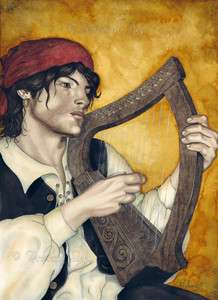
     A man was kneeling by the wall, half-sheltered by the overhang. The lamp sparked details that seemed to flash and vanish. Dark hair, the light easing over a strong line of shoulders, long fingers moving with delicate precision over the quivering strings.
     The music strengthened a little.  He had stiffened, even as he continued to play, his head moving slowly from side to side…
     Her breath caught as he raised his head. The wind teased the fringe of her shawl. She stepped back into silence.
      A soft shimmer of sound strengthened as the harpist played again.  She stepped softly away from the balustrade and returned silently to her rooms, to dream of moonlight and music. 

—————————————-

FROM THE MAN’S POINT OF VIEW.  HE IS AT THE LADY’S HOME TO NEGOTIATE A TREATY BETWEEN HIS PEOPLE AND HER FATHER’S.  HE IS IN AN OUTSIDE COURTYARD, HALF-DOZING IN THE AFTERNOON,  HE HEARS SOMEONE SPEAKING…  

     The voice made him open his eyes, oddly breathless. It was like a voice from a dream. It was a woman’s voice, but lower than many with a quality of water running over bronze. Chiming… But that implied a high voice, and this one was lower, softer, warmer, with the touch of a smile.
     Loveliness, he thought, and then blinked at the extravagance of the notion. But yet- He thought confusedly that ‘lovely’ was the correct word. Love…
     The voice spoke again. He frowned, trying to understand the words. He knew many languages and dialects, but this one was strange to him.
     He pushed to his feet as the voice spoke again with that same chiming sound…
     Who was she?
     He hurried to the wall, breathless, in time to see the flicker of a shawl entering the palace.
     He turned. The door— If he could overtake her, he thought feverishly, if he could see her – speak with her-
     “Highness—”
     He swore silently and turned to face the King.  

——————————————-  

THIS IS A DAY AFTER THE PRIOR SCENE.  THE LADY AWAKENS TO THE SOUND OF THE HARP.  

     A ripple of notes drew her to the edge of the casement.
The man knelt, as before, with the harp in his arms, coaxing the strings with quiet strokes that brought the song of the wind.
     She leaned over the casement. The wind caught her hair and spilled it across her face. She closed her eyes, reveling in its cool touch.
     “Welcome again, O Lady Watcher in the night.”  The words were quiet; for a moment she had thought it was the sound of the wind.  She had been silent, she knew. Something must have caught his attention. Perhaps the flutter of her sleeve?
     She opened her eyes. The man’s face was turned up toward her.  He was one of the Egyptians; the straight, dark hair confirmed that.  The flash of dark eyes caught her. But it faded, eased. The hands moved again on the strings.
     “Shall I play a song for you, My Lady?”
     His voice pleased her. It was quiet, tinged with a smile, though it had a sense of strength, as though he could fill a room with it if he wished to shout. 
     She chuckled.  “Wait,” she said. “Wait – I will come down to you.”
     The music stilled abruptly as she spoke. It began again with a slight quiver that had faded by the time she arrived at the courtyard.
     He was still kneeling by his harp, but he bowed over the strings.   “Am I intruding in your rooms?” he asked. He seemed almost breathless.
     She folded her hands at her breast and returned his bow. “No, My Lord. This belongs to no one…”
     “You were here earlier,” he said, plucking another ripple of sound. His voice had altered subtly. He almost seemed hesitant. “Who are you?”
     “I am Chara. And you?”
     “I am Hori.”

Surviving – A Celebration


Today I am celebrating surviving.

It has been a difficult, wheel-spinning, feeling tired, wondering why I have been put on the earth, doubting my abilities, living in a messy room and wanting to gas up my car and drive to Montana weeks (two, in fact).

I haven’t been to my blog, I’ve written maybe 1200 words in the past two weeks, I’ve cast an eye over the lovely posts and really nice comments and done…  nothing.

I’m working on a love story and I have a scene waiting to be written.  The heroine has come back to her home after being months away caring for a kinswoman with a new baby.  She arrives late, and she awakens in the night to the quiet sound of music.  Someone is sitting outside, softly playing a harp (it’s earlier times than now).  It’s lovely to listen to and she wonders who the musician is.

She is going to go out in search of the player and find the love of her life.  It will be a nice scene…  But I haven’t written it.  It has just been one of those difficult stretches of time that come for no particular reason.

Weather?  The raveled ends of old griefs?  (They say the first year after a bereavement is the worst).  I don’t know, but it has been a difficult week.

So what am I celebrating?

My friends, (whose comments I will answer this weekend, whose posts I will visit) I am here to tell you that the mood, ennui, exhaustion – whatever – is passing and I know I will be back to my usual form.  That  is something to celebrate, the knowledge that comes over time that moods do pass, energy does return, the world moves on and you move with it.

Maybe that isn’t exactly a small celebration.  It is, in fact, a lesson we learn after a long time.  What the heck!  I’m celebrating it anyhow.

And tonight…maybe…I’ll have her pause at the entry to the small courtyard, watching the harpist’s fingers move softly over the strings, and have her meet his gaze – and watch his face, somber in repose, warm into a sudden smile.

– – – – – –
This is a blog hop thought of by delightful, funny, enjoyable and very nice Viklit.  It is, for me, a way to remember how happy and fortunate I am, and how I am surrounded by good people.  (Thoreau said, “I have never gotten over my surprise at having been born in the most estimable part of the world – yes, and in the very nick of time”)

Why don’t you join?  It will certainly make you smile once a week! http://www.linkytools.com/basic_linky_include.aspx?id=179014

It ain’t over…


…till it’s over.  (Thank you, Mr. Berra.)

Done, finished, ready.  Well, almost.  This story is set to be released May 31.  Just over 24 hours from now, give or take.  It will be out of my hands.

…And I still have to finalize the Afterword.  All my books have Afterwords.  With historical fiction (which I claim to write) you absolutely have to explain where you have strayed from the conjectural into the invented.  (For example, one person in a main character’s life, mourned by that character as dead, historically outlived him…)  I have some words…where the story came from, why it had to be written.

It would be interesting to say what I have found to be true: that once you have written something in a universe that you have created, it is set in stone.  The presence of a specific character in the last book, chronologically, of this series – ‘The Memphis Cycle’ – mandates the occurrence that is at the center of this story.  …And then there are my thoughts about what, who, how, why.

Should I write it?  I think perhaps.

I’ll miss this one.  It’s a ‘bright’ story.  There is no mystery in it, nothing dire underlies it.  One of mine is a romp – the characters make it so – but the fact behind the story is a tale of treachery, rapaciousness and self-embraced evil.  This one has a love story, and – a blessing that I had not expected – it has a character whose ultimately bittersweet fate, followed through the entire course of my writing this, suddenly turned, rather like the Mississippi changing its course.  I was left standing there, ankle deep in the tide, filled with delight at the way matters fell together, threads were joined, and the flow of the Cycle went on.  I can only say that while I wrote the story, this character’s fate followed its true path.

There are some truly amusing sections for me, and some quotes my characters came up with that I found touching:

“Our children sometimes leave us too soon,” he said, looking down and away from the sparkle of tears in her eyes.  “You can give them birth, or cause them to quicken in a womb…  You give them the best childhood you can, try to be the father that you should be.  But, ultimately, they will leave you.  A month, a year…  Through marriage, through distance-you do lose them, or part of them you loved.  All that you can do is hold to what you did have, and remember the care you gave them.  And the love.  And also remember, for we sometimes do forget, that what we gave was the best we could at that moment.  And it was sufficient, no matter how we may dream of what we might have done, if only we had known.”


Or this, with (perhaps) a bow to Shakespeare:

Seti looked up at him.  “‘Tomorrow and tomorrow and tomorrow’,” he said.  “You say that too often.  Let me tell you, Djedi, you need to hoard your tomorrows, use them wisely, for tomorrows will run out and you will be left with only yesterdays, wondering where the tomorrows went and desperately wishing to have them back, just long enough to say a word, make a gesture, bind a wound, give one last kiss…”

There is this final worry.  (You may laugh at me – go ahead, guffaw, snicker, tee-hee, snort, chortle…)  The thing is too darned short compared to my usual output.  It is (ahem) only 84,700 words compared to my stripped-down 125K. 

Hah!  I’m going to bed!  24 hours!  Afterword or not afterword… Yikes!


…How Much is Too Much?


I must be crazy.

I have, going on at this moment:

The A to Z blog.  This is a wonderful event with hundreds of bloggers from all over the map who have committed to a post a day (except Sundays) in April with each day’s theme being a letter of the alphabet, in progression.  Some of them are hysterically funny, some of them are very educational (I am going to visit D.C. shortly, I think) some of them make you think, and all are pretty good.  For more info, check HERE .  It is a lot of work, but enjoyable.  I’m still in it.

The Small Celebrations blog hop.  This is an every Friday post where you celebrate something that might not be earthshaking but is nevertheless something worth noting.  It is the brainchild of VikLit  AT THIS BLOG (do visit the blog and the Friday Hop – well worth while).  I have had to drop out for the past three Fridays because of sheer busyness, but after April grinds to a halt, I’m back.  And perhaps sooner.

MOURNINGTIDE  is set to be published May 15.  I need to get things up and running (would anyone be willing to do a post for me?) and I am finalizing things. 

…and because I am bringing things into line for a series that I am writing (didn’t start out that way, but they’re all connected),  I am giving PHARAOH’S SON  a rewrite. 

I think that’s about enough for now.  We won’t mention a new job or other things.

…and yesterday I had a brainstorm for a story set in the timeline of my series.  After what I’m calling ‘Jubilee’, which is nowhere near being finished, and before LORD OF THE TWO LANDS, which is in the works and about 25% done.


Now, it is delicious to know that I still have ideas, and to see that the ideas are viable and could be very entertaining…  But I think I have enough on my plate.  Still…  The notion of two strong personalities grappling over a suddenly empty throne…  A hint of murder, a hint of betrayal…

And I wasted about an hour last night and today finding photos that would represent the two characters.  (The lady, on the right, seems formidable…)

I am a fool.

Uppity Characters


Dorothy Sayers wrote an excellent and fascinating book with the title The Mind of the Maker.  It is actually a treatise on the theology of the Trinity – but since it is told from the focus of a writer, specifically, it is a wonderful read.  You can find  it HERE on Amazon.

She talks of the three parts to a work – the Idea behind the work, the Energy involved in creating the work, and the Power that arises from the work – the reaction that readers have to it, and the way it changes them.  My copy is hopelessly marked up.

One of the most enjoyable discussions (for me) is her talk about the nature of characters, and how they have to arise out of a plot and be firmly centered in the plot to have any reality.  She gives as an example a passage from Writing Aloud by J D Beresford in which he tells about his attempt to write a book based on a character that he dreamed up.  It was a shambles.  The minute he put this character into a story, other characters, arising from the story itself, and conceived of as being in a situation took over.  They were immensely more powerful and more compelling.

Interesting, I thought all those years ago.  Something to mull over and marvel at.

And then it happened in my writing.

Pharaoh’s Son takes its title for the literal translation of the Egyptian term for ‘Prince’.  It is ‘King’s Son’, or ‘Pharaoh’s Son’.  Since the book involves a number of princes, I thought it appropriate.

The main character is a son of Ramesses the Great, well-attested in history with a character that comes through clearly across the centuries.  Historically, he was a scholar and was credited with being the first archaeologist in history.  He served as High Priest of Ptah and Governor of Memphis, and was Crown Prince at the end of his life.  He fulfilled these roles with such distinction that he was remembered as a wise man for centuries after his death.

With these attributes, how can such a character help but be splendid?

Well, my would-be main character was overshadowed by his brother, the Crown Prince of Egypt, who stepped into the story as a quasi-villain, had a turnaround, and ended up stealing the show.  A character in a situation, he was far more powerful than his brother, far more interesting…

The original hero ended up holding his own, and we had two main characters.  It worked.

And it provided for me  a very good illustration of Beresford’s situation.