Of Mice and (Wo)Men


A Sugar Ant

I came home from a long weekend away to find my cats waiting for me and looking hungry.  It doesn’t matter what arrangements you have made to feed them, a cat or cats will always stand before you, swaying with weakness, uttering faint cries of distress (as their distended bellies, caused by overly solicitous cat-sitters, sway gently from side to side, rather like those of sugar ants).

At any rate, I returned, counted noses, said hello, made certain they had food put out for them, and did a circuit of the house, checking to see that all was well.  Aside from the cries of the starving hordes, all was well. 

I thought. 

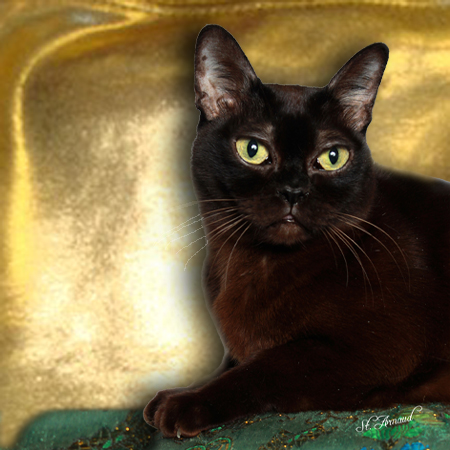
Dead Mouse.  RIP.  Caption by Frida


Then I found this:

Now, I don’t think animals are stupid, though I suspect the brain power of a lobster isn’t terribly high.  But you might think that a species that is always getting nailed by hawks, owls, weasels and cats might have some way of communicating the notion that a certain place is not necessarily the best one to slip inside and take a snooze.

Hoboes had a sign that indicated that a generous woman lived in a house:

“Kind Lady”


“Stay away from THIS place!!”


You would think that mice or voles or other such would have a similar sign that warns travelers off:


I’m not sure who left the love token, whether Frida (getting old at 9),

Frida, age 9


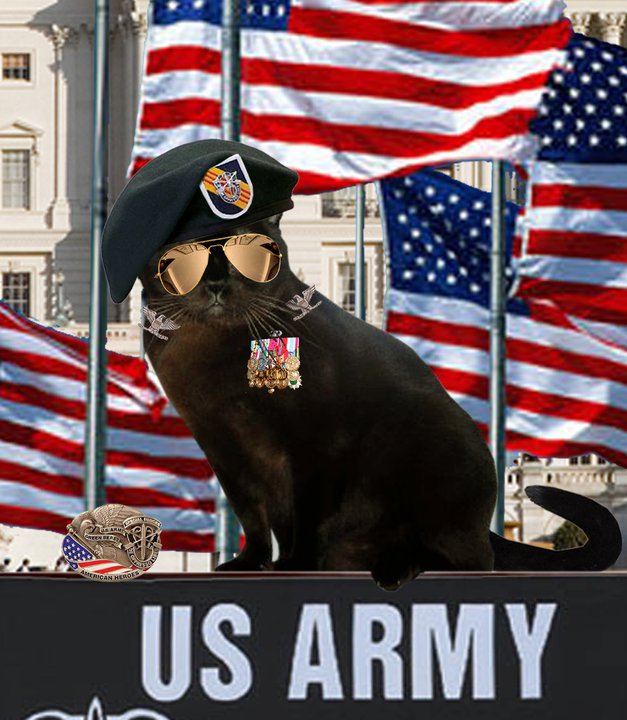
Orlando (in the Special forces but a bit of a doofus, 


or Casey (the Maine Coon, a breed famous for producing mousers).
My money is on Casey.  I think Frida wrote the sign, however…


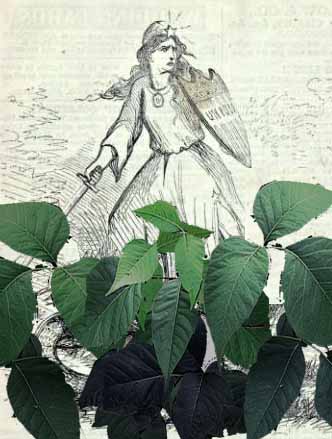
 Myself, I was busy doing battle with some poison ivy that strayed into my yard.  Wonder Woman (yours truly) is fine. 

Fabulous Fourth Fresh Berry Pie (recipe)


The Fabulous Fourth is upon us here in the United States.  I will be visiting my newly widowed mother who for grit and humor is unsurpassed.  She called to tell me that a neighbor admitted that she would be alone on the Fourth, so Mom said, “Well, spend it with me!  My daughters are coming and we’ll cook burgers and hot dogs!” 

She then called to ask me if I minded.  Minded?  Generosity?  Kindness?  Not I!  I’ve been the beneficiary of it quite a lot over the past several years.  How could I object?  

Fresh Raspberry Pie

I immediately offered to bring my favorite berry pie.  Mom said it might be a good idea.  So I made it, and here is the recipe. It is a simple fresh berry pie.  Not too sweet, rather perishable, easy to make (if you know what  you are doing and don’t waffle instructions).  And if you do it right, people think you’re the greatest chef since Brillat-Savarin.  A good thing if you go for such.

It’s easy, delicious – how could I not share the recipe?

So here it is:

Must use fresh berries!


FRESH BERRY PIE

I generally use raspberries (they eat them in Heaven, you know…) but you can use hulled strawberries (cut up slightly) or peaches, cut up (and drain them) or any other berry you like.


UNBAKED PIE SHELL
If you are one of those who likes to have people believe that

you never, ever, EVER use store-bought anything, you buy a frozen crust, thaw it and crimp the crust with your fingers once the thing is thawed.  Somehow, a crimped crust just looks more homemade to eaters.  Me, I don’t mind buying them (but check ingredients; some crusts do have sugar in them).  I also make a very good crust from scratch.  It’s a nearly-forgotten skill.  Rather like starting a fire using kindling.

BAKE THE CRUST:

Heat oven to 375.  Take a standard dinner fork and prick the crust all over (bottom, sides).  Holes everywhere.  If you have any pie weights, pour them into the crust to keep the thing from wrinkling.  Dried beans or peas work well, but then don’t use them in soup.  Bake the crust for no more than 15 minutes.  It should be golden brown.  Let it cool while you fiddle with the filling:


FILLING:

1 ½ cups cold water
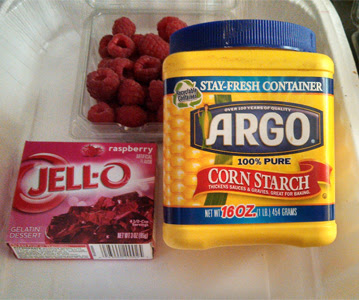
2 Tbs cornstarch
1 small package of gelatin.  If you’re using raspberries, use raspberry gelatin.  Sugar Free is fine.
3 Tbs granulated sugar
2 pints fresh berries, with any bugs or dirt picked out and washed off, well drained


PUT IT TOGETHER:

In a large saucepan combine until smooth:
1 ½ cups cold water
2 Tbs cornstarch
Bring to a boil, cook and stir constantly for two minutes, till thickened.  Take from the heat and stir in the gelatin.


The (very strong) temptation, if you have chidren watching as you stir in the gelatin, is to cackle, look slyly at them, and say with your best Wicked Witch of the West voice, “Poison!  It is Poison!”

Now we learn whether one is utilitarian or artistic…
UTILITARIAN:
Stir fruit into gelatin, mix well and pour into crust, and let it chill in the refrigerator.
ARTISTIC:

 Pour about ¼ C of gelatin mixture in the bottom of the crust and spread it. 

Add about ½ of the berries and drizzle half of the remaining gelatin over them, making sure most of the berries are held by gelatin.  Add almost all the rest of the berries (hold back a handful) and drizzle the rest of the gelatin over it.  Pretty it up and place the remaining berries on top.  Let it chill.

 
You can served this with the whipped topping of your choice.  I prefer whipped cream, myself, and I whip it myself, thankyouverymuch.  (But I also enjoy spritzing the pressurized stuff)
 
Leftovers are delicious stolen from the fridge at midnight…

Happy fourth, you all!
 

…Music in the Night…


I spoke about a scene I wanted to write in a love story I was working on, hindered a little by exhaustion and malaise.  People were very kind and supportive, and I am showing my thanks (well, trying to do so!) by posting a rough version of the scene I mentioned.

[Copyright (C) 2013 by Diana Wilder , all rights reserved, etc and reserving the right to edit this till I’m happy with it…]

————————————————–

  It was amazing, she thought, how tiring it was to recline upon cushions and allow beasts of burden to draw you along in a cart. Where was the sense of it?   She smiled at the menservants and stepped back as they began to lead the teams away.
     One of the donkeys sidestepped, throwing its head up and then prancing.
     As though he has not spent the better part of a week pulling me along, she thought. He still full of prance, and I exhausted.
     The doors swung open and she saw her mother’s butler beaming at her.
    “Welcome home, My Princess!”
     She returned his smile. “It is good to be back Master Hefner. Is my mother awake?”
     “She retired some time ago,” H said.

AND SO ON

     In her chambers, seated in the low stool, she listened, heavy-eyed, to the murmurs about her as they braided her hair. She lifted her polished bronze mirror.   Her fatigue-smudged refection yawned back at her. Her robes were folded and set aside, she settled into her sorely-missed bed to the sound of murmured good-nights. Someone’s kiss warmed her cheek as she faded into sleep…

** ** **

     The moon cast a coverlet of silver across her bed. She sighed and opened her eyes to smile at the stars, yawn and turn on her side, and drifted to the soft chime of music…
     Music…
     She rose through the layers of oblivion, her weariness falling away from her as the notes seemed to quiver in the night.
     A harp, she thought.  The music was almost too soft to hear. She sat up, scarcely breathing, as the notes rose and fell, softer than a breath but as clear as the sigh of the wind. …Where was it coming from?
     She rose from her bed, drew her shawl about her shoulders and stood silently as the sound faded. Had she only dreamed it?
     It came again on the echo of that thought, a sound of wind and sunshine.
     She was fully awake now, listening as the music twined through the wind, caught stars in its threads…
     She slid from beneath her covers, caught up her shawl, and went into the star-sparked night, moving silently along the worn stone ramparts. 
     The sound was nearer.  She could barely distinguish it from the wind sifting down along the ridges.
     The walkway passed above an open courtyard, half-sheltered by the ramparts’ buttressed overhang.  Her father had brought a worker in timber to build the supports. She had sometimes sheltered there when a rain squall caught her.
     She moved softly to the wall and leaned over to gaze into the courtyard.    The glow of a tiny oil lamp warmed the night.
     A man was kneeling by the wall, half-sheltered by the overhang. The lamp sparked details that seemed to flash and vanish. Dark hair, the light easing over a strong line of shoulders, long fingers moving with delicate precision over the quivering strings.
     The music strengthened a little.  He had stiffened, even as he continued to play, his head moving slowly from side to side…
     Her breath caught as he raised his head. The wind teased the fringe of her shawl. She stepped back into silence.
      A soft shimmer of sound strengthened as the harpist played again.  She stepped softly away from the balustrade and returned silently to her rooms, to dream of moonlight and music. 

—————————————-

FROM THE MAN’S POINT OF VIEW.  HE IS AT THE LADY’S HOME TO NEGOTIATE A TREATY BETWEEN HIS PEOPLE AND HER FATHER’S.  HE IS IN AN OUTSIDE COURTYARD, HALF-DOZING IN THE AFTERNOON,  HE HEARS SOMEONE SPEAKING…  

     The voice made him open his eyes, oddly breathless. It was like a voice from a dream. It was a woman’s voice, but lower than many with a quality of water running over bronze. Chiming… But that implied a high voice, and this one was lower, softer, warmer, with the touch of a smile.
     Loveliness, he thought, and then blinked at the extravagance of the notion. But yet- He thought confusedly that ‘lovely’ was the correct word. Love…
     The voice spoke again. He frowned, trying to understand the words. He knew many languages and dialects, but this one was strange to him.
     He pushed to his feet as the voice spoke again with that same chiming sound…
     Who was she?
     He hurried to the wall, breathless, in time to see the flicker of a shawl entering the palace.
     He turned. The door— If he could overtake her, he thought feverishly, if he could see her – speak with her-
     “Highness—”
     He swore silently and turned to face the King.  

——————————————-  

THIS IS A DAY AFTER THE PRIOR SCENE.  THE LADY AWAKENS TO THE SOUND OF THE HARP.  

     A ripple of notes drew her to the edge of the casement.
The man knelt, as before, with the harp in his arms, coaxing the strings with quiet strokes that brought the song of the wind.
     She leaned over the casement. The wind caught her hair and spilled it across her face. She closed her eyes, reveling in its cool touch.
     “Welcome again, O Lady Watcher in the night.”  The words were quiet; for a moment she had thought it was the sound of the wind.  She had been silent, she knew. Something must have caught his attention. Perhaps the flutter of her sleeve?
     She opened her eyes. The man’s face was turned up toward her.  He was one of the Egyptians; the straight, dark hair confirmed that.  The flash of dark eyes caught her. But it faded, eased. The hands moved again on the strings.
     “Shall I play a song for you, My Lady?”
     His voice pleased her. It was quiet, tinged with a smile, though it had a sense of strength, as though he could fill a room with it if he wished to shout. 
     She chuckled.  “Wait,” she said. “Wait – I will come down to you.”
     The music stilled abruptly as she spoke. It began again with a slight quiver that had faded by the time she arrived at the courtyard.
     He was still kneeling by his harp, but he bowed over the strings.   “Am I intruding in your rooms?” he asked. He seemed almost breathless.
     She folded her hands at her breast and returned his bow. “No, My Lord. This belongs to no one…”
     “You were here earlier,” he said, plucking another ripple of sound. His voice had altered subtly. He almost seemed hesitant. “Who are you?”
     “I am Chara. And you?”
     “I am Hori.”

Surviving – A Celebration


Today I am celebrating surviving.

It has been a difficult, wheel-spinning, feeling tired, wondering why I have been put on the earth, doubting my abilities, living in a messy room and wanting to gas up my car and drive to Montana weeks (two, in fact).

I haven’t been to my blog, I’ve written maybe 1200 words in the past two weeks, I’ve cast an eye over the lovely posts and really nice comments and done…  nothing.

I’m working on a love story and I have a scene waiting to be written.  The heroine has come back to her home after being months away caring for a kinswoman with a new baby.  She arrives late, and she awakens in the night to the quiet sound of music.  Someone is sitting outside, softly playing a harp (it’s earlier times than now).  It’s lovely to listen to and she wonders who the musician is.

She is going to go out in search of the player and find the love of her life.  It will be a nice scene…  But I haven’t written it.  It has just been one of those difficult stretches of time that come for no particular reason.

Weather?  The raveled ends of old griefs?  (They say the first year after a bereavement is the worst).  I don’t know, but it has been a difficult week.

So what am I celebrating?

My friends, (whose comments I will answer this weekend, whose posts I will visit) I am here to tell you that the mood, ennui, exhaustion – whatever – is passing and I know I will be back to my usual form.  That  is something to celebrate, the knowledge that comes over time that moods do pass, energy does return, the world moves on and you move with it.

Maybe that isn’t exactly a small celebration.  It is, in fact, a lesson we learn after a long time.  What the heck!  I’m celebrating it anyhow.

And tonight…maybe…I’ll have her pause at the entry to the small courtyard, watching the harpist’s fingers move softly over the strings, and have her meet his gaze – and watch his face, somber in repose, warm into a sudden smile.

– – – – – –
This is a blog hop thought of by delightful, funny, enjoyable and very nice Viklit.  It is, for me, a way to remember how happy and fortunate I am, and how I am surrounded by good people.  (Thoreau said, “I have never gotten over my surprise at having been born in the most estimable part of the world – yes, and in the very nick of time”)

Why don’t you join?  It will certainly make you smile once a week! http://www.linkytools.com/basic_linky_include.aspx?id=179014

Celebrating…Summer!


It is Friday again, a week has passed quickly and I am once again, courtesy of VikLit’s thoughtfulness and that of the others on this blog hop, thinking of reasons to count my blessings and smile.


I’m grateful for memories of:
colorful floats
flip-flops
sand all over my feet
squabbling in the car
riding with my head out the window
catching waves as they come in
watching my baby brother toddle to the edge of the wave and plunk himself down, diaper and all
swimming all day
having suntan lotion smeared over my back
listening to the seagulls

All the sounds that, to me, signified Saturday in the summer.  Since my family was living in Hawaii at the time I am remembering, the ocean is the color of an opal…

Ah….

We all need to count our blessings and celebrate our achievements or joys – why don’t you join us?  Here’s the linky – sign on!http://www.linkytools.com/basic_linky_include.aspx?id=179014

Another Writer’s Tool Discussed


“This is a very good story,” the Editor said quite a few years ago.  I was fresh out of grad school with a story I’d written and wanted to shop.  “It isn’t in our line of business – ” (they were a company that printed a lot of inspirational material.  They were one of the well-known companies, and if I were to name them, they would be recognized.  They had printed fiction in the past).  ” – but this is too good for you to send to a Vanity Press.  Keep submitting it – and don’t let yourself get discouraged.  It’s tough out there, but you’re good.”
Grieving

That was nice to know, of course, and she gave good advice, though issues arose that kept me from submitting for a number of years.  She hesitated, as though carefully considering what she wanted to say, then went on.

“Are you only working on the one story?”
I said I was.
“Oh no, dear.  You need to have more than one underway.  Otherwise, when you finish your current work, you will be knocked sideways.  Grieving, actually, and there will be nothing to distract you. and you’ll be lost.”
Well, that was nice of her, I thought.  But it sounded strange.  I was, as I said, fresh out of grad school, and I knew everything (just ask me at that time).  I didn’t give it another thought until I finished my story, finally and for all.
She was right.  I was lost, at loose ends, missing my characters, following them, forming them, making sense of my ideas and getting acquainted with them.  Seeing where they were going and helping them get there, polishing their descriptions and speech, making them as wonderful as I could (Reveling in polishing, I’d call it now).  And when the last word was done, the last paragraph polished, there was nothing more to write, the story was told –
I was empty.  And, as she said, I was grieving.
I remember that month or so.  I wandered around, doing my bread and butter stuff, riding the train into the city (1 ½ hours daily in which to jot and polish and daydream – gosh, I miss it!), walking through a season of rain (the sun was, actually, shining) and wondering what, oh what I was going to do.  Grieving, she said.  What?  These weren’t real characters, for heaven’s sake!  I mean, I made them up out of my head.  Didn’t I?  (Did I?)
Ultimately, I had another project underway, but it took a while.  I was ready this time.  I’d had an idea for another story, and I wrote up some notes about it – character thoughts, notions on where it was going – what I call ‘blips’ now.  I housed them in a notebook.

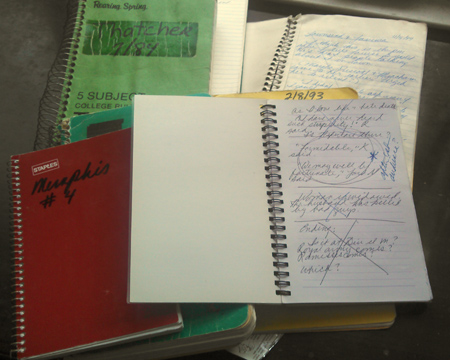
Be careful what you start.  I am a pack-rat.  I started notebooks for everything I was working

on.  I liked the ones I used in college: 6″ x 9″, three subject notebooks, or 5″ x 7.75″, all spiral bound.  They were fairly portable, but not too small (that gives me a hand cramp). 

Three ring binders didn’t work, even when I was in my briefcase-carrying mode because (1) they were cumbersome even with a shoulder strap briefcase, and
(2) someone apparently laid a curse on me at birth: ‘All her three ring binders will end up with one bent half-ring, which will cause her manuscript pages to jump off the ring and tear’. 
It is a dreadful curse, and if you combine that with my dislike of misaligned punched holes, three ring binders, even the expensive ones that hold The Decline and Fall of the Roman Empire, are ruled out.  Marble notebooks are nice, but if you muff an entry, it is a  bit of a production to tear out the offending page.  If you do it too well, the corresponding page on the other side of the stitching will cast loose its moorings, and if you do not, there is a rather odd-looking flap of paper left.(Warning: the spirals in spiral-bound notebooks end up squashed and distorted and will also foul up your paper.)

Writing instruments are important, too, I’ve learned:

  • Pencils smear (I don’t like smears, whether on my forearm or on a page)
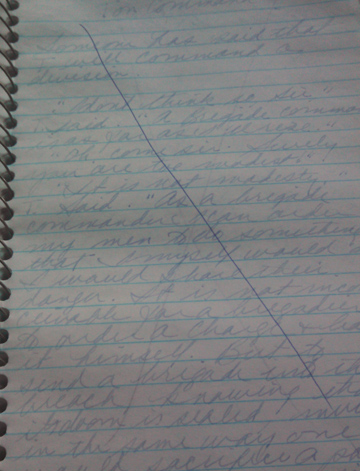
  • Fountain pens, which I happen to love, have water soluble ink that tends to fade rather badly. (see the image at right, which I had trouble reading when I photographed it) 
  • If you use permanent ink, your pen will get gunked up rather badly.  This is not a problem with the kinda-sorta throwaway pens, but with the Mont Blanc I inherited from my father, which has the 18K nib, it is not optimal.
  • Rollerballs have ink that sinks through the paper, so you can only write on one side of the page.  The other side is a complete loss.
  • Felt-tip pens can be fun, but they can smear.
This leaves me with good old ball-point pens, preferably blue.
Over the years I have developed a good system:


When you have an idea, jot it down.  If it seems to have possibilities, jot it in a notebook.  (Some kind of minor ideas are jotted in separate sections of three-part notebooks. 

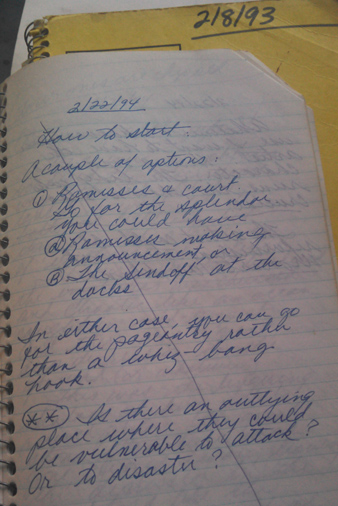
When you transcribe a page, mark it.  I draw a diagonal line across it.  If the whole page is transcribed, cut the upper corner off.

Never throw them away.  They may be worth something in five hundred years.  On the other hand, I myself won’t be worth much by then.  Sigh.

Still, it’s another tool writers can use.  (And it beats paper towels – see THIS POST…)
 

An Interview with Rowena Tulley


Rowena Tulley – in spirit, at least

I first ‘met’ Rowena Tulley a while back when she emailed me a question about one of my books.  I
did not know she was a writer at that time.  It was only later that I stumbled across her series of – well, while they are ‘Science Fiction’, they are set in a realistic universe that is a logical extension of the one we live in today.  No ‘Ta-DAH!!!’ moments, rather a lived-in, exciting extension of this world.
 
We ‘Chatted’ quite a bit, I reviewed one of the books (the first) in her series, and am set to read and review some more.  I thought that her enjoyable outlook and insights would probably entertain those who go by, so here she is: 

 
1.  How did you get started writing?

It began in the mid-nineties.  I was getting discouraged with science fiction at that time because there was very little stuff being written that interested me.  In addition, the shelves were filled with Star Trek and Star Wars offshoot stories.  I made an offhand remark to a girl friend at work that I could write better material, and she said “Well, shut up and do it.”  Best advice I ever got.
2.  One thing about your series that interests me (apart from the human angle – I’ve MET these people! – is the matter-of-fact way things are presented.  As an example, travel to the planet Venus is described as swift – it only takes a few months.  That echoes the time it took to travel from Pittsburghto Californiaby wagon.  Is this deliberate?  Logical?  What lies behind the ‘lived-in’ nature of your work?

I deliberately started with what will probably be the first generation of space propulsion—ion drive, using a slow build-up of acceleration, followed by a long, slow deceleration, finally braking into orbit at the destination.  Initial exploration of the solar system will be very slow, with trips lasting months or even years.  In later books, I have introduced gravitic drive to speed things up.  For interstellar travel, I start off the series with faster-than-light, or FTL drive.  In later books, I introduce sub-zero physics travel, also to speed things up.  As for the method of presentation, I want readers to think of space travel as commonplace, as well as the colonization of the planets in our solar system, and the gadgets of the future.  In other words, the future is the living present in these books, so they should be discussed in a matter-of-fact manner.

3.  Hobby, distraction or job – what is Writing to you?

All three!  It’s a hobby, in the sense that I can create stuff that people buy and hopefully enjoy.  It’s a pleasant distraction, in the sense that after work, I can come home and work on my hobby (one of many, actually).  Finally, it’s also a job in the sense that proofreading and editing is hard work.  As much technical writing/proofing/editing as I’ve done in the past (and still do), I’m amazed at how much harder it is to do the same thing to a novel.  The reason?  It’s difficult to ignore the story while looking at the mechanics of grammar, spelling, and sentence structure.
4.  Your heroine is in the Navy.  It seems to be an offshoot of the Navy we know now.  You seem comfortable with it.  Dare I ask why?

Many science fiction authors tend to choose either the Navy or the Air Force as the service branch for military travel in space.  Because the distances traveled are huge and the travel time long, I believe large spacecraft of the future will be run like ships, so the Navy seems to be the logical choice to me.  However, space travel is different enough to warrant a separate organization, so I decided to create the United States Space Service.  It is part of the Navy much like the Marine Corps, but separate enough to have its own distinctive Academy.  It’s not that any of this is unique.  Many science fiction books, TV series, and movies use similar logic.

5.  I understand there’s been criticism of the lack of a cover image.  Why are your covers the way they are?  And, since they are special for their very simplicity, do you have anything else in the works?

I’m aware of the criticism, but there is a method to my madness.  How many science fiction book covers do you see with a big-chested, scantily-clad female holding a ray gun, a menacing alien, a space ship, a star, a planet, or a combination of all of these?  If you approach cover art as advertising, then the idea is to make your product stand out from the crowd.  In a sea of half-naked women with ray guns, a solid cover stands out, particularly when the potential buyer uses a color device like a Kindle Fire, iPad, or iPhone.  Ultimately, any book is about the story inside.  Looking ahead to the next question, I have just enough time during the week to put all my effort into the story.  Couple that with my laziness and utter lack of artistic talent, I’ll stick with writing and leave cover art to the pros.

 
6.  If you’re like many of the writers I know, you do something else to put bread on the table, at least for the moment.  That takes a large chunk out of the day.  How do you squeeze writing time in?

Typically, I can squeeze a couple of hours in after I get home from work, and before I start dinner.  However, some days I’m so tired, I just come home and collapse on the couch.  My largest chunks of solid, quality writing time are usually Saturday and Sunday mornings, before the rest of the household wakes up.  Once the noise starts, it gets harder and harder to think.  I bet if I could be alone on a desert isle for a couple of weeks, I could write an entire book!  Retiring this summer would give me tons of free time, but our oldest daughter is in college, so the tuition and other costs suck the money out of our savings account almost as fast as we can put it in.  My advice to other writers?  Don’t quit your day job!  You’ll find the time somehow.

7.  A word utterly escapes you.  You know what you want and it is not popping into your head.  The perfect word – AWOL!  What do you do?

I do something fun that distracts my mind, such as playing a computer game, watching a DVD, or cooking.  Heck, I might even read something!  An adult beverage or two also helps.  However, sometimes a word, sentence, or plot idea pops up in my mind in the middle of the night, so I wake up and write it down—yes, I keep a note pad by the bed.

8.  People like to read books that interest and entertain them.  I have noticed, though, that an interesting and entertaining author also gets a following.  What is there about you that people might like to follow?  Don’t be shy.

Aw, you made me blush . . .  I like to think of readers as following the character or story line, not the author.  I do understand that once an author gets a reputation for good characters and stories, readers will buy the book just because of the name on the cover (not the cover art!).  My goal is modest—to write books people want to read, not to become the next J.K. Rowling.  If by some chance a miracle does occur, I’ll invite you and J.K. to my yacht for lunch . . .


9.  Speaking seriously about the craft of writing, what tools or procedures do you consider absolutely essential?
Tools (for me):


            A laptop computer (it’s portable, and the battery functions as an uninterruptable power supply)

            A non-electronic dictionary and thesaurus (it’s retro, but it works for me)

            A work surface with lots of space (I use the dining room table)

            Pads of paper, post-its, and pens (for jotting down ideas when the laptop is not around)

            Adult beverages (self explanatory)

            Peace and quiet (also self explanatory)

Procedures (and advice):

            Read lots of books about writing.  While every writer does things differently, you’ll discover things in common that the majority of writers do.  You may also find a process that a particular writer uses that fits your personality.  For example, one author in particular recommends writing one and only one book at a time.  I pretty much do that, but I will use a note pad to write ideas down for future books or short stories.

            Keep at least one pad and pen with you at all times, day and night

            Use a system for keeping track of book versions.  I use a letter revision system while writing the book, and a number system while editing the completed book.  For example, “Juggernaut” started at Rev A, and got all the way up to Rev N during the writing of the story.  Rev N then became Rev 0 (zero), and the subsequent proofreading and editing sessions got the book up to Rev 4 before publishing.  The latest revision (letter or number) is always the one you are currently working on.

            Save early and often.  Save every revision of your book on multiple DVDs, and keep them in separate locations (at least one not being in your home).  Save and copy after every writing session, no matter how short.

            Use Amazon’s recommended format and publishing procedures if you are using Kindle Direct Publishing.  They put out free e-books on the subject, so you have no excuses!

            Have other people review your work (and don’t forget to thank them in the “Acknowledgements” section of your book).  It’s surprising how much your innate knowledge of the story keeps you from passing needed information on to the reader.  This is related to the old adage “familiarity breeds contempt.”  In addition, make sure these reviewers are not close relatives.  My mother will look at my grocery list and tell me how great my writing is. 

            Do the last proofreading/editing review on your Kindle (or whatever e-book reader you use).  This way, you’ll view your book just as your customers would.  You can also use the Kindle Previewer on your computer.  I also discovered that reviewing your book with different margins and a different font makes previously hidden errors jump off the page at you (yes, I’m learning things as I go).  There are tons of books out there on other proofreading and editing techniques, so read them. 

            When doing the actual creative part of writing, don’t worry so much about spelling or grammar as much as getting your ideas down on paper—er, in the computer.

10.  What else is in the works for you?  

I’m intrigued by the Ellen Nichols character in my short story “Light Duty”.  I’m thinking of writing a mystery with her as a younger woman, at the beginning of her career with the National Intelligence Agency.  In the meanwhile, I have plans for two more books in the Linda Kay Daniels adventure series.

OK, we have an open forum here: what would you like to say?
Thanks for the interview!  Your questions made me step back and think consciously about what I’ve been doing all this time.


Celebrating….Reading (but read on…)


We have another Friday – another week come and gone, and time for this blog hop, the brainchild of Viklit (check the linky below) that provides a wonderful chance to sit back, think and smile.  And share.  I’ve been blogging for a bit, from the standpoint of how many months or years are involved. But there is a lot I did not know or appreciate until I stumbled across this blog hop and started participating. 

Do check the other posters and celebrate!  It’s hard to feel upset or hopeless when a number of people open your eyes (mine, at least) to the small wonders that are well worth celebrating. 


Peanut butter and Jelly and a good book…

I wasn’t able to post last week, and I missed it.  But I have an offering for this week.

I love to write.  I like storytelling, and I love my characters.  It sounds odd to those who don’t write, but characters take on a life of their own.  For me, at least, it is separate from my work – once I distance myself. 

Oddly enough, writers often forget to read what they have written.  And that is a shame, because it’s rather like forgetting to cut yourself a slice of the cake you’re serving up. 

So here is what I am celebrating this week:
Enjoying the fruits of my labor.  It’s actually an enjoyable read. 

What do you have to celebrate?  Why not join?  See below.

 
http://www.linkytools.com/basic_linky_include.aspx?id=179014

Wanting to strangle friends…


I treasure all my friends.  They all are valuable to me in different ways. One can always make me laugh, another is very wise and unflinching in his honesty.  One is the most generous person I know, another is very inventive and will never bore you.

And with each and every one a moment comes when I would cheerfully (pick one): 

  • bop him or her on the head with something fairly firm
  • drop him off by the side of a road in the middle of nowhere with a pup tent, a Coleman stove, a compass and a book of instructions on surviving in the wilderness
  • Grab a bull horn, switch it on, and announce to a large crowd that So-and-So is a pain in the neck
  • Take a container of Reddi-Whip (canned, pressurized whipped cream for those of you not of this continent) and anoint her face with it
  • Push him off the end of the dock
  • Hit her in the face with a blueberry pie
  • Make a rude gesture with my hand
  • wrap a rubber band around the handle of their sink’s spray nozzle

We all have times we want to hit the ‘delete’ key on our list of friends.   I ran into one of those times yesterday when a dear friend, to whom I owe much, said something so amazingly snarky, I had to turn, walk away, and find a place to sit down and breathe deeply.

It’s one of those facts of living, and the friendship is more valuable to me than my temporary pique.

I am so very glad that I don’t behave in a way that gets others angry.

Do I? 

Nope.  (Just ask me.)

Serendipity…


…is defined by Webster as:

the faculty or phenomenon of finding valuable or agreeable things not sought for

We have all had experience with this.  The turn in the road that opens out to a vista of a splendid purple sunset (I was driving on Rte 87, heading south in southern New York state), the bird glimpsed at the moment of flight…

I have a camera in my phone, and I’ve started using it.  I also have a nice camera at home, but it isn’t always with me. 

I remember one time (the umpteenth time) walking past an old, beautifully weathered wooden barn sitting in a field of larkspur and bright dandelions and pausing to fill my eyes with the splendor of rich brown, periwinkle blue and brilliant yellow among velvety green, with hills rising behind it.  It was at the end of the street on which my parents’ lakeside cottage was built.  It would be there the next day, I’d grab my camera first thing in the morning, when it was catching the dawn light, and click away.

…the next morning I looked at the new-mown field and shook my head.  The larkspur never came back.

So, t’other day, driving along past another serendipitous sight on my way to the post office, I decided to take action.  And I’m going to share.

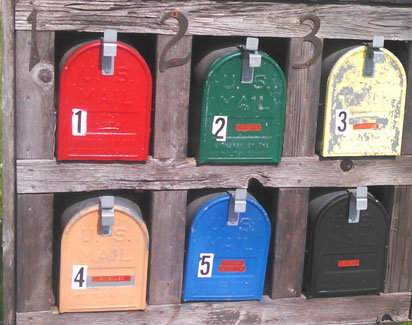
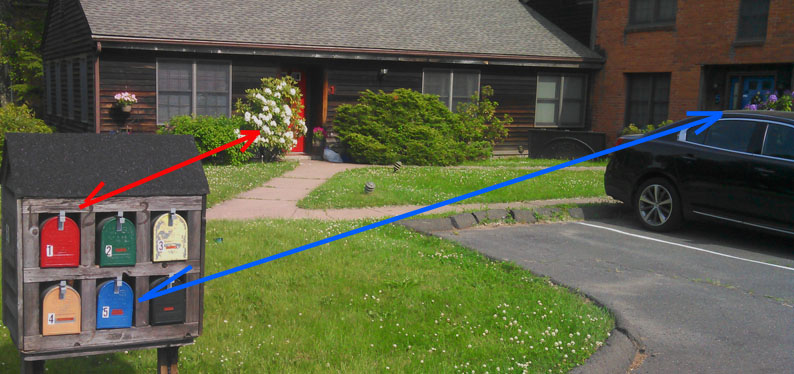
Here it is.  Six mailboxes in a weathered wood setting.  Bright colors – true red, hunter green, (weathered) cream, peach, blue and black.  I’ve been driving past them for years, smiling at them – and then, yesterday, in a bit of a hurry, I nevertheless stopped, parked, and jumped out of my car with my phone clutched in my hand. 

I took several shots, then backed up and took a photo of the entire scene.  My passenger (my sister) thought the view was pretty, but she’s the one who came up with the reason for the colors: 

“If you look,” she said, “The mailbox colors match the doors.  I frowned, squinted, and then began to laugh.  HOW many years had I driven past and enjoyed the view?  There’s the red door, and there’s the blue door (check the arrows).

And now they’re caught!

Maybe I’ll catch a snapshot of that old hand-made shelter by the side of the road…