 The name of the Muse of Writing, according to the ancient Greeks, was Calliope. Actually, she was the muse of heroic and epic poetry. Since I write historical fiction, I think that’s about as close as I come.
I’ve been going hammer and tongs at a new project, and she has been with me every step of the way. …or do I mean that she has obstructed me? Hm. Perhaps that is a better choice of words… The hard thing is that if you do write, you have to have a muse.
…but do I have to have one that sits on my keyboard?
Now all I need is Terpsichore (muse of dance) to tap-dance on my keyboard. I suspect it’s only a matter of time.
Tag Archives: writing
Polishing a Draft
So, you have finished your story. It is complete. The tale has been told and was done rather well, if you say so yourself. You ‘compile’ the manuscript (for, after all, you are using Scrivener) and you then print the thing. The result is a two-inch thick pile of bright white paper with printing on it. The manuscript. Finished! Hurrah!
 |
| Wordsmithing as I do it. The logic is hidden by the lack of prettiness… |
The delight lasts only as long as it takes you to flip to a random page, and read…
“Did I say that? What a passive construction! What was I thinking?“
You seize a pencil/pen/whatever, circle the offending phrase, write in what you should have written if you had not been under-caffeinated, and then sit back, scowling, and look at the rest of the manuscript.
…And now you are in ‘polish’ mode.
It’s been a while since I did this, and I had forgotten how enjoyable it is. Wordsmithing, pure and simple, is a pleasure in itself. It is, however, annoying when you have been envisioning a finished manuscript and, looking down at it, pen in hand, realized that the thing is anything but.
So you sigh, assemble the things you will need, and go to it.
What do you need?
 |
| Just the basics, ma’am, but in all available colors… |
Pens. Lots of them. They tend to grow legs and walk. I have one that was made by an artisan using chestnut wood salvaged from an colonial-era house on the seacoast. Chestnut isn’t seen any more since the blight destroyed most of the chestnut trees. That’s a pity because the wood is very rot-resistant and has a wonderful color. Then there are the gel pens that are a delight to write with and have thick, visible ink. The problem is that the ink tends to sink into paper and go through the other side. Not pretty.
 |
| Authentic Marvin the Martian Pen |
I also have a special Marvin the Martian pen I bought years ago at a Warner Brothers store and carried to various meetings over the years.
You need highlighters in various colors. Why? Well, what if you highlight something in pink and then think of something else that needs to be done with the highlighted passage, but is different? Pink won’t work, it’ll be confusing. Besides, hot pink is something of which I can only stand so much. Purple, I think. Or maybe blue…
Post-it notes, or reasonable facsimiles thereof, are very useful for marking places (‘Oh – that’s right! I edited to here!’), marking thoughts (make sure you don’t get cheap imitations because they’ll fall off, and you will face your greatest fear: that your inspired edit will be lost forever and your powerful intellect, having decayed rather badly, will not be able to retrieve the perfect word in the perfect location.)
But you go cooking along, making corrections – until it suddenly occurs to you that the reason that the beginning of the novel seems to plod just a wee bit, with lots of information being made available rather quickly is that you have been going about it the wrong way, and it would work out better if you start in with the third chapter, scrap the first and second chapters, and then adjust as necessary. You greet this revelation with a cry torn from your very entrails as you realize that the entire beginning of the @#$%! story has to be reworked.
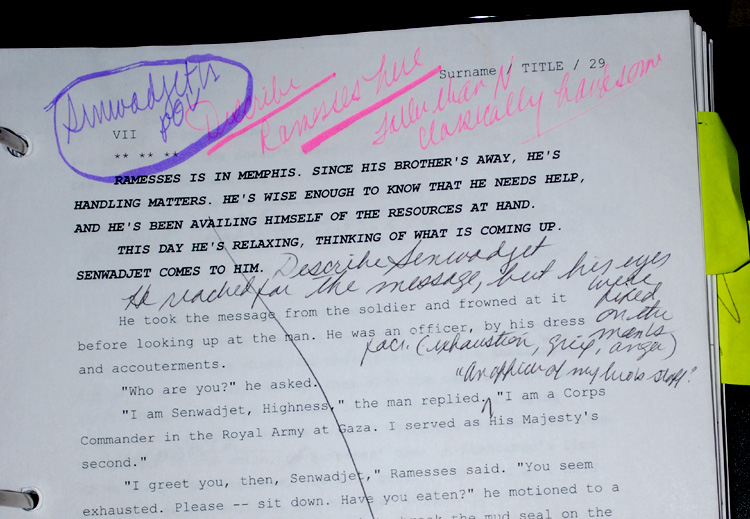 |
| Is it a disaster if it makes the whole story better but drives the writer mad? |
You brew another cup of tea (did you read my post about tea?), get out the materials, and go to work, muttering under your breath even as you see that it truly will do better. You bid farewell to the end of year release, the editor’s feedback, the new story that has been nudging at your elbow and presenting lusciously tempting scenes… You buckle down –
 |
| Will pester for catnip… |
And pray that your work is not interrupted by the dreaded ‘attractive nuisance’ that likes to grab your hand as you mouse…
First Final Draft Finished….
I have just (this morning) finished the First Final Draft of my latest, Mourningtide. That means I’ve filled in holes, the narrative flows, I’ve found most basic mistakes, and I’m satisfied with it as it stands at this moment.
It also means that I’ll be doing a beta read (and perhaps inflicting it on associates to do the same) and will be tweaking and deepening and possibly, coming up with another title.
My earlier works were over ten years in the making. That is to say, I finished them, copyrighted them, sent them around and then went into a dry spell. During the time I tried to decide what to do with them I picked at them, re-edited them, deepened them… They are in good shape.
But I don’t have ten years to spend on this one. Actually, it came together more quickly than the others (thank you, plotting-by-the-seat-of-my-pants) and I think it will be a year’s project, since it started November 1.
It will be available in Kindle, but I’m also thinking of Smashwords (and the others), and I’ll have it available in paperback, too.
Whew! I’ll be missing these characters, but I am finding it easier to move on now.
Interview on Jenna Johnson’s blog today!
Writer and illustrator Jenna Johnson has honored me with an interview on her blog today. You can find it HERE
The interview concerns

..And while you’re there, do check out her work!
In The Works – Lord of the Two Lands
 This is from a story with the tentative title Lord of the Two Lands. It takes place two hundred years after Pharaoh’s Son. I had a strong idea of a character (years ago) and jotted down some things. I had an idea, suddenly, for a scene, wrote it (or risk forgetting it) and the story has taken off. Alas, it is on ‘the back burner’ because I must finish Mourningtide, which is going well. But still… It’s delightful to know that the springs have not run dry.
This takes place after a battle. The king has been captured by rebels, who are holding him in a courtyard. Herihor, who is to all intents and purposes the de facto ruler of southern Egypt, has just arrived at the end of the fighting. He has found Pharaoh where he is being held.
Herihor stopped and stared.
A torch lay in a shallow pottery bowl, spilling light across the wall’s carved relief: Pharaoh lunged forward, his fist clenched on his foe’s upraised arm, the swing of his war mace caught at the moment before it descended. Movement – emotion: Pharaoh triumphant. It was magnificent, vibrant, awe-inspiring, from the king’s jutting jaw to the despairing faces of his foes. The dynamic thrust of the leg, driving into the ground, brought his eyes down in a diagonal to a figure at the carving’s feet.
Herihor stopped and stared.
A torch lay in a shallow pottery bowl, spilling light across the wall’s carved relief: Pharaoh lunged forward, his fist clenched on his foe’s upraised arm, the swing of his war mace caught at the moment before it descended. Movement – emotion: Pharaoh triumphant. It was magnificent, vibrant, awe-inspiring, from the king’s jutting jaw to the despairing faces of his foes. The dynamic thrust of the leg, driving into the ground, brought his eyes down in a diagonal to a figure at the carving’s feet.
A man stood half-collapsed against the wall, his shoulder against it, his lowered head turned toward it, catching the lingering warmth of the stone in the fading day. As Herihor watched, the man pushed away, staggering a little, and looked up at the carving.
The thought came unbidden: A flame cast by a shadow.
He had made some slight noise. The man glanced over his shoulder and then turned to face him with raised head. His hands and arms were bound behind him, wrist and elbow. They had not been gentle with the ropes. He was pale with exhaustion, blood was caked in his hair and sweat made lighter streaks in his dusty face, but the black eyes that traveled scornfully from Herihor’s feet to his face were as sharp as Herihor remembered. “You, too,” he said.
The contempt in his voice made Herihor wince as he moved forward. “Sire-“
Pharaoh frowned. “Will you spare my troops?” he asked.
Herihor stared. Blood was trailing from the side of the man’s mouth and he saw the dark smudge of a bruise at the side of his face.
Pharaoh tried to shake the hair from his eyes. “I am defeated: I admit it. How can I not? Do with me as it pleases you. My only request is this: those soldiers that fought for me, those cities and temples that assisted me, did so out of loyalty to their king. I beg you: do not fault them or punish them when you set up your–your dynasty. They will love you and yours all the more for that.”
The gallant generosity of that speech made Herihor pause and look down. He drew his dagger after a moment and stepped forward.
Pharaoh watched the knife leave its sheath. He lifted his chin and faced Herihor more fully.
Using Visuals When Writing
One of the things I really need when I’m working on a story is something that I can actually look at, that will give me an idea of how something looks, works, is sized. Several series of books are chock-full of photos and explanations, and they are invaluable.
The Shire Egyptology series is a good example. It is published in the UK and each book covers a subject – food and drink, household pets, medicine, textiles, weapons and warfare, Akhenaten’s Egypt… They are not written by the same person. The photographs and explanations are especially useful.
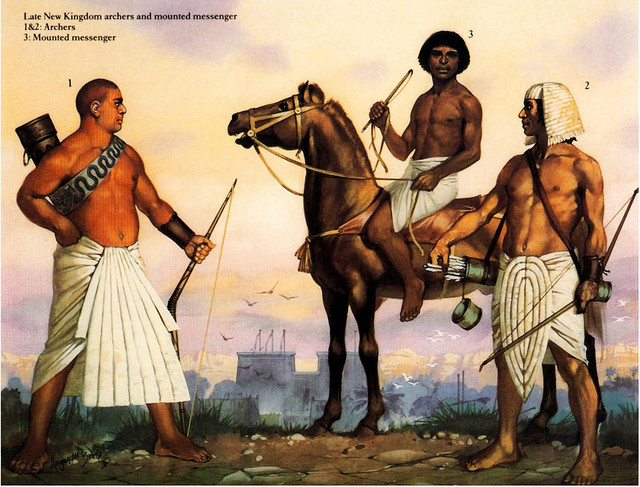 Ancient Military history is covered by the Men At Arms series published by Osprey (here is a sample of one of their books on New Kingdom Egyptian military).
 I have similar sources for other books; one series set in 1830’s Paris was helped immensely by a book of old photographs.

Time-Life books put out Echoes of Glory in two volumes. This is one of the most useful books I have ever encountered. It is separated into sections covering edged weapons, firearms, soldiers’ life, the home front. Modern photographs of arms and equipment are paired with period depictions. It has been invaluable to me, being, as I am, rather visually oriented.
 In Mourningtide, I write of the effect of the death of a son and brother on his family. One of the characters is Ramesses, the younger brother of the man who died. He became the pharaoh Ramesses II, one of the great rulers of his age. I have seen his statues and photographs of his reliefs, but finding anything that has him pictured as a living person in the flesh is difficult. Fortunately, I have succeeded.
Here he is, Ramesses himself, as depicted by Yul Brynner in the movie The Ten Commandments. He is not a prince in this photo – the golden headband with cobra and vulture tends to indicate that he has succeeded his father. I find it a very enlightening photograph, something that I will have to refer to over and over, I think.
One more item for my toolbox…
How on Earth Do You Write – Some Observations
Snippets from discussions on process and necessities in writing:
I seldom visualize the beginning of a novel. Usually I have an idea for a happening or series of happenings upon which the novel is based. Writing their progression almost always leads to clarification of their point of origin (as to the story flow..)
cough! cough! Gosh, I’m sorry. That was a horrible bit of talking.
What I mean is that the flow of the story helps to clarify things that have caused its course.
An example: I’m working on a story right now involving the death of a young man and its effect on his family, including a younger brother and his father, who receives the word late. My first image of the story was the young man’s death and his father’s initial reaction. As I filled that in, I was able to picture how the fellow ended up in the position in which he was killed.
Ultimately, I realized that the best way to start the story was to show the father taking leave of his sons, with some instructions to the older one. The older son (who dies) has shown uneasiness with his situation, which ultimately leads to his death. It works, but my first image was of the father’s initial, anguished reaction.
Another story involves a colossal statue crashing down into the middle of a festival throng. The mystery progresses from there. In that case, that scene is chapter 1 – but there is a prologue set several decades before the provides clues to the mystery.
Must Do’s
From what I’m reading, we all have some sort of ‘routine’, however loose, and some sort of absolutely must do’s, no matter how loose they seem.
It’s delicious when an idea catches hold and the words come flowing out faster than your fingers can move. But why, oh why, does this happen when you’re going hammer and tongs with something that absolutely must be finished within a certain time frame?
You give a shout of joy and then start swearing. Or, I do.
 My ‘Absolute Must’ is that I must somehow, in some retrievable way, capture the idea, the snippet of speech, the scene setting, the plot twist. Thinking ‘I’ll remember this, certainly!’ doesn’t work. I speed-jotted a scene that I was delighted with in the manuscript that I am finishing up. Delighted – and I tried to tell a friend just what happened in the scene. Here’s what I said…
He goes on to patrol the upper path, and she goes with him because she believes he needs the company after the extreme danger and stress of the morning.
He says… Well, he tells her… Um. He apologizes. She says he doesn’t have to. No, wait! I forgot! She insists on going with him because she is a soldier’s widow and knows about how things work.
Gah! I’m telling it wrong.
Anyhow, he tries to apologize and her heart turns over. I think that’s how I phrased it…
What did he apologize for? Why, for being emotional a couple days before. You mean you couldn’t figure that out? What the heck?
Well, anyhow it was a great scene and I captured it before I forgot it. What do you mean I’ve forgotten it? I have it written down! ‘Mind like a sieve???’ Now just a minute! OK, OK, I’ll let you read the scene once I print it.
Sheesh!”
In with the new…
 I have at least two projects underway in any given time. This has several benefits:
- It helps to minimize the strange sense of grieving I suffer from when I’ve finished a story and am no longer dealing with a group of characters that I have come to love. I remember I received this advice years ago from an editor. “Never have only one work in the pipeline,” she told me. “It’ll help you cope with finishing a work.” I learned the hard way that she was right.
- It helps to minimize writer’s block. I think it’s sometimes the result of working too intensively on a specific project to the exclusion of everything else. It is an excellent way to burn out. Switch off to something fresh and you can catch your breath, and regain your stride.
- It will give you an excuse not to work on something. Actually, this isn’t a benefit.
At the moment I’m finishing the first draft of Mourningtide. I’m also working on Crowfut Gap, a novel set in Civil War Virginia, near the West Virginia border. There’s another Egyptian story, The Jubilee, which I started a few years back. It’s moving along slowly as things occur to me and I jot them down.
Lately I have been going back to a period that is slightly after A Killing Among the Dead. Ranefer is the last of his line, a family decimated by a systemic ailment that has killed them one after another, leaving only him, the third son of a king, the brother of two kings and the uncle of another. Egypt is crumbling; What is to be done if you are Lord of the Two Lands, and The Two Lands has forgotten that it has a Lord?
It is a bittersweet story (in its current shape) and puts an unusual twist on history as we know it.
The twist came to me as I was driving the three hundred odd miles home from Upstate New York. I think it may work. It might help if I stopped blogging and typed it, but I can mull it over a little more…
Only 6,800 words currently, but it should grow nicely – once I really start working on it.
The Hyphen is Mighty Indeed
I just threw out five brand new copies of one of my books that I had ordered for a GoodReads giveaway. They were free, a perk for finishing NaNoWriMo.
I had updated the book’s cover. When you do that, you have to resubmit the text. And there was the rub: there had been a problem with the text: my laptop had been stolen, and with it my final version of that manuscript. (Yeah, I know. I’m backing everything up now.)
It’s easy to retrieve the text of a Kindle book, and I retrieved the MS that way, plugged it into the book setup, did a perfunctory final text check – the text had been fine before, and I had simply updated the cover image – and gave the go-ahead. Then I ordered my five copies for the giveaway.
I’m beta testing a new feature for manuscript editing on CreateSpace. It’s a good feature, and since I had this book up in the program, I went through that manuscript. I sat back and went to one of my favorite scenes, one toward the end where Ramesses the Great, having extricated himself from arrest ordered by his eldest son, arrives at the palace to get some answers, is denied admittance by an over-zealous servant who isn’t aware who’s waiting outside the door, pulls out all the stops and, in the scene, is questioning the servant, a man he’s known for fifteen years. The scene is related from the servant’s point of view:
“Let me see if I understand you,” Pharaoh said thoughtfully. He raised one long fingered hand and ticked off the points as he spoke. “One the Crown Prince has gone haring off to parts unknown. Two you have no idea where Prince Khaemwaset is, but three you do know that he tried to drug his brother, and four a spy sent the Crown Prince’s ring back to him as a sign of urgent danger to Prince Khaemwaset. Five the army is in a state of alert, and six the city of Memphis is virtually under siege. Am I correct so far?”
It took me a moment to realize what was wrong with the text. Actually, it doesn’t look so bad, even now, but I’d placed hyphens in to highlight the way Ramesses was ticking off the points on his fingers. And the hyphen between ‘long’ and ‘fingered’ described the sort of fingers he had on his hand. Without it, His Majesty had a long hand equipped with fingers.
It should have looked like this:
“Let me see if I understand you,” Pharaoh said thoughtfully. He raised one long-fingered hand and ticked off the points as he spoke. “One-the Crown Prince has gone haring off to parts unknown. Two-you have no idea where Prince Khaemwaset is, but-three-you do know that he tried to drug his brother, and-four-a spy sent the Crown Prince’s ring back to him as a sign of urgent danger to Prince Khaemwaset. Five-the army is in a state of alert, and-six-the city of Memphis is virtually under siege. Am I correct so far?”
In looking things over I discovered, to my dismay, that the file transfer from Kindle to print had stripped every hyphen from the text. And I hadn’t caught them.
I started looking for them. I went to another scene where the servant, newly captured after a battle between Egyptians and Hittites (his country), gives everyone a piece of his mind using a coarse expression that draws a parallel between their sexual propensities and Oedipus’. (I am not going to quote it here; it’s about an eighth of the way through Chapter XIX; the bottom of page 121 if you have a paperback copy of the book.)
In my defense, the text had been perfect when I sent it to Kindle; the manuscript in my (stolen) laptop had been lost, I had retrieved it (I thought…) and simply plugged it in. But my father always told me never to make assumptions.
Ultimately, I pulled up the adobe document for the manuscript and manually searched it for hyphens. When I found one, I went to the manuscript and replaced it. I was able to do global searches for set expressions, but when I relied solely on that method, checking afterward, I kept stumbling across hyphens that needed to be inserted. (To be honest, I would never have found Mutallish’ epithet directed at Pharaoh if I’d done a global search and replace for commonly used hyphenated words.)
Things were fixed. Finally. It was too late to cancel my order of the printed books. So what to do about them?
Well, they’re defective. I’ve read enough diatribes on the subject of defective books, whether self-published or not. These are all, every one of them, being consigned to the trash. Sigh.
Lesson Learned.
The Ghosts of Older Editions
Once upon a time, a long time ago (like, over a decade), an aspiring writer who was heartsick from her dealings with a dishonest agent, who is now featured in ‘Preditors & Editors’ (no, that is not a misspelling) read about a (self) publishing company that was stepping into the very new world of electronic publishing.
She thought it might be something to explore, so she sent her novel there, and it was placed online. Later, she was contacted about publishing a paperback version of the book. Although sales weren’t stellar (sales?) she went ahead and paid for the process.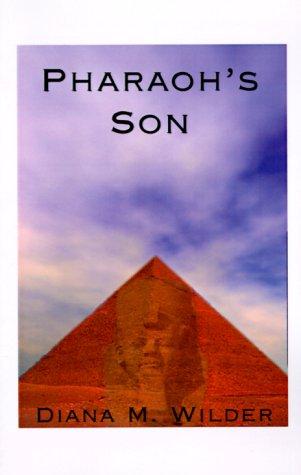 The book was published with this cover (left), and remained in circulation for over ten years. The edition had all sorts of typesetting errors; it was a mess.
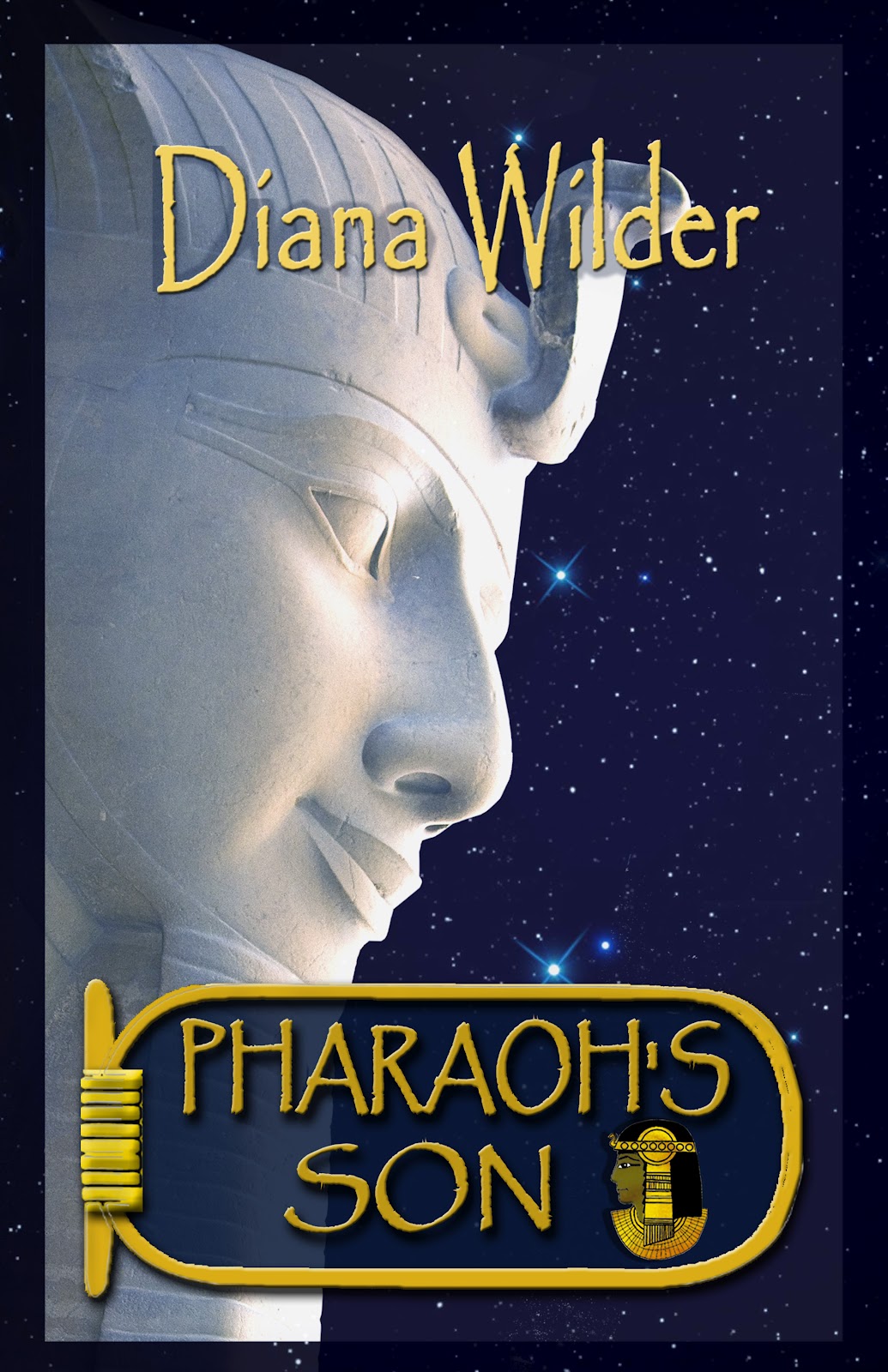 The author sat up after ten years, looked at it, and now that things had changed in various ways, opened her manuscript, edited it, tightened it, changed it and, now that the publishing industry was in a state of change, decided to put it on Kindle. She also examined the paperback possibilities and issued an ‘Updated and Revised’ edition through another publisher, with a far better cover (right).
 She contacted the first publisher and terminated their relationship, and she received confirmation of their actions. It was quite a relief to be rid of the older, terribly done edition. The book was made available on Kindle and in paperback, and was listed on various online sites. Sales were fairly good.
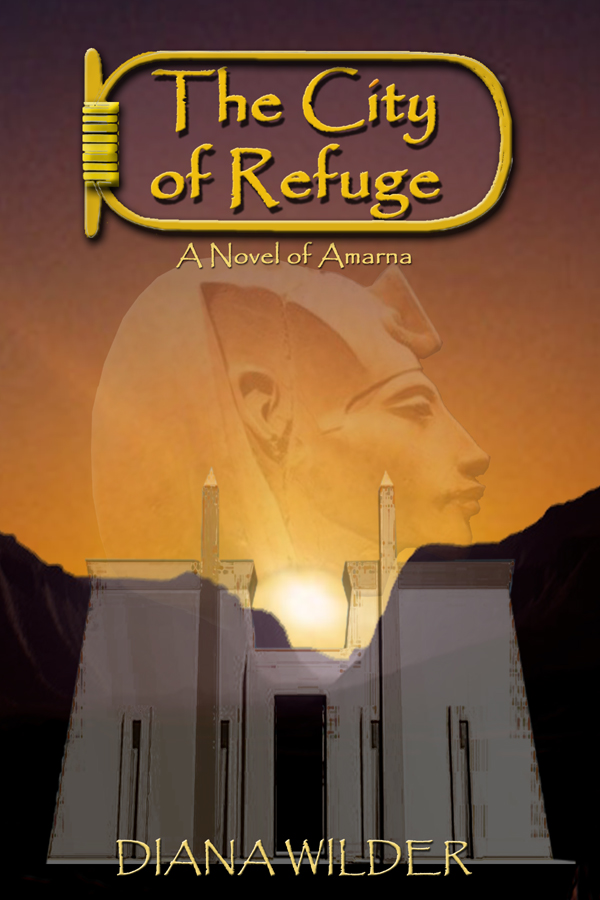
 This author had also written another book, published with the same group. This book was put out with this cover (left). Typesetting was equally atrocious. She reviewed, revised, updated, and improved the text. She also had another cover designed (she is a graphic designer) and, satisfied with it, placed it in the market both in Kindle/Nook and in paperback.
As with the first book, she contacted the original publisher, directed that all publishing by them be stopped, and terminated their relationship. After all those years, and after learning of the sort of operation that they were, she was very happy to have the relationship end. Things were going well, she was now satisfied (as much as a writer can be) that what was available to her readers was the best that she could produce with those books.
And then, going through an online library site, she was astonished to see that the older editions were being listed as the primary ones, and that people were putting them on their ‘to read’ lists.
 It was nice to see that people were interested in those books, but the thought of those poor people, expecting a good tale (and, dare I say it?, getting one but an earlier, rougher, poorly typeset version) made her cringe.
I suppose it’s something we learn to live with, but if anyone has one of those earlier copies, the author hopes that he or she will contact her. She proposes to sell a paperback at cost. Or lower the Kindle price as low as it will go. Or something.
 dianawilderjottings

