Small Celebrations May 29,2015: a Small Vacation and a Large Doofus


This is the Celebrating the Small Things blog hop, started by VikLit and now run by Lexa Cain, our fearless leader and her two wonderful co-hosts L.G. Keltner @ Writing Off The Edge and Katie @ TheCyborgMom.

Over the years this wonderful hop has made lots of people pause, consider, smile, often laugh outright and, maybe, mist up.  I think gratitude often has a touch of tears to it.

Map of the coast of Maine, with Boothbay at center
View from my hotel

Today (meaning Friday, May 29) I am celebrating by driving about 250 miles north and east to the Maine coast, to visit Boothbay harbor.  The Maine coast is full of inlets and islands, perfect to moor a boat or explore.  I encountered Boothbay quite by accident on early June day when I agreed to travel to a Maine-based potter (Edgecomb Potters, founded by a man and his wife who grew tired of teaching and became potters.  And very fine ones they are, too.  Nice people, as well. 

View of the little church in Boothbay

As it happened, they had a store just up the coast from Boothbay, and when I was through  transacting my mother’s business (“Would you pick up a birthday gift for your sister, dear?  I have an idea for it, and you know the area.  Thank you so much!”) I drove into the little harbor town and stopped at a restaurant to have a bite of lunch.  Would I like to sit on the terrace?  Yes, I thought I would.    

So I disposed my bags and boxes, straightened – and looked out into a little harbor in mid-afternoon sun.  The water sparkled like diamonds, in the middle distance a sloop was heeling over in the cool wind, and the pines were dancing in the breeze.  I’m afraid I fell in love.

I’ve gone back nearly every year.  Tomorrow is the day.  By the way, the photo at the top is the view from what will be my deck in the old, refurbished house.

As the ads say, “I need it bad.”  What are you celebrating?  

Memorial Day, 2015


Some years after the American Civil War, some women went to the local cemetery, bringing flowers with which to adorn the graves of the war dead.  Over in a corner they saw graves of the soldiers who fought for the other side, all unadorned.  Almost with one accord they went over there and placed flowers on the graves.

“There are others, back at their homes, who mourn them and loved them,” someone said.  And the tradition of Memorial Day began.

Where did it start?  I’ve heard several accounts, all believable, and I have concluded that it was something spontaneous in its truth and its generosity.

          By the flow of the inland river,
          Whence the fleets of iron have fled,
          Where the blades of the grave-grass quiver,
          Asleep are the ranks of the dead:
          Under the sod and the dew,
          Waiting the judgment-day;
          Under the one, the Blue,
          Under the other, the Gray

          No more shall the war cry sever,
          Or the winding rivers be red;
          They banish our anger forever
          When they laurel the graves of our dead!
          Under the sod and the dew,
          Waiting the judgment-day,
          Love and tears for the Blue,
          Tears and love for the Gray.
 
Lincoln’s second inaugural address, given in 1865, the year he died, closes with this sentiment:
 

With malice toward none, with charity for all, with firmness in the right as God gives us to see the right, let us strive on to finish the work we are in, to bind up the nation’s wounds, to care for him who shall have borne the battle and for his widow and his orphan, to do all which may achieve and cherish a just and lasting peace among ourselves and with all nations.


Introducing: A CHANGE OF MIND and Other Stories


I’m delighted to participate in the Launch Day for Nick Wilford’s new collection, A Change of Mind and Other Stories. 

Would you change something about your personality if you had the chance? Reuben Timsbury is ready to say yes to that question, but what is the cost? Read A Change of Mind and Other Stories to find out. This collection of dark, speculative fiction contains a novella and five accompanying stories. Ebook available for only $0.99 on launch day, May 25th.

Title: A Change of Mind and Other Stories
Author: Nick Wilford
Genre: Speculative fiction
Format: Ebook only
Page/word count: 107 pages, approx. 32,000 words
Release date: 25th May 2015
Publisher: Superstar Peanut Publishing
A Change of Mind and Other Stories consists of a novella, four short stories and one flash fiction piece. This collection puts the extremes of human behaviour under the microscope with the help of lashings of dark humour, and includes four pieces previously published in Writer’s Muse magazine. 
 
In A Change of Mind, Reuben is an office worker so meek and mild he puts up with daily bullying from his boorish male colleagues as if it’s just a normal part of his day. But when a stranger points him in the direction of a surgeon offering a revolutionary new procedure, he can’t pass up the chance to turn his life around.
But this isn’t your average surgeon. For a start, he operates alone in a small room above a mechanic’s. And he promises to alter his patients’ personality so they can be anything they want to be… 
In Marissa, a man who is determined to find evidence of his girlfriend’s infidelity ends up wondering if he should have left well alone. 


The Dog God finds a chink in the armour of a man with a megalomaniacal desire to take over the world.

In The Insomniac, a man who leads an obsessively regimented lifestyle on one hour’s sleep a night finds a disruption to his routine doesn’t work for him.

Hole In One sees a dedicated golfer achieving a lifelong ambition.

The Loner ends the collection on a note of hope as two family members try to rebuild their lives after they are torn apart by jealousy.

 
Excerpt:
     “Not seen you in here before,” said the barman, while dispensing the frothy liquid into a glass. Fascinated by the collection of grubby beer mats on the ceiling, I was jolted by the fact another person was apparently trying to start a friendly conversation with me.
   “Errm… I don’t get out much.”
   Well, there it was. I’d revealed himself as a loser already, as if this guy didn’t already know.
   “Why’s that, pal?” The barman put the dripping glass onto a stained towel covering the bar. I gazed into the bubbly liquid as if it held all the answers to life’s dilemmas. The urge to simply walk out was overwhelming, but I steeled myself and took a deep draught of the beer. It settled in my stomach and then seemed to radiate outwards, imbuing a sense of calm.
   “Well, I don’t have any friends.”
   I expected the barman to walk away and find something else to do, although there were no other customers at the bar, but the man remained where he was, absentmindedly running a cloth over the discoloured bar top.
   “Seems to me, if you got out more, you might make some friends. Seems to me you’re in a bit of a vicious circle at the moment. What’s your name?”
   “Reuben.”
   “Reuben. I’m Dave. Now let me give you a bit of advice. When you came in just now like a drowned rat – I know, it’s not your fault it’s raining – you stood there like you owed the world an apology. Like you were sorry for using up air. And you looked like you were terrified of everyone. If you stood up straight, acted a bit more confident, you might get on better.”
   I had to stop myself from rolling my eyes and telling the guy he sounded like my dad. Somehow, I didn’t think that would help.

Of course you’re interested! 
Here are the Purchase links:

Meet the author:
 

Nick Wilford
Nick Wilford is a writer and stay-at-home dad. Once a journalist, he now makes use of those rare times when the house is quiet to explore the realms of fiction, with a little freelance editing and formatting thrown in. When not working he can usually be found spending time with his family or cleaning something. He has four short stories published in Writer’s Muse magazine. Nick is also the editor of Overcoming Adversity: An Anthology for Andrew. Visit him at his blog or connect with him on Twitter or Goodreads.


Celebrations, May 15 2015 – Grandmother


Welcome to the Celebrating the Small Things blog hop, started by VikLit and now run by Lexa Cain, our fearless new leader and her two wonderful co-hosts L.G. Keltner @ Writing Off The Edge and Katie @ TheCyborgMom.

What am I celebrating?  Well, once upon a time, longer ago than I care to recall, I  had a grandmother (my mother’s mother) who was a wonderful cook. She made apple pie, strawberry rhubarb pie, crisp-skinned roast chicken…  All things good seemed to come from her kitchen.

And the kitchen itself was a wonderful place, full of delicious smells, with a table in the corner and lots of comfortable kitchen chairs to settle into and watch Grandma cook.

She made doughnuts (Dunkin Donuts would be jealous), cookies…  She came from an old homesteading family, out in North Dakota, and she somehow ended up in Vermont.  She wasn’t just a cook (‘just’ is not derogatory; she did a lot of things) she dealt with antiques, was busy with the town she lived in, and she was a wonderful grandmother.  She died long ago, and I miss her still.

The cover


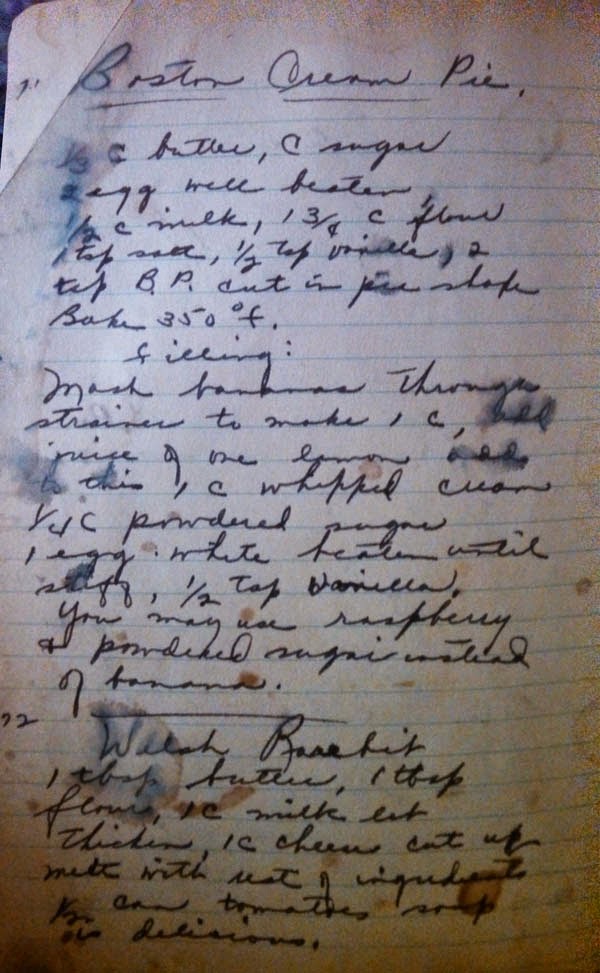
Well, while visiting my mother, who is older now than my grandmother was when she died, I came across, forgotten in a drawer, a beat up old book:

I opened it, scanned it…  Why had I never seen it before?  It wasn’t as though I was never in the kitchen.  …Although my mother was a charming pack-rat when it came to recipes, with clippings going back to the fifties and sixties.

I opened the book and began to look at the
recipes.  I saw some old favorites…

…Boston Cream Pie!


Boston Cream Pie (actually a cake with custard filling and a chocolate-iced top:

Molasses what?

Molasses everything (they used a lot of it in Victorian times on the Great Plains)

So many things that Grandma made, that I had thought long gone.  Yes, my mother had transcribed some of the older recipes from her grand parents: (“Take butter the size of a walnut, mix well with flour and roll out until satisfactory.  Add essence of lemon and let sit…”)

What else was there?  Well, lots of old favorites, including date-filled cookies that, I hoped, were the cookies I remembered as a child.  They looked right…

“Mom?” I said, “May I borrow this?”

She frowned and looked up. “What is it?”

“Grandma’s cookbook.”

She had forgotten she had it.  Grandma’s departure had been hard, with her leaving my grandfather who was in his late nineties.  Things were done hurried.  “Well, yes,” she said.  “But be careful with it.”

Oh, I will be.  I’ve been reading the recipes and toying with the notion of putting them in a cookbook, just for the family, with facsimile pages, with some of the recipes transcribed  for those who wanted to make them.  Maybe.  There was a lot to dig through.

On the third- and second to the last pages I found this one last thing:


An index, by golly.  Thank you, Grandma.


What are you celebrating? 

Celebrations, May 8, 2015, Fragrant Flowers and Two Books.


Welcome to the Celebrating the Small Things blog hop, started by VikLit and now run by Lexa Cain, our fearless new leader and her two wonderful co-hosts L.G. Keltner @ Writing Off The Edge and Katie @ TheCyborgMom.

I found my first post, written in February of 2013.  I remember I’d never been in a ‘blog hop’, and everyone would be certain to know what a newbie I was.  No doubt I’d post something stupid and annoy someone.

Not so.  This wonderful hop has made me smile, has let me enjoy the thoughts and insights of so many truly delightful people.  I can’t imagine not being a part of it, and it is a mark of the kindly nature of the blogosphere in general and this group in particular, that my off-again on-again participation has been tolerated and even smiled at. 

Fragrant Viburnum

So…what am I celebrating?  The fragrant Viburnum bush outside my front window is in full bloom.  The breeze sifting down from this hilltop is rich with its scent.

I have a circle of antique irises, bought years ago from an old estate near the ocean, and they’re coming back for the spring, as well.

Fresh sheets on the bed, a very nice book to finish reading, and then to review:  Afraid of Everything, by Karen Jones Gowen.  I bought it last year, began reading it, got busy with Christmas, family, other issues, and rediscovered it, to my delight, this past week.  It is an enjoyable story, profound and almost dreamlike.  It reminds me, a little, of The Five People You Will Meet In Heaven, though this story is a little more profound, to me.  The heroine had been afraid of everything, increasingly a captive of her own fear.  It is a story of liberation and of understanding, and Gowen writes beautifully.

It’s available in various stores  Amazon’s worldwide link is RIGHT HERE.

Killer Exposure

My final celebration is that I just learned that I won a copy of Lara Lacomb’s book Killer Exposure.
Lara, who also blogs, often on this thread, writes an excellent romantic suspense story.  Her experience in science gives things a ring of truth, and those of us who enjoy her blog are familiar with her humor and skill.

Amazon’s worldwide link for the kindle edition is right hereI won a paperback copy, another thing to celebrate.

I was not asked to write about these or link to these.  It’s just nice to look forward to two good books.

What are you celebrating? 

Love Never Lost


I was at a cat show this weekend.  It’s a long story, and involves my eleven year old cat, Frida, who also modeled for Harry Winston.  I kid you not.  She loved the attention, the petting, the fussing over her – and, as vain as all cats, she enjoyed the necklace.  This photo was in the catalog for Harry Winston for that year, and I had obtained a copy of it for myself.  No, I didn’t make any money for the sitting.  I hadn’t expected to.  It was a favor for a friend, and I was tickled to see her wearing a quarter of a million dollars worth of diamonds.  Apparently, she enjoyed everyone.

I brought the catalog with me to the show.  My dear friend who gave me Frida (for the sum of $1) was there, and I wanted her to see it. 

The catalog had a pocket in the back cover.  I found a folded piece of paper there.  I took it out, unfolded it, and saw my father’s handwriting:

Dear Diana,

It’s been a rough time for you, I know, and I’m sending you a little something to help you along.  There is more where that came from, as you know, and you only need to ask.

Your mother and I are proud of you.

Love,

Dad 

I had to turn away, a hand to my eyes.  I had not expected to find that. I remembered that terrible time, the economy at a halt, layoffs, no one hiring…  I remembered a lot of things.  Sternness when necessary, always there, always reliable.  Strike him as I might, he always rang true.  Perhaps the best gift I ever received.

I was remembering him just now, listening to this song:

The words to the second verse always speak to me:

          If heaven was a town, it would be my town
          Oh – on a summer day in 1985
          And everything I wanted was out there waitin’
          And everyone I loved was still alive

I thought of them as I folded the note and put it back in the pocket.  Often, what was never dies, but still is…


We always loved fireflies

The First Annual Bonehead Blog Hop!


THE BONEHEAD BLOG HOP!
 
Welcome to the first Bloghead Bone Hop!  This is the idea of Cherdo, who never ceases to make you laugh uproariously…and at the same time make you think.  The thinking usually continues after you have finished laughing.
 
…oh, wait.  It’s the Bonehead Blog Hop.  My first boneheaded endeavor here, wouldn’tcha know…
 
Your hosts are Cherdo, of Cherdo on the Flipside.
And me (Diana Wilder)
Our motto: 
“Confession is good for the soul…it may not 
be your soul, but trust me – it’s good for someone’s soul.”
 
The problem with confessing to being a bonehead is that it’s so much easier to remember the boneheadedness that you have witnessed than that which you have actually done. 
 
I’ll never forget the Presbyterian minister who told of the time he was supposed to be the guest pastor at the First Presbyterian church in some town in rural Virginia, USA.  He got a late start, flew down the highway, cringing whenever he saw a large Ford sedan (the police used them almost exclusively at that time), found the church (impressive old edifice), turned into the parking lot at 70 mph  with gravel spraying under his tires as he yanked the wheel toward the door.  Scrambling into his robes, he went tearing up the side of the building and into the door near the sacristy, knocking over an usher and what looked like one of the deacons.
 
The service hadn’t started yet.  He wiped his brow with his flowing sleeve, turned to the ushers and elders who were standing before him with their jaws sagging.  “We have five minutes till the service starts!   I have my sermon ready.  Who’s the chief usher?  Listen, I can signal when it’s time to start the collection.  Here’s my sermon-” he slapped it on the podium “-let’s get going!” 

Sideways glances.
“Well?”
”Er…  What church are you supposed to be at?”


Vestment for a Bonehead
He stared.  “The First Presbyterian Church of Littleville, Virginia, of course!” he snorted.  
“…if you go out the driveway, sir, and take a left, you’ll find it on the right a mile down the road.” 
Silence followed by a polite cough.  “We’re the First BAPTIST church?  If you hurry, you won’t miss the
 

service.”

**   **   **
I was in the drama club in college.  I worked on costumes, set, props.  Generally made myself useful.  …And I so wanted to have a speaking part.  Somehow, other people got them.  You know, the popular folk who looked like popular stars but had a quality of emoting that rivaled Charlie McCarthy (or Mortimer Snerd) in emotion and delivery.
But I got a part!  Yes, indeedy!  I got to go on stage during the ball scene of The Sound of Music, standing there in a long, pink gown with a glass of ginger ale (looks like Champagne, don’t’cha know?), watching the various people whirling around the dance floor.  I was supposed to turn to Captain Von Trapp and say, with a cultured smile, ‘Frau Schraeder is charming, Georg!’
I felt pretty, I had a speaking part!  Captain Von Trapp was watching me with rapt attention, as was the entire cast.    I made my exit from the ball with my head high, my hair piled atop my head, my swan-like neck poised…
I shed my costume and went back to manhandling props and scenery flats, hissing cues to the performers.  It was all good!  And everyone was applauding and cheering – a standing ovation!  (College productions in college towns tend to garner such tributes.)
I smiled, sighed, helped clean up.
“Hey, Diana!”  It was the chief of the lighting crew, a lanky fellow with a marvelous grin.
I turned with my best Beauty Queen smile.  From the way he was looking at me, he found me fascinating.  …dared I say intriguingSexy?

He came up to me, set an arm around my shoulders.  “You were great!  It went off pretty good, if I say so!”  He tightened his hold for a moment.  “But, say!  Can you tell me…”


Bicycle Panties for under Stage Lighting
He paused, and I looked up at him, thinking that he really was pretty cute, the way his mouth began to quirk…


His eyes crinkled, “But say, do you always wear bicycles on your panties?”

Lights cut through chiffon.  How could I have forgotten? I crumpled in mortification.  No wonder everyone was gazing at me, transfixed, as I flirted with Captain Von Trapp!  A walking, talking bicycle-butt! 

My friends still mention them.  Well… They were my friends once…
Go visit the hop!

https://www.simply-linked.com/listwidget.aspx?l=64D9E1B9-9C54-4E05-905B-7E58CF1B028C

Knowing What They Want From You


How many of us are asked to look something over and give an opinion?  In general, not limited to professional requests?  Most of us, right?  From the child who comes up to you in an outfit he put together himself and asks ‘how do I look?’ to the acquaintance who comes shyly up to you and asks if you would mind looking at his ‘story’ and telling him what you think. 

It’s a part of living, people asking for your thoughts.  To a great degree, that is what underlies a great deal of modern business.  Consulting, diagnosing, advising (financial, editorial, culinary, medical)…it is everywhere.  Say, can I ask you what you think of this? 

Years ago a friend, who posted regularly on a board I used to frequent, began a very small photography business. She was in a home situation where she really needed to make a little money to make ends meet. And since she had some ability, she hired herself out to take photos of children’s birthday parties, pets, horsey events, all on a small scale in a rural area of the United States. She shared some of her photo scrapbooks with the board and asked how we liked them.   They were good, for a beginning professional. In fact, I’d have described her work as that of a ‘talented amateur’. She needed polish and practice and the opportunity to rub shoulders with other professional photographers, but the eye was there, and improvement was inevitable.  

Most of the people oohed and aahed over the pet photos, said nice things, were supportive. But one person responded differently. “These are terrible,” she said in her post. “Look at that cat photo and then go to Chanan Photography’s website and look at his photos. You aren’t in the same league.” Nothing helpful was said, no specific criticism, just the overall, scornful thumbs-down. And she said she was being helpful to a friend. 
 

I’m often asked to try something a friend cooked and let him know if it’s all right.  Someone has found a new favorite type of music.  Someone is considering getting a certain type of car.  Someone wants me to read something he or she has written, whether a manuscript or a published book or a sheaf of poems. What do I think? 

I think a lot of things.  I have a decent eye for art (can’t draw at all, myself), enjoy music, know how to cook to suit myself, and I write.  The important question is this:  What is the asker looking for? 

That person standing with a happy smile and a manila folder with papers in it, the friend who emailed me with a .mobi attachment, the friend who calls me up in excitement because she has the most fabulous idea for a story and she’s just so excited!  What do they want?  Do they want me to give my unvarnished, sincere assessment of a piece of work?  Like a line-edit or a beta-read?  Where they want me to be completely factual?   

I can do that, and I can be thorough about it.  I can say, “You know, a strong man wearing a lion skin and fighting a twelve-headed dragon-like monster has been handled many times.  It’s old hat now, unless you can put a good spin on it.” To a good friend I can say, “You just told me you’ve got a deadline breathing down your neck right now: are you making excuses to fail, or has this truly grabbed you?”  Or I can say, “A new spin on Heracles and the Hydra?  That could be fun to write…  How would you have it set?  Modern times?  Magical realism? Or dystopian where the old gods and monsters of mythology return?  Hmmm…” (Note that none of these are destructive.) 

I was in an advanced Poetry class, my senior year in college.  As in writing poetry.  I’ve inflicted enough of my verse on readers of this blog, so won’t give examples. 

A delightful older woman, a part-time student, was drinking coffee with me one day after class.  She liked what I wrote and thought I might like to see her daughter’s work.  Would I mind?  I told her that if her daughter did not object, I’d be happy to. 

I saw her at the next class, and she put a folder full of handwritten sheets into my hands, beamed, and left.  I returned to my dorm room, sat down and put my feet up, and began to read. 

The poems were scraps of self-conscious emotion.  The words had no flow.  It was like listening to the disjointed exclamations of someone on the phone after a major event.  They were, for me, truly terrible.  Not at all to my taste,  nothing that I would ever want to purchase or read.  I gathered the pages, tapped them into alignment, put them in their folder, and sat back to think. 

I saw the mother at the next class, and handed the folder to her with a smile.  She returned my smile with a delighted one of her own and sat down beside me.  “Did-did you read them?” she asked. 

“I did,” I said. 

The smile widened.  “Well?  What did you think?” 

“Your daughter writes with pure emotion,” I said, and watched her smile soften.  “It is as though her pen is catching her feelings and putting them on the page.  As though I am sitting there with her as she feels things and expresses them.” 

Now she was beaming. “Yes!” she said, holding the folder against her chest.  “She is so…so spontaneous.  I knew you’d see it!” 

“It was generous of her to share them with me,” I said. “I sense that she is very private, and it probably took her a struggle to agree to it.” 

The mother smiled and put the poems away.  “She is.  I’m proud of her.” We continued friendly until I left the university to graduate. 

I could have given a critique of the poetry.  I could have told her just what I didn’t like about her daughter’s poetry.  I could have told her to check the poetry of (name any one of hundreds) and see where she fell short.  I could have given suggestions for change.  The reason I did not is that it struck me, as I was thumbing through these very emotional, very private writings, that my friend only wanted someone she thought was a good writer to look at her daughter’s work and say, “Isn’t that wonderful?”  That’s all.  Everything I said was true.  And, looking back after twenty years, I suspect her daughter grew and evolved and harnessed that emotional power into something pretty good.  You never know. 

My point is that when we are asked our opinion of another’s work or idea, we need to be certain what is being asked of us, and to moderate our response accordingly.  If a line edit is not requested, don’t give one.  Or else say, “If I run into a typo or something, do you want me to mark it?  It’ll interrupt the flow, but I’d be happy to do it.” 
 
…and if a friend in financial difficulties places her efforts at photography before me to look at, I can say, “You’ve got talent.  That’s a good shot.  Are you taking lessons or working with another photographer?” 

The best critics do that, and it’s always the truth. 

And this brings me to the April 24 edition of the Celebrating the Small Things blog hop, started by VikLit and now run by Lexa Cain, our fearless new leader and her two wonderful co-hosts L.G. Keltner @ Writing Off The Edge
Katie @ TheCyborgMom

Today I am celebrating two things.  First, I have so enjoyed remembering my co-student and reflecting on how very proud she was of her daughter.  I am certain her daughter knew it, too.

And this weekend I’m driving south to see my mother and speak with her, at her request about living facilitites that will enable her to be independent and still have lots of people around, and be confortable.  She’s a stubborn one, but I have great hopes.

So what are you  celebrating?  (And have a wonderful weekend!)

http://www.simply-linked.com/listwidget.aspx?l=79cd691b-a101-48a4-8603-4d22bb6626d8


Celebrations 17 April, 2015


Welcome to the Celebrating the Small Things blog hop, started by VikLit and now run by Lexa Cain, our fearless new leader and her two wonderful co-hosts L.G. Keltner @ Writing Off The Edge and Katie @ TheCyborgMom.

This wonderful hop has generated many smiles, made me count blessings, helped me encounter some wonderful people, and given me a chance to catch my breath and reflect on how truly fortunate I am.

Today I am celebrating one of those items peculiar to me: finishing a chapter that had been giving me some trouble.  The two characters are major players in the story.  One is a elderly prostitute who had been a dancer before she broke her ankle and had no choice but to go on the street.  In France of that era, prostitutes were not criminals, provided that they checked in with the authorities on a regular basis.  This one is a skilled nurse.

The other is the main character of the trilogy, a police officer with an unusual past.  She saved his life when he was badly wounded in the revolution of 1830, and he has been trying to get her to come off the streets.  What happens after she agrees is a pivotal moment in the story.  (It is not in this section.) It’s good to finish it:

  “It was a pleasure,” Malet said. “In return, Fanny, let me ask a favor.”
  Fanny looked up at him through a blooming smile that softened the fatigued lines of her face and made her seem pretty.  “Anything,” she said.
  “Come in off the streets,” Malet said. “Now.”
  “Off the streets?” said Fanny.
  “You heard me,” said Malet. “You’re too old for this. People here have changed. You’ve been coming in with black eyes and bruises, and it’s only going to get worse. I’ve done what I can for you, but my influence extends only over the Police, the Army and, to a degree, the criminal world. I can’t control half-crazy, randy-drunk students!”
  She looked up at him.  “What else can I do? Prostitution’s the only thing I know.”
   “Who told you that and why in God’s name did you believe him?” Malet demanded. “The scoundrel who blacked your eyes?  Who would credit such a villain?  My God, Fanny! I owe you my life from the rioting in ’30 when I was shot through the lungs! You can work for the Prefecture as a nurse. Sonnier thinks you’re a finer physician than he is! It would be an honorable retirement. Haven’t you earned it?”
     Tears welled from her swollen eyes and slid down her cheeks. “This is the only thing I know,” she repeated.
     Malet took her slender hand in his. “That is a lie and you know it.”  He raised his eyes to hers. “I can’t imagine what possible crime you may have committed to make you convinced that you are fated for such a dwindling life and squalid death.”
  Her eyes filled with tears.
  He lowered his eyes, withdrew his handkerchief and gave it to her.  He was silent as she blotted her eyes and then handed it back.  “Fanny,” he said. “I am begging you: if you love me, come off the streets.”
  She was weeping now.  “Oh you’re a devil!” she said. “You got no call to talk to me like that! I never tried to solicit you—you’re not for the likes of me and I know it!”
  “You are my dear friend, Fanny. God knows I love you! I mean what I say: get off the streets. Please! I don’t want to have to investigate your murder.”
  Fanny dabbed at her face. “It’s too late for me,” she said.
  “It is not!” Malet looked down into her tear-drenched eyes and gathered her hands again. “Listen to me,” he said more quietly. “You are not doomed to a lonely and wretched old age. There are many here who love you. You saved my life. Please: won’t you allow me to save yours? It would give me joy!  You can step off the streets, away from all those who mock you and use you. You can be the healer you always have been, and you can go into an honorable and well-loved old age. We will care for you. You have earned it. And it will give happiness to all of us.”
  He could see that she was wavering. “Come with me now,” he said.
 

That is not the entire scene, but it is the part that troubled me, that was difficult to put into words.  No doubt I’ll tweak it more.

What are you celebrating?  why not celebrate the vast array of creativity, humor, beauty and wisdom of the A to Z challenge?  I will be!

Click here to Go to the A to Z Challenge

(and have a good weekend!)

http://www.simply-linked.com/listwidget.aspx?l=79cd691b-a101-48a4-8603-4d22bb6626d8

M = Marginalia


Today’s letter for the A to Z challenge (link below this post)  is ‘M’, and in the spirit of the literary alphabet, I am discussing a term for illuminated manuscripts I had not heard before:  Marginalia.

Wikipedia, gives this definition:

Marginalia or apostil) are scribbles, comments and illuminations in the margins of a book.

Another way of describing Marginalia is that they are sketches, notations, doodles, scribbles and paintings that are found in the margins of a medieval text or document, generally having very little to do with the main text itself.

They can be fanciful scenes, like this knight jousting against a snail.  This is a little work of art, from the colors of the flowers behind the knight to the curve of the branch and the blue tendril twining downward.  (And note the shadow of the writing on the other side of the vellum

Or a peasant riding his noble steed, a duck, webbed feet and all.  I see that the saddle is exactly like those used by knights, with a high back, and it is equipped with stirrups.  The position of the saddle and the rider’s legs would make it hard for the duck to fly.  I’d be curious to see how well the bit works.


Musical deer would be fun to watch.  this one has a rather Christmas-y feel to him.  I do think he’s reading a book of music, and I’ve seen medieval music manuscripts that were identifiable as sheet music, though rather more decorative than the ones we’re used to.
       This fellow is beautifully done, from the execution of the folds of his pink robe to the glittering blue flower to the right of the doodle…


To the left, we have another man doing battle with a snail.  He is wielding a sword and carrying a shield.  Surely there are better ways to exterminate snails, but I may be thinking out of period.  I always thought them pests, and in the age before pesticides and whatever else you use to get rid of snails, I could see that they might be viewed as a terrible evil.  I love the colored flowers in among the tendrils, and the gilding on the shield and the snail’s shell.  The scarlet lining of the man’s long blue sleeves is also attractive paired with the spring green hose, shoes and sleeves.


Speaking seriously, I do need to caution readers here, especially if children are hovering by the monitor: these are the amusing and pretty ones that I was able to find.  It took a while.  I warn those who see these and grab their keyboards, thinking, “Gosh, how charming!  I must rush out and have a look myself!” that the marginalia brought up by a google image search are notable for their crude raunchiness.  I had to work very hard to find ones that were G-rated.  In fact, I had to delete one just now that I had planned to use because I noticed, for the first time, a distinctly scatological bent in one of the characters which seemed, on closer scrutiny, to be a monkey. 

And the next time I watch a movie set in medieval-type times, and they have a line of trumpeters blowing a fanfare on their long trumpets with the banners attached, I will probably give in to a fit of mirth that has nothing to do with the sound of the music but only the way that I saw the trumpets being blown in the marginalia. It will ruin the fight scene in the castle between Basil Rathbone and Errol Flynn.

No, I won’t get into detail, but simply say that from my reading of The Canterbury Tales, I would not be at all surprised to know that Geoffrey Chaucer probably consulted some of the more…vigorous depictions for ideas for his stories.  Consider yourself warned.