…or the disinclination to listen to feedback…
I am a writer. I write things. I really enjoy writing stories, but I’m actually pretty good at writing reports and tightening descriptions for other people. I write a mean complaint letter, too – rip out a hum-dinger and then sit on it for a day, review and amend, sit on it, review and adjust, and finally send out an effective, non-condemnatory missive. It’s the only way to go. You’ll seldom encounter a thoroughgoing villain in this life, and treating people like one when it isn’t deserved is never a good idea.
One thing writers really need (and which many say they want) is criticism. The text is always the same: Read what I’ve written: What do you think of it? Can you think of anything that would improve it? Or anything that is really outstanding about it? Could you let me know?
So, I look over what is written and give my feedback. Sometimes nothing is needed (in my own, specific, narrowed-to-my-preferences opinion). And sometimes there are major wordsmithing issues.
At this point the choice is to give honest feedback (‘Gosh, this stinks’ is never appropriate) or to soft-soap things.
I’m involved in a contest at the moment. It’s a good one, I’ve learned a lot from it and it’s helped me to grow. But it has also led to some disillusionment. I have learned that there are a lot of people who want to be writers. They do write and they do have talent, but their sub-text is different.
What they want from a reader is not criticism or suggestions for improvement, or a different point of view. They want to be patted on the back and told that their work is very good.
How do you love it? Isn’t it wonderful? Gosh, I’m just in awe!
Most recently, two writers asked people to read previews of their novels and provide feedback. Both people presented themselves as experienced and their work as polished. I read the previews and reported on my impressions. I was honest and complimentary,though I found some problems. (As an example, in a novel set in 1860 in a British province of North America, a married woman was described as ‘Mrs. Suzanne Chalfont’. This would have been a divorced woman’s name. There was a description likening sea lions to the dark brown, globby oil – it was a little early for crude oil to be part of the normal consciousness. The writer of this excerpt was described by self and others as an historian.)
The other excerpt had stylistic issues – a case of heightening a ‘feel’ by flip-flopping paragraphs, some suggestions as to wording (substituting one word with a ‘dirt’ connotation for another). Neither of my reviews were dictatorial, and both were written in a complimentary fashion. And, let us remember, both these people asked for everyone’s feedback.
In each case I heard nothing. In the second case I specifically asked if the feedback had made it through (it’s posted electronically). No response or acknowledgment, though others’ input was acknowledged. I went back and checked them out. One had the book in question published in Kindle (you can update that) and would be putting it out as a paperback some time in the future. The other person had self-published one book and had a speaking engagement or two as well as some published essays. The people they both interacted with said their work was fabulous, excellent, just to-die-for, stellar…
I checked the historian’s blog and was interested to see that the book was one of two that were described as ready to be sent out to agents. Aha, I thought. With those errors you might want to polish a little longer. But that was that writer’s choice.
As for me, I hadn’t been aware of the sub-text. You take people as you find them, and you accept and enjoy them as they are. I don’t believe I’m on this earth to force others to accept my own requirements.
But still –
No novel is perfect, though it’s possible to over-correct one. I have one that is a vivid romp (Pharaoh’s Son). I’ve polished and polished it, but I can see changes that I really should make: hunt down and delete any hint of the passive voice. Insert information that ties in to a novel set earlier in the timeline but written after it. It’s an ongoing thing, and while I’m not delighted to have someone tell me that he or she doesn’t like the story, if they’ll tell me why they feel that way, I’ll look into it and probably make changes. Someone read an excerpt of mine, and he took a lot of time to go line by line (almost) and point out tendencies I had and wasn’t aware of. Wordsmithing. I was thrilled. Yes, it pointed out deficiencies, but it led to a way to improve my writing, make it more polished, more gripping, less turgid.
I may be expanding this post in the future as thoughts come to me, but as Yul Brynner said as the King of Siam: Is a Puzzlement.
Category Archives: Uncategorized
Happy Valentine’s Day!
I remember Valentine’s Day in grade school. You could go to a drug store or a five and dime and buy a box full of one-side die-cut valentines. Some of them were pretty cute:

I remember we’d count how many we got (of course, nice people gave everyone a valentine, even if they thought the recipient was an idiot. I remember once, very daring, I gave my teacher a card with a rooster that said ‘Don’t be a Dumb Cluck – Be my Valentine!’ There was no fallout from that. One year the boys gave out insulting valentines. Or I thought so at the time. Now I feel honored to have received one, since only the prettiest girls (those reported as such) got one.
I love your smile
I love your gait
I love your style –
It’s you I hate!!!
I wish I’d kept mine.
Well, time passes and people move on or they leave our lives one way or another. There are several people I wish I’d given valentines to, or told them one way or another how much they’d meant to me.
Maybe we lack the courage of one little boy in the summer of 1976. I was working at a summer camp as one of the counselors. I also did a stint in the office there. I was a junior at the University, and I liked the children.
On the last day of one of the camp periods (they ran two weeks) one fellow came in to see me. I’d seen him here and there. He was about seven years old, sturdy-built with spiky light hair and a smiling face.
He came into the camp office and went up to me.
“I”m leaving now,” he said. “I…I just wanted to…” he stopped and took a long breath. “I just wanted to tell you that I really like you, and I’ll miss you!” And he left.
Hm. I bet he grew up to be quite a wonderful fellow. He was most of the way there that summer, if he could express himself so well to me. I wish him well.
And to the rest of you, here’s my valentine. I hope you enjoy it. The fellow in the center rejoices in the very apt name ‘Angel’:

Scrivener – A Love Letter
 I love Scrivener. I don’t think I’m the only person to say this, and I suspect my statement is by no means the most immoderate statement of love they’ve received.
So, what is ‘Scrivener’, exactly? It is, in my opinion, the most useful creative writing system to come along since word processing began. It enables a novelist, like me, to write a book in my usual willy-nilly fashion with an outline. Chapters are conceived of and composed, not always in sequence, and they are inserted in the point of the manuscript where they most likely appear.
My stories tend to come in fits and starts. I have an idea, I toy with it, have an overarching notion of what is happening and why – not set in stone, though. I write scenes and insert them in my manuscript (which is generally a Word document). After a while I have a long line of text and it gets unwieldy, at which point I split it into two separate documents under a file name (‘Mourningtide’, for example).
Here’s a page from a manuscript I’m working on. This is now in Scrivener, but here’s the Word draft:
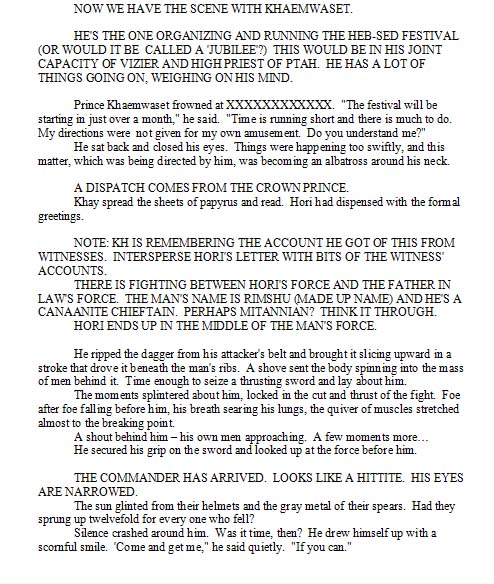 This blip has the potential for three chapters in it. The first being Khay setting things up for the jubilee. Two more chapters might involve Hori’s battles. They’d have to be split up, inserted. Cut and paste work.
Scrivener lets me do that, sort of.
Here’s a chapter in my manuscript for MOURNINGTIDE:

The center section has the chapter itself. And you can see from the list on the left (of chapters) that this is fairly early in the story.
That column (on the left) has all the chapters of the novel in the order in which I have put them. Here it is, in part (I have a lot of chapters):
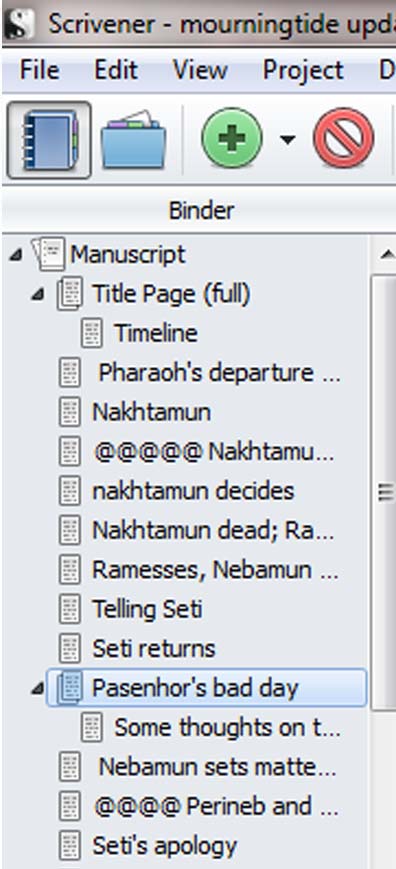
I’ve given the chapters informal names to help me to know what they are. In the finished manuscript they will be numbered with, maybe, a notation as to where they are (the action in the story takes place in three locations). Or not.
If I decide that I want a chapter to come before one above it, I click on the chapter’s name and drag it up in the list.
As the manuscript grows in size, the list itself can become cumbersome. If I am working on a chapter that takes place near the end of the story and I want to double-check something that occurs near the beginning, it can get to be troublesome to scroll all the way up and locate the chapter.
Scrivener has taken care of that matter by inventing something called the ‘corkboard’:
 …And here it is. Each square (they look to me like index cards) is a chapter. You can label the chapters as final drafts, needing work, whatever.
 One last feature that I find particularly useful is the split screen. Recently, I was working on a chapter that referred directly back to something that happened near the beginning of the story. I didn’t want to open two pages and go back and forth. Scrivener allows you to split the screen:
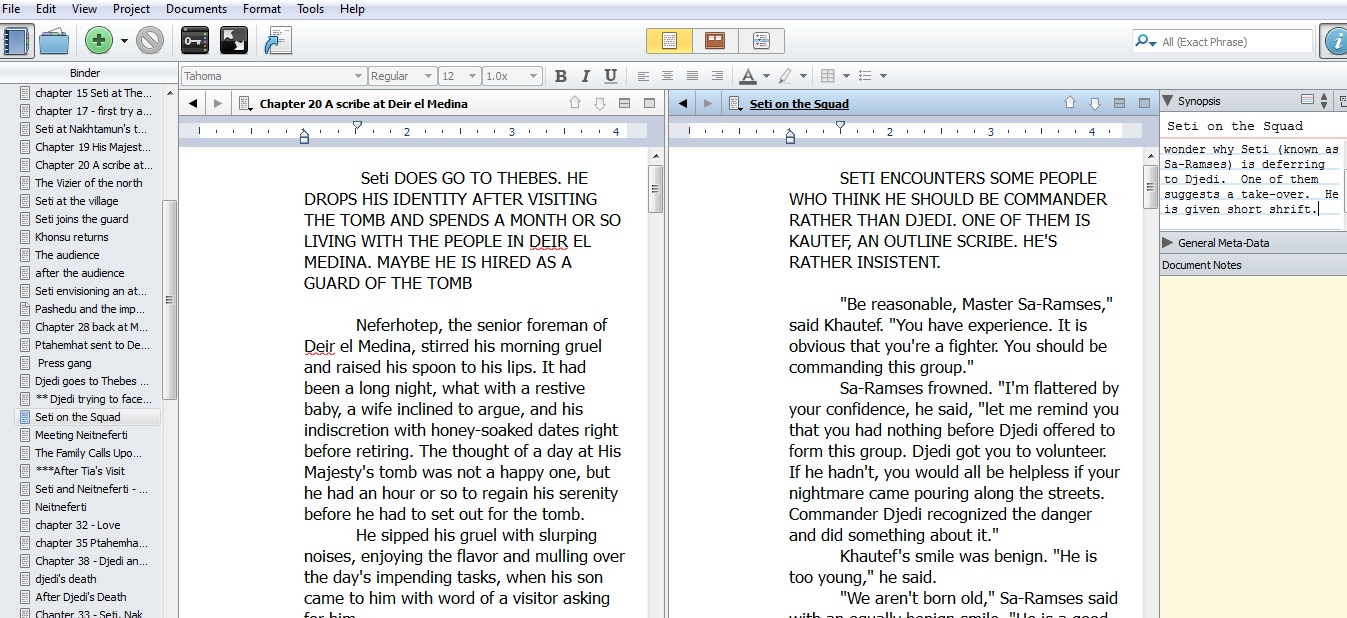 You can check back and forth between the scenes to make sure your facts are straight. (I had some dates wrong in one of my chapters; this feature helped me to adjust things.)
…and when you’re ready to produce a full-fledged manuscript, there’s a command that puts things together in order, formatted, as a .doc.
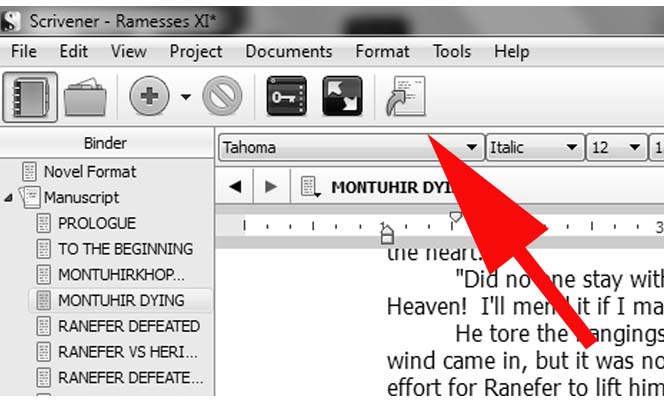 This is the ‘Compile’ command. When you use it, it will show you a list of the pages you have. You select the ones you want to put together, and whether you want ‘hard page’ breaks.
 You then can choose from a drop-down box the way you wish to save the manuscript. I save mine as .doc, which, being such, MSWord can work with.
They have places for research, for images, for character notes (and some nice templates that help organize your thoughts). And the program is $40 US.
What’s the downside? Well, you don’t get a CD. It’s download only. I’ve downloaded the program to two computers (my laptop was stolen). Scrivener folks were charming about restoring my program. I suspect I could upload it to every computer in my house.
Support is charming and the product is very, very good. I can’t recommend it highly enough.
If you’re interested, the company is Literature and Latte. Scrivener is available for Mac and for Windows.
And If I’m ever anywhere near them, geographically, I’ll drop in with hot chocolate for all. And maybe some Bakewell tarts…
Tea…
Strange how a teapot can represent at the same time
the comforts of solitude and the pleasures of company. ~Author Unknown
the comforts of solitude and the pleasures of company. ~Author Unknown

There is no trouble so great or grave that cannot be
much diminished by a nice cup of tea.
~Bernard-Paul Heroux
~Bernard-Paul Heroux
The last time I traveled to London, I arrived before my hotel room was ready. It had been a long flight, I hadn’t slept, I was frazzled and dead tired. I was told to return after 1:30, at which time my room would be awaiting me.
I did, and it wasn’t.
I burst into tears.
At this point three people converged on me, one of them patting my hand, the other guiding me to a nice, bright table in the dining room screened from the noise and commotion, another bringing me ‘A nice cup of tea, dear…’ They scattered, then, returning after I’d drunk the tea and eaten the biscuits and dried my tears. My room was ready…
Another novelty is the tea-party, an extraordinary
meal in that, being offered to persons that have already
dined well, it supposes neither appetite nor thirst,
and has no object but distraction, no basis but delicate enjoyment.
meal in that, being offered to persons that have already
dined well, it supposes neither appetite nor thirst,
and has no object but distraction, no basis but delicate enjoyment.
~Jean-Anthelme Brillat-Savarin, The Physiology of Taste
I enjoyed tea in the British Isles. When I traveled through Ireland (bed and breakfast; rental car, lots of photos…) my midday meal was tea.<

I fell in love with Bakewell tarts, and the strong, milk-laced tea.<
Sandwiches, too…

And scones…

I have my laptop on my lap (where else?) I’ve eaten a light lunch and I’m contemplating putting the teakettle on to brew what will be my sixth cup today. I should be working on my current story-in-the-works (see my post entitled Mourningtide), but right now the thought of tea is holding my attention.>
It sounds like a good idea. There’s something about a cup of tea that seems to steady and comfort (not to mention the tannin that is good against a sore throat). Definitely comfort drink…And I still haven’t put the kettle on. Excuse me, one and all. I’ll write something literary and well-thought-out tomorrow. Tea time!>
NaNoWriMo – Roller Coaster
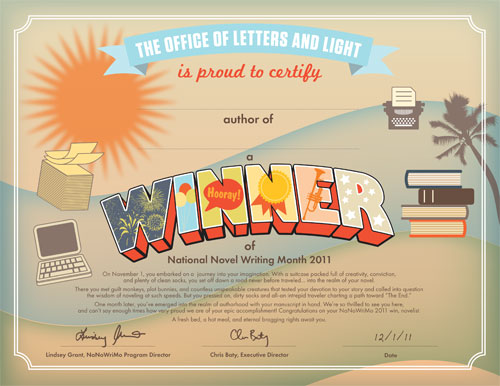 I was reading some emails and came across one from Flylady (an excellent, motivating group for those who need to organize and get their houses in order). She was talking about something called NaNoWriMo, a group endeavor (I can’t call it a competition, exactly, because you’re competing with yourself) that takes place in November. From November 1 through November 30 the participants buckle down and write a 50,000 word novel.
After looking into it further, I signed up for NaNoWriMo – National Novel Writing Month just for fun. The premise was interesting: the novel didn’t have to be finished or polished, it just had to be fiction and have at least 50,000 words. (50,000 words equals about 150 pages in a standard, smaller paperback.)
Considering the length of fiction that I’ve written (admittedly not within thirty days) I thought it would be easy.
Rules were simple: you could not start writing your novel until November 1. You could:
jot down character information
jot down plot thoughts
do research and make notes
do a lot of thinking
The actual composition started only on November 1.
I’d had an idea for a story arising out of my Egyptian cycle. It involved an uprising in Nubia and the way several people handled the matter. I had an array of interesting characters:
Maya, a master artist
His young apprentice
Merneptah, an Egyptian prince, in Nubia under training by the Crown Prince
some other folks, bad and good
I had my research set out, character notes, lots of thinking… But I didn’t write it. It didn’t seem right.
I did no writing on November 1, or not much. I was visiting family, and the great snow catastrophe of 2011 slammed my area. No power for a week, Not a lot of writing done. The folks at the Office of Letters and Light (which holds NaNoWriMo) have a handy little calendar that shows a writer’s output during that month:

The red spaces show no writing. Orange is very low. Green is cooking right along. Yellow is so-so.
I scrapped the Nubian story and went with one that popped, like Athena, fully armed into my head. It has the working title of Mourningtide. It flowed nicely, though I really had to push to get any momentum after the disruption of the blizzard and the forest of broken trees.
But – I finished!
It’s a wonderful thing to work under pressure and discover that if you don’t have the opportunity to laze around and write a bit here and a bit there you can nevertheless produce the bones of a very good story within thirty days.
But Mourningtide is another post…
Bread and Butter…

There’s an artist whose work I like. I contacted her to see about possibly commissioning a work, and an interesting discussion ensued. Thanks to some things that were happening, she had trouble understanding my explicit statement that I didn’t want a copy of anything by anyone. She stated that she did not do such things; when she finally got the message she said that she didn’t do commissions, but would offer a ‘first refusal’ to me. I would see a work and have 24 hours to decide if I wanted it.
That seemed fair enough. I replied that I would certainly be agreeable to that.
She forgot the arrangement (there was a lot going on) and when I approached her again to ask about a work that she had put up for sale she was nonplussed. We got into a discussion of her work. She supports herself with her art (she does other things on the side). There are things that really move her, that she strives to capture, to achieve. And there are pieces – well executed, to be sure – that put money in her pocket. Nothing exciting.
I mentioned one piece that was available, and she said, “Well… you know… I hate to say it, but that is a bread and butter piece.”
The inflection was interesting, almost as though there was no merit at all to it. As though it were something cranked out to satisfy people.
I said something suitable, and we ended the conversation with the remark from me that I would be in touch.
Then I went and looked at the bread and butter painting again.
Hm. Nice balance, a good play of color, capturing the idea of ‘negative space’ through the trees, on the water… I have a pretty good eye for quality, and this had it – in my eyes.
I started mulling over the notion of ‘bread and butter’ work, and the notion that people who like something that is not exactly a magnum opus are somehow stupid or tiresome.
No one likes the paparazzi (not that they chase after me), and clamorous people who say that everything you do is fabulous, even when you know jolly well that it isn’t up to your own standards can be pretty annoying. But still… There’s a kernel of liking, of acceptance, even of love in such attitudes. So why are they so often considered a pain in the neck?
I was at a cat show once, chatting with a woman who bred Burmese. A man came by, smiled at her cats, complimented her on their beauty, and then said that he had a Burmese at home. A Champagne Burmese. The woman said, “Champagnes are just poor quality sables.” and turned away.
I was too stunned at this ferocious rudeness to do what I should have, which was to run after him, tell him that his champagne was gorgeous, and introduce him to people with Burmese like him. What had he done to merit contempt? He admired her work. Rather like admiring the artist’s ‘bread and butter’ work. The stuff that supports her.
Next time someone admires my bread and butter work, I’m going to do what I always do: smile and thank him. It isn’t hard to do. And who knows? Maybe he’ll want to buy some more bread and butter…
Anachronisms…
A writer of historical fiction/mystery (like me) runs into the problem of Anachronism on a regular basis, whether in trying to avoid it or in accidentally inserting it into a work.
Webster defines Anachronism as:
1: an error in chronology; especially: a chronological misplacing of persons, events, objects, or customs in regard to each other
2: a person or a thing that is chronologically out of place; especially: one from a former age that is incongruous in the present
3: the state or condition of being chronologically out of place
A reader posted a review of my book The City of Refuge on a message board devoted to reading. This person is very widely read, eloquent, knowledgeable, with a fine understanding of writing, both style and content, and an excellent critical eye. The review was invaluable to me, and I re-read the story with an eye to improving it.
One of his comments, though, was this:
There are some anachronisms that could also be jarring, the worst was a character saying ‘It boggles the mind.’ – which made me laugh, but could annoy those who are purists. There are others, but I find if I am enjoying the rest of the book, I can accept them.
Here is the scene. The story is set in ancient Egypt, approximately 1309 BC. The speakers are a general (‘Seti’) and the commander of a provincial army (‘Khonsu’).
After the man had left, Khonsu turned to Seti. “Lord Achtoy,” he said. “Nothing less than a hero of Egypt and a Commander of Five Thousand, sent to carry a message all the way north from Thebes to a wrecked city in order to tell us to leave His Grace alone.”“The mind boggles,” Seti agreed. “Well, now we know what His Grace had waiting for us.”
That made me blink. That was an anachronism? In what way?
The verb ‘to boggle’ dates from around 1590, per Webster.Definition of BOGGLE
Intransitive verb1: to start with fright or amazement : be overwhelmed2: to hesitate because of doubt, fear, or scruplestransitive verb2: to overwhelm with wonder or bewildermentOrigin of BOGGLEFirst Known Use: 1598
So the verb ‘to boggle’ seemed anachronistic to the reader. That’s fair enough, though the term, actually, is not a modern one and not tied to any sort of technology that would tend to disqualify its use in a novel set in the distant past.
My thoughts turned to the various things that I consider ‘anachronisms’, per the definition. Let’s look at them in the context of that bit of conversation:
Here’s one type:
You can have anachronistic speech:
‘Loud and clear’, a radio term, is a different matter. Wireless telegraphy was proven to be possible in the late 1800’s; Guglielmo Marconi invented the radio in the early 1900’s. The expression was used extensively by the military during World War II to acknowledge radio messages. An ancient Egyptian would not have used such an expression, though he might have said “He couldn’t have made his message any clearer if he had shouted it.”
We tend to assume that what is normal for us was normal throughout time. Hollywood tends to make this mistake. We have Pharaoh Khufu (Cheops) shouting “Saddle my swiftest camel!” in Land of the Pharaohs (screenplay by William Faulkner, whose grounding in early history was sketchy, but who wrote a heck of a good story)
Some people perceive anachronisms in things that are in their proper time and place. One friend, reading one of my manuscripts, told me quite seriously that “They didn’t have beer in ancient Egypt!” Well, there’s some doubt as to whether the Sumerians or the Egyptians invented beer (my money is on the Sumerians), but they sure had it. Someone writing in the time of classical Greece likened the quality of Egyptian beer to the best wines.
What is the point of this discussion? I have two of them.
First, and most importantly, research is crucial if you are writing of a specific time and place. Secondly – and this is often unrecognized – the reader is the ultimate judge of fitness (for himself).
My reviewer, to whom I am very grateful for a well thought out and meaty critique that will be very useful when I do revisions, felt that a specific expression was out of place. I did not agree, but I adjusted it after thinking it over. Writers tend to live within their own minds, and it’s easy to forget the audience.
That is a big mistake.
My thoughts turned to the various things that I consider ‘anachronisms’, per the definition. Let’s look at them in the context of that bit of conversation:
Here’s one type:
You can have anachronistic speech:
‘Loud and clear’, a radio term, is a different matter. Wireless telegraphy was proven to be possible in the late 1800’s; Guglielmo Marconi invented the radio in the early 1900’s. The expression was used extensively by the military during World War II to acknowledge radio messages. An ancient Egyptian would not have used such an expression, though he might have said “He couldn’t have made his message any clearer if he had shouted it.”
We tend to assume that what is normal for us was normal throughout time. Hollywood tends to make this mistake. We have Pharaoh Khufu (Cheops) shouting “Saddle my swiftest camel!” in Land of the Pharaohs (screenplay by William Faulkner, whose grounding in early history was sketchy, but who wrote a heck of a good story)

Some people perceive anachronisms in things that are in their proper time and place. One friend, reading one of my manuscripts, told me quite seriously that “They didn’t have beer in ancient Egypt!” Well, there’s some doubt as to whether the Sumerians or the Egyptians invented beer (my money is on the Sumerians), but they sure had it. Someone writing in the time of classical Greece likened the quality of Egyptian beer to the best wines.
What is the point of this discussion? I have two of them.
First, and most importantly, research is crucial if you are writing of a specific time and place. Secondly – and this is often unrecognized – the reader is the ultimate judge of fitness (for himself).
My reviewer, to whom I am very grateful for a well thought out and meaty critique that will be very useful when I do revisions, felt that a specific expression was out of place. I did not agree, but I adjusted it after thinking it over. Writers tend to live within their own minds, and it’s easy to forget the audience.
That is a big mistake.
After the man had left, Khonsu turned to Seti. “Lord Achtoy,” he said. “Nothing less than a hero of Egypt and a Commander of Five Thousand, sent to carry a message all the way north from Thebes to a wrecked city in order to tell us to leave His Grace alone.”
“The mind boggles,” Seti agreed, reaching into the breast of his tunic, extracting his cigarette pack, and shaking one loose. He tapped the cigarette against his palm to settle the tobacco, Setting the filter end in his mouth, he struck a match against his sandal, lit the cigarette, and took a long drag. “Well,” he said through the smoke that curled from one corner of his mouth, “now we know what His Grace had waiting for us.”
The anachronisms here are the cigarette and the match. Every culture in history has habits like smoking, whether it is chewing betel nut or spruce gum. But tobacco is a new world plant, and the earliest depiction we have of its use is Mayan, after dynastic Egypt.
After the man had left, Khonsu turned to Seti. “Lord Achtoy,” he said. “Nothing less than a hero of Egypt and a Commander of Five Thousand, sent to carry a message all the way north from Thebes to a wrecked city in order to tell us to leave His Grace alone.” He sat back and shook his head. “Well,” he said, “His Grace got his message across loud and clear!”
“Good grief!” Seti agreed.
In this case ‘good grief’ might be allowed. It seems to be a ‘softened’ exclamation: ‘good grief’ instead of ‘good God’. Since it was made popular in Charles Schultz’ Peanuts comic strip, I’d tend to stay away from it, myself.
Incidentally, here is the changed passage:
Incidentally, here is the changed passage:
After the man had left, Khonsu turned to Seti. “Lord Achtoy. Nothing less than a hero of Egypt and a Commander of Five Thousand, sent to carry a message all the way north from Thebes to a wrecked city in order to tell us to leave His Grace alone.”
“Incredible,” Seti agreed. “Well, now we know what His Grace had waiting for us.”
Camels were a late arrival in Egypt. So were chariots (at least as to the reign of Cheops). Also (staying with Land of the Pharaohs for a moment), the short wrap skirt, head cloth and light scarf of Thai raw silk woven in a sort of plaid worn by Jack Hawkins as Cheops, along with gold lame’ sandals are out of their proper time, as well, no matter how sweet he may have looked in them.
The same person informed me, quite seriously, that “they didn’t have bricks back then, either.” (This was one of my fantasy novels, set in no time in particular.) I only smiled.
…To Be Continued…
This world is not conclusion;
A sequel stands beyond,
Invisible, as music,
But positive, as sound.
(Emily Dickinson)
People are naturally curious. They like to ‘fill in the blanks’. When I was growing up, I’d see someone and figure out what went before I saw him and then project what would happen to him afterward. I still do it. In cases of extreme annoyance, I sometimes write a mental scene in which the person in question has an unpleasant experience – usually involving a blueberry cream pie in the face. (Blueberry stains and custard is gooey.)
How many times have you read a book and wondered what happened to the characters afterward? Jane Austen addressed this curiosity about her characters’ lives, I understand, after Emma was published. She stated that Mr. Woodhouse lived a time after Emma and her Mr. Knightly married (and moved in with him) and by dying allowed them take up residence in Mr. Knightly’s residence of Donwell Abby.
While it is wonderful to finish a story, I always feel a strong sense of loss when I have to leave characters that I grew to love. It’s like leaving beloved friends. You can write a sequel – I’m doing it right now with Pharaoh’s Son – but sometimes the books stand alone and require no sequel. In The Safeguard, my novel set in 1864 Georgia, the story ends in October of 1865 as Lavinia sees her little daughter throw aside her imaginary tea set, pick up her skirts, and go tearing across the lawn toward Sheppard, who has returned as he promised. They marry, certainly, and they probably spend their time between her properties in Georgia and his home in Geneva, New York. But there are no conflicts, no loose ends. To follow them would be a letdown.
At the end of A Killing Among the Dead, Wenatef is leaving Egypt. There is no life for him there, and he knows he will not live the year out if he stays. But he’s heard of a white substance found in the mountains across the ocean, something soft and cold that you can crush in your hands like bread dough. He decides to leave Egypt and travel to the mountains to see the white substance called ‘snow’. Somehow, that situation caught my readers’ attention and people ask me “Will you write a story about Wenatef encountering snow?”
Well… I may just write a quick several pages for my father, who really wants to see it. But the story is set and while I have my own opinion of Wenatef’s future, it isn’t necessary to write a sequel.
How many series have continued to be written because the author has bowed to the wishes of a public who wants, say, just one more Sherlock Holmes story? Or one more (fill in the blank with the name of a popular detective) story? I think the test of the necessity of a sequel is this: is there an overarching story line that mandates more than one ‘story’? For example, in the Harry Potter series by J. K. Rowling, each story is complete in itself, but when they are strung together they lead to the final resolution envisioned in the first novel.
Perhaps we are too used to being spoon-fed. We are told what is what, our children play on toys that do everything for then, we sit in a constant stream of information and statistics. I do not see that we are allowed much scope for the use of that wonderful power, imagination. Perhaps we don’t want to use it. It’s too dangerous. Like a half-broken horse, it can run away with us and take us places that are uncomfortable, wild, perilous.
There’s a piece of conversation toward the end of A Killing Among the Dead that seems to fit into this train of thought. When Wenatef is speaking with Unas the last time they meet, and Unas speaks of his madness:
“…To turn away from that – to fight free..” He drew a shaking breath and was still.
“You can do it,” Wenatef said. “The choice is yours.”
It isn’t such a terrible plunge to take. Let me set it up:
“So… What happens next?”
“Next? What do you mean? That’s the end of the book.”
“No, really – what happens next after he leaves Egypt?”
The author sits back with a smile. “What do you think happens next?” she asks.
Try it. it’s fun. Addictive, too. In a nice way.
I Am a Writer…

Diana Wilder
I am a writer. That is to say, I write books. I do other things, as well, but this blog is devoted to my writing. Where it comes from, what I’m doing, what I’m enjoying, what is annoying me. Not so much of the last part, actually.
Why am I a writer? Well, because it suits me. I like to tell stories, whether or not I have an audience. I make up stories in my mind – or perhaps I tend to ‘fill in the blanks’ on a situation, and it becomes a story. I write some of them down. Where do they come from? All over the place. I used to carry a notebook around with me to catch my thoughts; I fell out of the practice during a hurried and harried time, but I’m back to it.
What have I been doing?
Well, I wrote my first poem back in fourth grade a few decades ago. It was so much fun, I kept up with it. Some of my poetry is enjoyable, some isn’t. I haven’t done much of it in years; it is a demanding activity, and my writing skills lie in another direction. Or maybe I mean that I enjoy channeling the skills in the direction in which they’re going at the moment.
I wrote my first novel, as such, around 8th grade. Hand written in fountain pen. I still have it. It’s a story about Hawaii in the time of Kamehameha the great. The title was Born of the Sea. I followed that up a couple years later with a story that was set in French Canada around the time of the French and Indian Wars. That didn’t have a title, though someone suggested Jaws because some of my characters were rather chatty.
I went to college and a year of grad school. I was involved in the student newspaper and the fine arts publication, and a number of my poems were printed there. I wrote a colum – thinking aloud, I guess. Actually, the colum was rather like a blog. I did have a following, but it was cut short when I graduated.
Then came The Snowhawk. That gets a post of its own. My first full length novel (in three parts, too, so it’s a three-fer). I wrote it before electronic copies and there it sits, not edit-able because it’s only in hard copy. But there are other things about it that have earned it an honest retirement.
I have four novels published and more in the works. But that’s another blog post.
 dianawilderjottings