Celebrations 17 April, 2015


Welcome to the Celebrating the Small Things blog hop, started by VikLit and now run by Lexa Cain, our fearless new leader and her two wonderful co-hosts L.G. Keltner @ Writing Off The Edge and Katie @ TheCyborgMom.

This wonderful hop has generated many smiles, made me count blessings, helped me encounter some wonderful people, and given me a chance to catch my breath and reflect on how truly fortunate I am.

Today I am celebrating one of those items peculiar to me: finishing a chapter that had been giving me some trouble.  The two characters are major players in the story.  One is a elderly prostitute who had been a dancer before she broke her ankle and had no choice but to go on the street.  In France of that era, prostitutes were not criminals, provided that they checked in with the authorities on a regular basis.  This one is a skilled nurse.

The other is the main character of the trilogy, a police officer with an unusual past.  She saved his life when he was badly wounded in the revolution of 1830, and he has been trying to get her to come off the streets.  What happens after she agrees is a pivotal moment in the story.  (It is not in this section.) It’s good to finish it:

  “It was a pleasure,” Malet said. “In return, Fanny, let me ask a favor.”
  Fanny looked up at him through a blooming smile that softened the fatigued lines of her face and made her seem pretty.  “Anything,” she said.
  “Come in off the streets,” Malet said. “Now.”
  “Off the streets?” said Fanny.
  “You heard me,” said Malet. “You’re too old for this. People here have changed. You’ve been coming in with black eyes and bruises, and it’s only going to get worse. I’ve done what I can for you, but my influence extends only over the Police, the Army and, to a degree, the criminal world. I can’t control half-crazy, randy-drunk students!”
  She looked up at him.  “What else can I do? Prostitution’s the only thing I know.”
   “Who told you that and why in God’s name did you believe him?” Malet demanded. “The scoundrel who blacked your eyes?  Who would credit such a villain?  My God, Fanny! I owe you my life from the rioting in ’30 when I was shot through the lungs! You can work for the Prefecture as a nurse. Sonnier thinks you’re a finer physician than he is! It would be an honorable retirement. Haven’t you earned it?”
     Tears welled from her swollen eyes and slid down her cheeks. “This is the only thing I know,” she repeated.
     Malet took her slender hand in his. “That is a lie and you know it.”  He raised his eyes to hers. “I can’t imagine what possible crime you may have committed to make you convinced that you are fated for such a dwindling life and squalid death.”
  Her eyes filled with tears.
  He lowered his eyes, withdrew his handkerchief and gave it to her.  He was silent as she blotted her eyes and then handed it back.  “Fanny,” he said. “I am begging you: if you love me, come off the streets.”
  She was weeping now.  “Oh you’re a devil!” she said. “You got no call to talk to me like that! I never tried to solicit you—you’re not for the likes of me and I know it!”
  “You are my dear friend, Fanny. God knows I love you! I mean what I say: get off the streets. Please! I don’t want to have to investigate your murder.”
  Fanny dabbed at her face. “It’s too late for me,” she said.
  “It is not!” Malet looked down into her tear-drenched eyes and gathered her hands again. “Listen to me,” he said more quietly. “You are not doomed to a lonely and wretched old age. There are many here who love you. You saved my life. Please: won’t you allow me to save yours? It would give me joy!  You can step off the streets, away from all those who mock you and use you. You can be the healer you always have been, and you can go into an honorable and well-loved old age. We will care for you. You have earned it. And it will give happiness to all of us.”
  He could see that she was wavering. “Come with me now,” he said.
 

That is not the entire scene, but it is the part that troubled me, that was difficult to put into words.  No doubt I’ll tweak it more.

What are you celebrating?  why not celebrate the vast array of creativity, humor, beauty and wisdom of the A to Z challenge?  I will be!

Click here to Go to the A to Z Challenge

(and have a good weekend!)

http://www.simply-linked.com/listwidget.aspx?l=79cd691b-a101-48a4-8603-4d22bb6626d8

M = Marginalia


Today’s letter for the A to Z challenge (link below this post)  is ‘M’, and in the spirit of the literary alphabet, I am discussing a term for illuminated manuscripts I had not heard before:  Marginalia.

Wikipedia, gives this definition:

Marginalia or apostil) are scribbles, comments and illuminations in the margins of a book.

Another way of describing Marginalia is that they are sketches, notations, doodles, scribbles and paintings that are found in the margins of a medieval text or document, generally having very little to do with the main text itself.

They can be fanciful scenes, like this knight jousting against a snail.  This is a little work of art, from the colors of the flowers behind the knight to the curve of the branch and the blue tendril twining downward.  (And note the shadow of the writing on the other side of the vellum

Or a peasant riding his noble steed, a duck, webbed feet and all.  I see that the saddle is exactly like those used by knights, with a high back, and it is equipped with stirrups.  The position of the saddle and the rider’s legs would make it hard for the duck to fly.  I’d be curious to see how well the bit works.


Musical deer would be fun to watch.  this one has a rather Christmas-y feel to him.  I do think he’s reading a book of music, and I’ve seen medieval music manuscripts that were identifiable as sheet music, though rather more decorative than the ones we’re used to.
       This fellow is beautifully done, from the execution of the folds of his pink robe to the glittering blue flower to the right of the doodle…


To the left, we have another man doing battle with a snail.  He is wielding a sword and carrying a shield.  Surely there are better ways to exterminate snails, but I may be thinking out of period.  I always thought them pests, and in the age before pesticides and whatever else you use to get rid of snails, I could see that they might be viewed as a terrible evil.  I love the colored flowers in among the tendrils, and the gilding on the shield and the snail’s shell.  The scarlet lining of the man’s long blue sleeves is also attractive paired with the spring green hose, shoes and sleeves.


Speaking seriously, I do need to caution readers here, especially if children are hovering by the monitor: these are the amusing and pretty ones that I was able to find.  It took a while.  I warn those who see these and grab their keyboards, thinking, “Gosh, how charming!  I must rush out and have a look myself!” that the marginalia brought up by a google image search are notable for their crude raunchiness.  I had to work very hard to find ones that were G-rated.  In fact, I had to delete one just now that I had planned to use because I noticed, for the first time, a distinctly scatological bent in one of the characters which seemed, on closer scrutiny, to be a monkey. 

And the next time I watch a movie set in medieval-type times, and they have a line of trumpeters blowing a fanfare on their long trumpets with the banners attached, I will probably give in to a fit of mirth that has nothing to do with the sound of the music but only the way that I saw the trumpets being blown in the marginalia. It will ruin the fight scene in the castle between Basil Rathbone and Errol Flynn.

No, I won’t get into detail, but simply say that from my reading of The Canterbury Tales, I would not be at all surprised to know that Geoffrey Chaucer probably consulted some of the more…vigorous depictions for ideas for his stories.  Consider yourself warned. 

Celebrating the letter ‘I’, for ‘Inhabited Initial’


Welcome to the April 10 edition of the Celebrating the Small Things blog hop, started by VikLit and now run by Lexa Cain, our fearless new leader and her two wonderful co-hosts L.G. Keltner @ Writing Off The Edge
Katie @ TheCyborgMom

I am combining this post with a series of alphabet posts I’ve been making for the past week or so.  If you are familiar with the blogosphere, you will know that the A to Z Blog Hop is in full swing.  I bowed out, more or less, because I’m racing toward a self-set deadline and just don’t have the time to fully immerse myself.  But I can go along, post when I can, and direct folks to the hop (see the very bottom of this post).  So why am I celebrating this?  Well, just look around at the various posters and themes.  Such a wealth of creativity, of effort and enjoyment!  Do go look.

Meanwhile, combining my alphabet with this celebration, I’ve been celebrating illuminated manuscripts.  Luscious, splendidly colored, a joy to find details.  And today’s offering speaks of Inhabited Initials: 

According to the Oxford Reference, an Inhabited Initial is…

an enlarged initial letter decorated with a figure or figures. The figures  may be purely decorative  or only  loosely related to the text,  whereas  historiated  initials contain  scenes  directly illustrating it


This ‘B’ has, in no particular order, gremlins (to the left) weird faces (lower opening of the B, the circular elements on the R, top and bottom, human-headed critters (between the top and bottom) bluish animals, top and bottom, that could be either be blue dogs or some sort of sea serpent with ears.  Below, we have a letter ‘S’ with a bird and a deer…

…And at the bottom of this page we have clerks singing in the center of  a small-case ‘A’.

                                                                 Doodling?  Or for a purpose?  My conclusion was that they may have started as doodles, but the whimsical quality of these letters caught the imaginations of the scribes, and they were put in to make the manuscript beautiful.


What better way to deepen thought than to allow the mind to linger on luscious shape and vibrant color?

Mouse and cat?

H = Historiated Initial


The Good Shepherd 

Continuing with the discussion of Medieval Manuscripts and their ‘Initials’ today we speak of the ‘Historiated’ Initial.

A Historiated Initial is an initial (enlarged letter that starts the first word of a passage) containing a scene from the work. It could be an episode from the subject, a portrait of the author, or landscape from the text.

In this scene (to the right) we have a manuscript from Dante showing a scene, found in the story, of a sailing ship.

And below we have King David playing his harp, above, and, as a young man, facing Goliath (lower register)


I can’t resist putting in one of my favorite Historiated Initials.  Well…if it is a book on wine-making, or the evils of drink…


G = Grisaille


‘Grisaille’ is the term for scenes in illuminated manuscripts where the scenes are executed in shades of gray (‘gris’ in French) or brown.  The backgrounds are often brightly colored or gilded.  The effect is almost the same as looking at a statue or a carved frieze.


While this technique has been found in some English manuscripts, most of this style of painting is found in manuscripts from the continent.


How did It come about?  Who thought of it?  It seems to me, looking at the calm, almost monumental, scenes executed in this fashion, that the artist-scribes had to be thinking of the shimmer of light over  polished marble.  The touches of color, like the golden ray descending in the painting to the left, and the heavenly blue sky, lend a richness to the images.

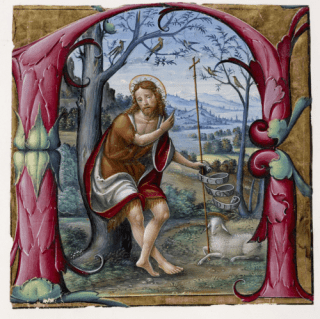
The jewel-like decorations bordering the illustration of John the Baptist, right, would be lovely sandwiched between clear sheets of rock crystal, framed in gold, and hung from a chain.  (Notice that he is wearing animal skins…)

F = Flyting


Flyting is a sort of contest involving an exchange of insults.  In Germanic tales, it usually occurred between two warriors, each of whom is trying to show that he is bigger and braver and knows more words.

Here are some instances from literature:

(from Troilus and Cressida, by Shakespeare)
Ajax: Thou bitch-wolf’s son, canst thou not hear? Feel then.
Thersites: The plague of Greece upon thee, thou mongrel beef-witted lord!

But soft!  I have here a reenactment of such an exchange:

Does it sound like Rap?  Flyting is thought to be one of the origins of Rap.  If I had more time, I would expand on this.  Instead, here is a Flyting session staged between a Scot and Margaret Thatcher (if you suspend your disbelief…)

E = Epithet


Today I am speaking of epithets.  Years ago I had thought it a word synonymous with ‘insult’.  In fact, you read in books of people ‘hurling epithets’.  But the definition is a short nickname, often using an adjective or descriptive phrase, which is attached to the person’s name.  (Read on regarding the insult issue)

 
 Epithet is defined as a short, poetic nickname–often in the form of an adjective or adjectival phrase–attached to the normal name.  (Richard the Lionheart or Duke John the Good.) 

You will often see this in poetry when the poet needs a few more syllables to make his lines scan properly.  Let’s say he is short four syllables while writing about one or another of the Erics that you might encounter while dealing with Vikings.  Eric wore glasses (obviously a warrior ahead of his time) so the poet could tack on ‘The Short-Sighted’ and fill the necessary syllables.   

Hector


The Homeric Epithet (found, not surprisingly, in Homer) has Fleet-Footed Achilles, Menelaus of the Loud War-Cry, Hektor of the Glancing Helmet, Sneaky-Minded Odysseus.  (Some of these names may be my own invention…)

Edward Longshanks
The use of the epithet comes into its own with heads of state.  We have Edward Longshanks (Edward I of England) who was, himself, the son of John Lackland (John I, Richard the Lionheart’s youngest brother).
The Prince of Whales
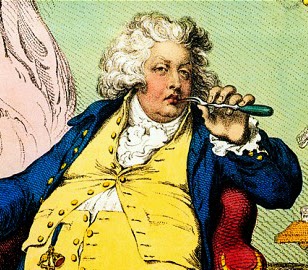
In history we have Ethelred the Unready, Berthe aux Grands Pieds (Big-foot Bertha), Pepin the Short, Louis (XIV) the Sun-King, The Grandmother of Europe (Queen Victoria).  My favorite of all of them, however, is the nickname for the Prince Regent, the man who became George IV: “The Prince of Whales”.
Wikipedia has a fascinating listing of epithets applied to rulers Here.
It is worth a visit.
 

D – Decorated Initial


If, like me, you enjoy looking at illuminated manuscripts, you have probably noticed that the first letter of a passage is often (a) larger than the rest of the text, (b) decorated in some way, and (c) truly beautiful.

The word for this first, larger letter is ‘Initial’.  Initials come in three types:

Decorated (the most basic type), Inhabited (incorporating a picture) or Historiated, which has a scene from the story or subject of the text, incorporated in it.

The design or embellishment of a Decorated Initial generally has nothing to do with the subject of the text and is, as they say, ‘just for pretty.’

The scribe appears to have liked Morning Glories…

Celebrations – April 3, 2015


Welcome to the April 3 edition of the Celebrating the Small Things blog hop, started by VikLit and now run by Lexa Cain, our fearless new leader and her two wonderful co-hosts L.G. Keltner @ Writing Off The Edge
Katie @ TheCyborgMom

I am celebrating several things, in ascending order:

  1. This has been a busy week and I accomplished a great deal (for myself)
  2. Winter is broken and yesterday I saw the first shoots of daffodils.  I know we have crocuses coming up at the front of the house, purple and yellow.
  3. Writing is coming along well, I’m finishing my first finished draft of VENGEANCE, which is the second book in my Paris 1834 series, and…
  4. Today is the beginning of the days leading to Easter, a day I love.  It is, as well, the first day of Passover.  

 I’m home alone this weekend with a real yen to cook and (I gasp at this admission from a confirmed ‘pantser’) to actually do a chapter outline of this story and the next in the series, as well as my other, Egyptian work in progress.  I’ve done this in a desultory fashion (hm…  A word I can use in my going-along-with-the-A to Z-blog-fest-when-I-have-the-time.  No, wait.  D, for me, is Decorated Capital.  Ah, well.

Joy, good weather and blessings to all of you.  Have a wonderful weekend!

http://www.simply-linked.com/listwidget.aspx?l=79cd691b-a101-48a4-8603-4d22bb6626d8

C is for Circumlocution


CIRCUMLOCUTION
elaborate, roundabout, or indirect speech or writing. 
Also known as Periphrasis.


He was dispatched to his Final Reward somehow sounds nicer than The Feds shot him away. (this is also known as a euphemism)

The fact that we are taking a muscular stance does not require that we must ride that horse to the bitter end and go down with it. (I did a blog post on this one, uttered in a meeting, which had me so delighted, I had to write it down before I forgot it.  It would have been better if he had said, We have taken this stand, but we don’t have to die for it.”)
 

Circumlocution is often used in order to avoid saying outright something that might be painful.  My cat crossed the Rainbow Bridge seems somehow less tear-making than “I had to have my cat euthanized.”  

Damon Runyon’s stories about the seamier side of New York City involved a lot of circumlocution:

If I have all the tears that are shed on Broadway by guys in love, I will have enough salt water to start an opposition ocean to the Atlantic and Pacific, with enough left over to run the Great Salt Lake out of business. But I wish to say I never shed any of these tears personally, because I am never in love, and furthermore, barring a bad break, I never expect to be in love, for the way I look at it love is strictly the old phedinkus, and I tell the little guy as much.

 In Runyon’s case, the circumlocution serves to illuminate a certain sort of character.  And here, for a wonder, is a scene from the movie Guys and Dolls with Marlon Brando and Frank Sinatra, where their words are drawn out and ornate and the speech (Brando’s, I mean) is one of my favorite in literature.  He speaks of advice from his father:
 

“Son, you are now going out into the wide, wide, world to make your own way, and it is a very good thing to do, as there are no more opportunities for you in this burg. I am only sorry that I am not able to bankroll you to a very large start, but not having any potatoes to give you, I am now going to stake you to some very valuable advice, which I personally collect in my years of experience around and about, and I hope and trust you will always bear this advice in mind. Son, no matter how far you travel, or how smart you get always remember this: Some day, somewhere, a guy is going to come to you and show you a nice brand-new deck of cards on which the seal is never broken, and this guy is going to offer to bet you that the jack of spades will jump out of this deck and squirt cider in your ear. But son, do not bet him, for as sure as you do you are going to get an ear full of cider.