Tinkering with Art When One Is Not An Artist


Diana, reading a newspaper affixed to an easel
Artists run in my family.  There is so much sheer talent among my family members, they could populate the Royal Academy or else serve as Staff for the Rhode Island School of Design.  I must have been busy elsewhere when the artistic ability was handed out because I most emphatically am not one of them.  My drawing ability is limited to stick figures and somewhat fantastical horses. 
No false modesty, no hiding my talent up my sleeve: I can’t draw or paint and that’s flat.  But I do enjoy designing book covers for my work.  Fiddling with images is not the same as drawing or painting, but it can be rewarding.  Sometimes.  Then there are times where you want to tear your hair out.  


Book 1: Tuileries
I have a series in the works, with the first book out.  It is set in 1830’s Paris.  The series is called The Orphan’s Tale.  The second is, I’d say, 80% finished.  The third is not too far behind.  Because Book #1 is published, it stands to reason that it has a cover: 
The lady, who is Elise, the heroine, is taken from a portrait of that era, and the structure in the background is the Tuileries palace in Paris.  It stood opposite the Louvre, but was destroyed around 1870.  This painting, executed some 20 years after the setting of my story, shows a party at the palace.  It works very well with the lady’s hair and fashion.


The second book is not out yet.  Projected release is year’s end.  I do have that cover designed.  The boy, Larouche, is taken from a Victorian genre painting.  I really wanted to use his whole form, but was forced to drop that idea when I realized that the full-length painting depicted a newsboy peddling the New York  Times, a publication that would have been difficult to find anywhere outside the United States.  The building is the Hotel de Cluny in an old quarter of Paris.  The painting, executed by a Californian in the 19th century, is titled ‘Christmas Morning’.  The book ends with Christmas Eve, and the painting works.
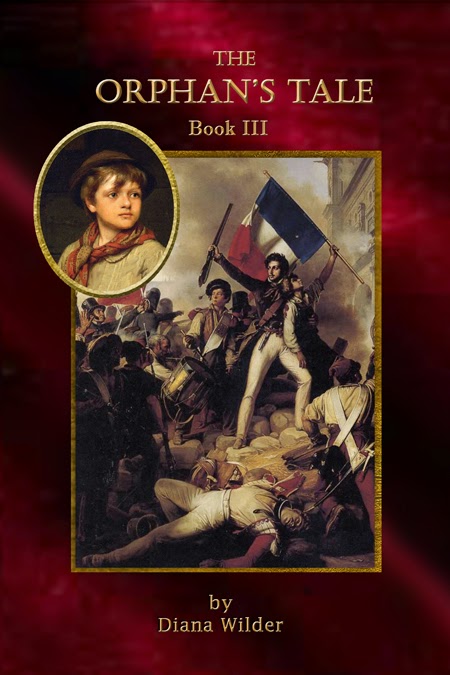

Ummm…  No.
The big problem arose with Book #3.  It originally had Larouche in place and, it taking place during one of the periodical riots that plague Paris, was appropriate.  Or so I thought.  Unfortunately, some of my nearest and dearest pointed out issues with the painting.  The fellow motioning to the rough-looking crowd is rather dopey-looking.  The face fungus appears out of period, the apparently dying boy (who somehow appears  strong enough to hold up a flag straining in the breeze) is not an asset, and the dopey young man is wearing striped trousers.  Enough said.  Besides, I needed a depiction of the main male character, Paul Malet.
That was difficult.  He is described as a tall man.  His hair is thick, dark, and graying, and his eyes, set under straight, dark brows, are a light brown, almost green.
When you are working in period, as opposed to simply trying to set a time-like feel to the story, you have to be careful about facial types.  The western Europeans of two hundred years ago do not look the same as they do now.  There has been a blending of peoples.  One forensic anthropologist, often called upon to identify bodies found on a certain battlefield, said that he could usually tell by looking at the skull.  In my case, I needed images to work with, either to be purchased, or in the public domain.  I started looking among portraits of the era.  Sir Thomas Lawrence was a portraitist active at that time.  I strolled through his paintings.  I wanted someone who was under 50 years old, moderately refined.  I only needed a head.
I found one.  This fellow, one Sir Codrington Edmund Carrington, was a distinguished and well thought-of aristocrat.  Perhaps a little too refined, not to say effeminate.  Paul Malet had been an artillerist in the armies, was a swordsman (they used edged weapons in the military – in Malet’s case, heavy, long swords).  As a high-ranking police officer, he would still carry a sword.  But he had dark eyes while this fellow had gray eyes and, unfortunately, a cast in the eye on the right.  That was fix-able, I thought, and I broke out my Photoshop and set to work.

I came up with this.  The coloring is appropriate, though he still looks delicate.  Still, I had been looking and LOOKING, and this was the best I had.  A little refined, but setting the head in a uniform coat seemed to help for the moment.  Now to look for some appropriate settings.
  
Well, there was Lawrence’s portrait of Admiral Pellew, who fought in Britain’s navy during the Napoleonic wars.    The body looked pretty good from the neck down.  From the hair, crew cuts were a Napoleonic invention, but I didn’t plan to use the head.  It only remained to paste the head I had designed atop the body.  I set to work and finished it fairly quickly.  The proposed image is below:
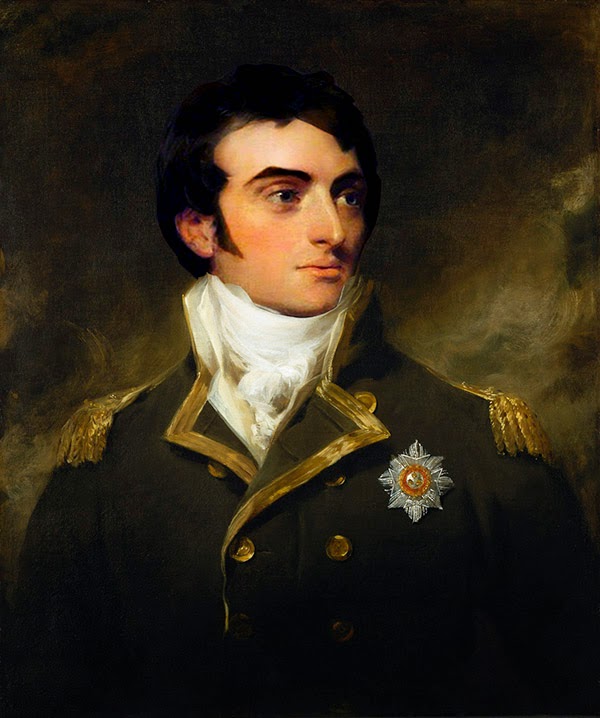
A Frenchman in the Royal Navy?  Uh… No.
The big problem with this, aside from the apparent olive color of the uniform coat, is that the hero, Paul Malet, would have been the last one to wear an English uniform, admiral or not.  I was aiming for historical accuracy.
I tried another uniform, just to see how it would look.  The hero, being a veteran and a police officer, would have worn a uniform.  This one was a little better, though the man who posed for that one was Russian and, for reasons unknown, had stopped in the middle of doffing his cloak.  
May I take your coat, sir?
The general effect is rather awkward.  And this ruddy smiling fellow, also painted by Lawrence, was Russian.  Hm…    I found I could not take the painting seriously.  When I added the head of my character, the result was especially laughable. 
It was worth a try, but the result could be summarized with the words…

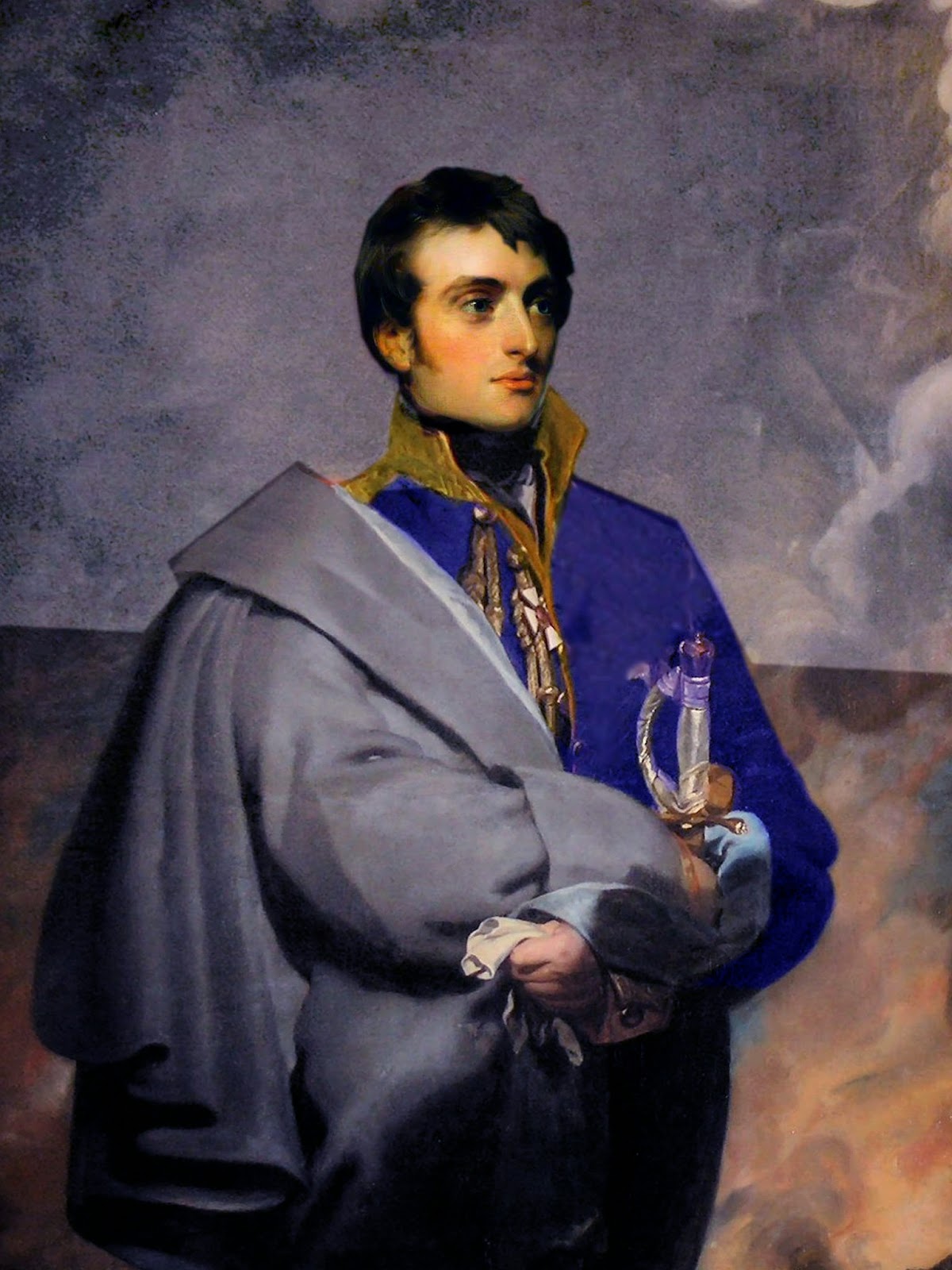

Uh…  No.
The possible solution was to simply use an inset head on the cover with an image I wished to use.

I tried it.  Truly I did.  It should have worked.  The background image was perfect, and I had my adjusted head.  Unfortunately, I learned to my dismay that while the head, somewhat over-refined, was not so bad from a close vantage point, when you put it at a distance it looked somewhat like a snipe.  Or,  perhaps, like Bob Hope.  In fact, it reminded me forcibly of a cartoon by Honore’ Daumier:
Blast!  It was back to the drawing board. 

Fortunately, I found the perfect image when I wasn’t looking for it.  In fact, I caught a glimpse and spent a good long time trying to find it again.   
General Maurice-Louis Gigost d’Elbee


This man was one of the royalist generals who fought in the counter-revolution during the Terror (French revolution). 
Freedom of Worship had been denied, the king was imprisoned, and the Terror was in full swing under Robespierre.  Led by a peasant, wearing the emblems of their faith, aristocrat and commoner, wealthy or poor, they fought with courage and firmness.  The ‘Republican’ government’s suppression of the revolt, is considered genocide.  It was a terrible time, but heroes and heroines arose, as happens during such times.  This man was one.  I am surprised that he is not better known, but then people tend to shy away from those who lose wars.  Napoleon, by the way, came to power while the strife continued, though weakened.  He made inquiries, realized that the people were fighting for freedom of worship, and stopped the war and the killings.  The portrait was commissioned posthumously by Louis XVIII after 1817.
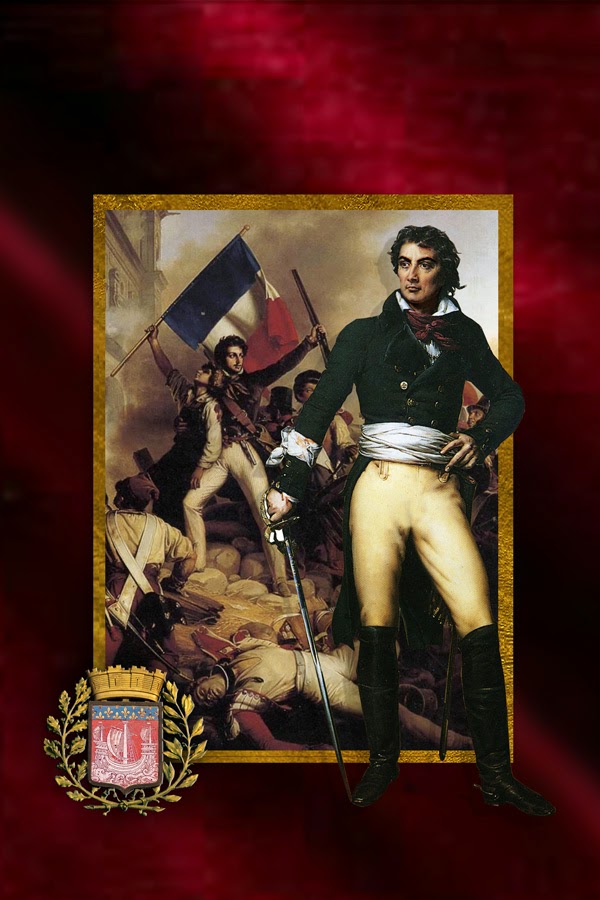

Uh, no…
…And, on a less impressive note, I had an image I could use.  It was in the public domain, and I could not imagine that Maurice d’Elbee would object to my borrowing his portrait as a basis for a character that was also a hero.


I adjusted the image: the epaulettes were out of place, the hair out of fashion.  During the action of the third book, the hero is trying to make his way out of a riot.  He would not be in uniform and the uniform would not, at any rate, look like that.  He would, at least at first, be carrying that heavy cavalry sword (it’s a sword, for thrusting, and is straight: sabers, used by light cavalry for slashing, are curved) I tried the earlier cover: 
There is too much going on.  Too many bodies, too tangled.  And the expression, looking grimly to the left, does not work with the background.  He doesn’t appear to be paying attention.
I liked the flag, but …  No.  I needed something to show tumult.  I also needed to find something to go with the theme of the earlier covers, which incorporated monumental buildings. 
I had an idea, and I tried something else:

This is a little better, but rather boring, truth to tell.  It’s a good thing the Chief Inspector is placed where he is, because if his hips were not in that exact spot you would see the Duke of Orleans, who became King Louis-Philippe of France, riding his bright bay horse across the cobblestones with his doffed hat in his hand.
In fact, the cover was boring as all get-out.  And another thing: the white silk sash (used by the counter-revolution to show support for the Bourbon kings) was out of place.  I decided to remove it.
That took some work.  I had to reconstruct the man’s coat, which involved constructing the double-breasted placket down to his waist, creating cloth and blending it in.  I admit that it was fun:
While I was at it, I added what I thought were lively people on the left, complete with tricolor.
It being Christmas day, a friend asked me what on earth Bob Cratchit and Tiny Tim were doing there.
Errrrrrr….
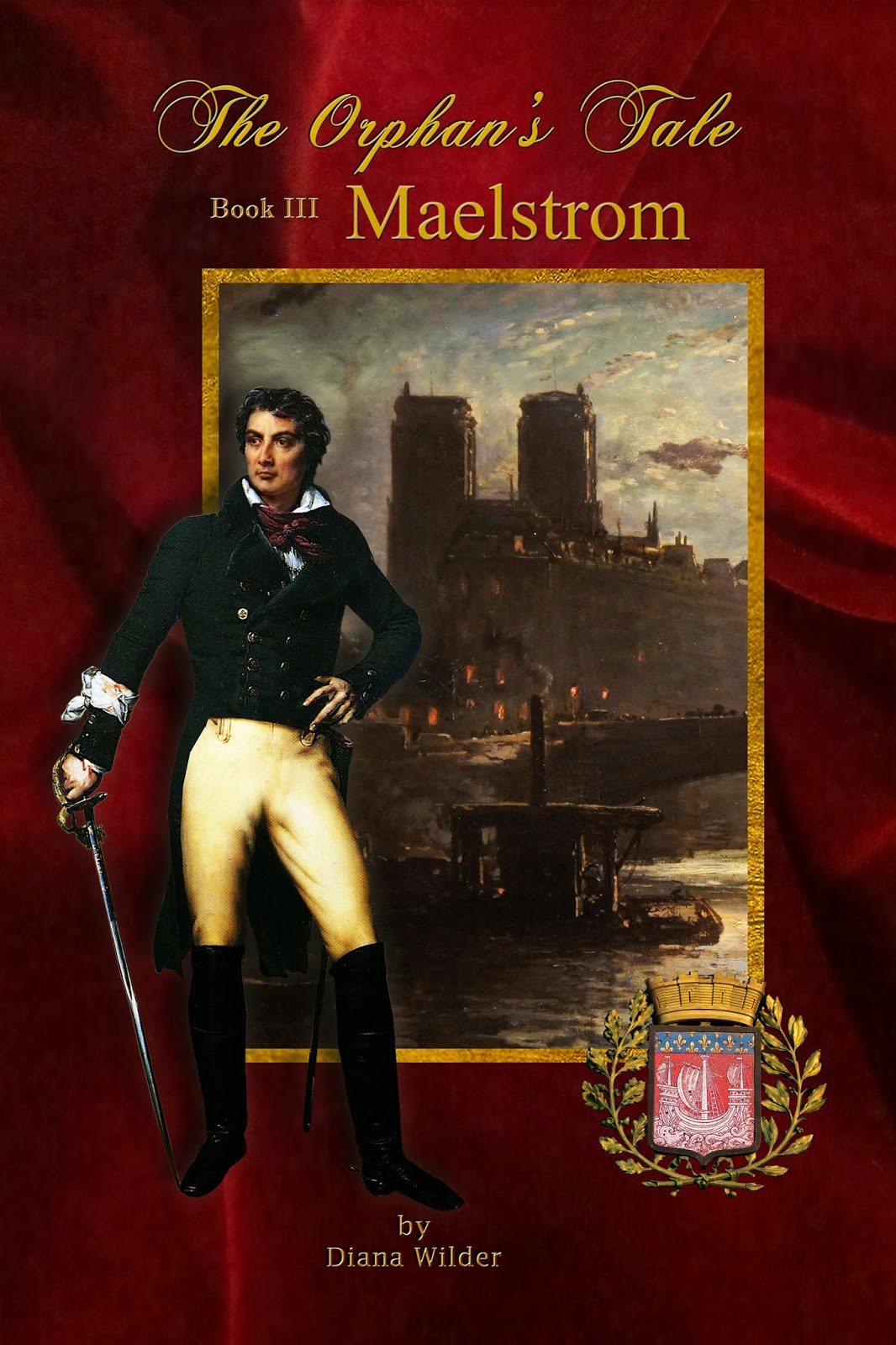
Almost there

They had a point.
What the heck to do?
I sat back and thought…

You can’t get much more monumental than the Cathedral of Notre Dame de Paris on the Île de la Cité.  Placing the figure on the other side of the composition provided balance.  It worked.
Well…  Maybe.


Picture


I sat back with a frown. 
Aside from the fact that my hero appeared to have a light saber embedded in the heel of his right boot (on our left) with the blade beaming downward, it was OK but not really good.  So what to do…?

I eyed the design, reached for my mouse…

Done.
…now all I have to do is finish volumes II and III.

Piece of cake.
…and avoid watching my nearest and dearest as they draw and paint. 


Yes, M. Gustave (Courbet) I know the feeling!
*Sigh*

Celebrations January 16, 2015


Older code

Welcome to the January 16 edition of the Celebrating the Small Things blog hop, started by VikLit and now run by Lexa Cain, our fearless new leader and her two wonderful co-hosts L.G. Keltner @ Writing Off The Edge
Katie @ TheCyborgMom

Do stop by and visit!

Today I am celebrating being a smart-aleck.  Or…  Oh, dear, that’s probably not something I should say.  Let’s just say that I am celebrating being given the opportunity to figuratively nail one of those people who call and try to persuade unknowing folks to part with their money because they have been trapped by a scam. 

Hi, there!  Come closer!

There are far too many of such people in the world.  I, having a strong streak of commonsense and dealing, in my professional life, with cheats and sneaks and liars on a far too common basis, can identify them a mile away.  Usually.  Once I fell for a scam, but I recognized it for what it was and backed out. I think I scared them, rather like the emotion you feel when what you thought was a pretty, longhaired black and white cat turns out to be a skunk.  

Anyhow, today I received a phone call.  The caller ID screen said it was a Skype caller.  I picked up, said hello, and the conversation went from there…

–Hello?  This is Diana Wilder?
I admitted that it was.
–I need to speak to you about your computer—
I gasped.  M-my computer?  You mean like fixing a problem?


(Note:  There is absolutely no reason for anyone but The Geek Squad to phone me about my computer.  Perhaps others, but not me.  This was a known scam that nearly caught me last year until I realized that the people who said they were part of Trend Microsoft – an excellent virus control software – were not, and backed out.  I checked with Trend Micro, who got the giggles when I showed them my screen prints of the ‘problems’ the scammers had pointed out.  In my case, I had encountered a problem and phoned what I thought was the group.  It was a lookalike phone number. I realized my mistake.  Others were not so fortunate.)

But they were game and motivated.  Yes!  If you give us control of your computer we can see problems in your computer—
(Yeah, right.  Uh Huh…  And I have a bridge to sell you.)  –And y-you can fix them? (quavering voice) You could w-walk me through it?  Oh, could you?
–Yes, we do.  So if you—

I gave a cry of dismay.  Oh, if only you had phoned me last week!
–Yes, but we—
I began to sob.  If I had only known about you—  If I had only known you could have helped me.
–But Madam, we—

Alas, too late! (sob)

–No—no— I wept.  It is too late!   My computer blew up and I just…  I just…  No (wept I) it is too late. Too late!  I c-can’t talk any more.  G-good-bye!


Well, I at least thought it was worth celebrating.

So what are you  celebrating today?

http://www.simply-linked.com/listwidget.aspx?l=79cd691b-a101-48a4-8603-4d22bb6626d8

January 2, 2015 – Celebrations


This is the January 2, 2015 installment of the Small Celebrations blog hop founded by Vik Lit, the Hop she started and ran for two years while holding down a job, having a social life, and being an utterly delightful person.  I don’t know how she did it.

Managing a hop takes an awful lot of work and time (I know: I only helped out a very little) and this wonderful get-together has had an effect on me beyond having to try to think up something to post on a Friday.

It made me:

1.  Sit down and take stock of things

2.  Notice things

3.  Do what a friend called ‘Looking For The Blessing’

I would think, It’s Thursday: what will I post for Friday? or else I would think This is so nice!  I’ll talk about it on Friday. 

It was a way to really start noticing the good things.  I can lump along with the worst of them and find things to grouse about, but this hop made me look up.  It has been a blessing.

…so today I’m celebrating her.  That’s a lot to be grateful for.

And we’ll see how things go.

What are you celebrating?


http://www.linkytools.com/basic_linky_include.aspx?id=179014

My Favorite Christmas Memory


This post is part of ‘My Favorite Christmas Memory’ blog hop, organized by Cherdo and JuneBug. 

Look around, read the posts, enjoy the memories.  I suspect there will be a log of laughter, smiles
and, maybe, some misty eyes.
Maybe.

**   **   **

Mine has been a wonderful family.  Loving, certainly, smart-alecky at times (children and parents), enjoying each other.  I never doubted that my parents had my best good at heart, though I wished from time to time that I could adjust their notion of exactly what that entailed.  We enjoyed Christmas, the carols, the decorations, the reason for the season. Mom and Dad deplored the shops that put decorations out before Thanksgiving.  Mom has some pithy things to say now about the pre-Halloween Christmas decorations.  But that’s another story.

We went to Christmas service, whether at midnight (when we were older) or with the laughing, chattering throngs mid-morning.  It was always good.

Santa ate milk and cookies, left a thank-you note in handwriting that was similar to Dad’s.  Once he tracked ashes from the fireplace across the rug. Mom was not happy.

But what about my favorite Christmas memory?  That was a tough one…

And then I was down in my basement fiddling with the laundry and I happened to see a purse on a hanger.


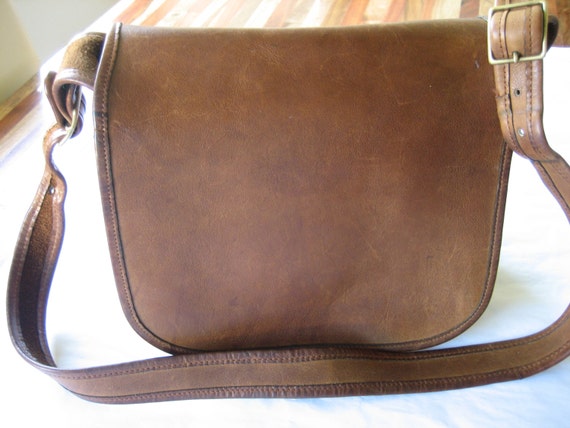
It is a Coach purse, made when the company was still owned by its founders, who went into leather goods by way of baseball gloves.  It has a sturdy shoulder strap, elegant (and sturdy) pure brass buckles and clasps and zippers.  It’s numbered…and it is very old.  I haven’t carried it in years, it needs a good saddle-soaping and some TLC, but I will never give it away.  It is a symbol and an affirmation.

Christmas of 1990 was a difficult one.  My grandmother had died, my sister had moved to Japan and I was paying all the rent.  It was hard going.  My employer had closed its offices in Philadelphia and I had spent some months out of work. I found another job at a pay cut, I had double the expenses, and money was very, very tight.  And I needed a new purse.

When we move through trying times, we tend to fix our attention on things that are not the actual cause of the problem.  My financial difficulties, my family worries (Grandpa, in his late 90’s, was doing poorly after Grandma’s death), my frustration with the new job…  All crystallized into the notion that my purse was worn out (it was) and needed to be replaced, and I simply could not afford to do so.  I could not afford a great many things, and it was hard.

All of this was in my head, you understand.  Stiff upper lip and all that.  I was far more fortunate than many that year of 1990.  Counting my blessings led to an impressive total.  I was properly and appropriately grateful. 

…So, Christmas morning, 1990 found me at my parents’ house with two less people than usual.  My brothers and their families were out of state and would be coming by after Christmas.  My grandmother’s chair was echoingly empty, and my sister, who could always be counted on to liven things up with her humor and knack for finding what made people happy and doing it for them, whether they wanted it or not, was half a globe away.

I gave out my presents, opened the ones given me, chatted with my grandfather, and listened to the music.

…And then Mom handed me a package.  “Here is your last present,” she said.

It was a fair-sized package, wrapped with her usual style.  A box…


I pulled the tape away (my family always says, “For  heaven’s sake, Diana, would you just OPEN the thing???”) revealed the box, and frowned down at it.  Plain brown box.  I lifted the lid…

Sitting in some tissue paper was a rich brown Coach shoulder bag with gleaming brass hardware.  It looked like something you would find in a fine tack room.  A Coach bag.  Big enough to hold all the stuff that I carried with me, redolent with the smell of fine leather.

A Coach bag.

I took it from the box, smoothed the strap with shaking fingers.  And then all the worries, all the self-pity that I had resolutely fought, the stiff upper lip I had shown people, telling them that all was fine with me, they didn’t have to worry – all melted and ran down my face as tears.

Mom was watching me, smiling quietly.  “Do you like it?” she asked.

“It’s…beautiful,” I said.  “Beautiful.”

“I noticed that yours was worn, and your father and I thought we would get you a really good one.”

That Christmas gift was far larger and more complex than a purse that I had secretly yearned after, the lack of which had served as a sort of symbol for the difficulties I was facing at that time.  It served to confirm that I would be cared for, one way or another, whether or not I was in difficulties.  It made me realize that I could trust those who loved me to, well, love me.   And, sometimes, unspoken wishes were granted.

That was twenty-four years ago.  The bag has been well-loved and is now retired.  I think I may take it out, give it a good saddle-soaping, and carry it for a while.  More immediately, I will finish this post (I am writing this on December 21), get in my car, and drive the 250 miles to my mother’s house and do my best to make this Christmas, the third since she was widowed, a warm and happy one for her.

http://www.linkytools.com/basic_linky_include.aspx?id=247230

Thought for the Moment: Discipline


A sometimes unwelcome truth…

I stumbled upon this image while thumbing through various ones trying to find something for a book cover design I was working on.  It made me pause and think.

Slow and steady wins the race…haste makes waste…Measure twice and cut once…

They all refer to our need to refuse instant gratification.  To allow the wine to age, to permit the flowers to grow, to let a relationship deepen.  In my case, referring to my writing, it was very hard not to give in and shoot for that ‘Holiday Release’ when I knew jolly well that the book simply was not ready.

I’m older than I was (ten minutes older right now than when I started jotting my thoughts for this post) and I have learned a thing or two despite my best efforts to the contrary.  Around late September of this year I sat back, looked at my ‘Holiday Release’, lowered my head and advised all who were concerned with the book that it simply was  not ready, and needed to be pushed back at least four months.  Everyone was charming about it, and while I still felt the itch to get that wonderful book cover I’d put together out to be seen, I knew I had done the right thing.

Guess what?  I really had done the right thing.

·     The book cover was scrapped and a far better one designed.

·     With the pressure off, I found that the storyline itself was deepening, growing more complex and tighter, and setting up for a really good (I think) finish in the third volume of the series…

·     …which, incidentally, was being pushed toward finishing by my work on the second volume.


The entire effort is far better than it was in September.  And once again I have to concede that impatience is best restrained and time, in matters of creation, is generally an ally.


Celebrations December 12, 2014


It’s celebrations Friday again, and time for the Celebrate the Small Things blog hop, a brilliant idea conceived by Viklit .  Every Friday we post about the things that have happened that are worth celebrating, however small.  It’s fun, free, and makes  you think – and there are some wonderful bloggers who participate. 

Today I’m kicking back and enjoying the season.

There are all sorts of things about this season that I like:

the end of the ‘blast furnace’ heat that seems to come in July and August.

falling leaves (to really like those, I need to celebrate a willing neighbor child who will rake leaves for me)

And for the rest, some images:

You *are* wearing your slippers and have your (chose 1) cat on your lap, dog at your feet, main squeeze in your arms…

They left out the cognac!

The difference between ‘hot cocoa’ and ‘hot chocolate has been discussed.  I prefer ‘hot chocolate’, but if either is brought by a smiling loved one, then I am happy.  I do, of course, eat the whipped cream (if any) first.  A jigger of cognac helps matters, too…

Ah!  The snowplow is com-  Aaack!  Run!!!  **WHOOSH!**


Ideally, this last is a view out the window.  …although after a nice day of making snow-angels in the snow, watching the dogs romp through the drifts, and seeing that your local municipal snow removal concern has managed to (a) remove the snow without (b) destroying your mail box or (c) blocking your driveway with icebergs that will require dynamite to shift, it is pleasent to bundle up and sit on front step and watch the snow.

…though, for myself, perhaps I will look at this scene out my picture window while toasting my toes by the fire and sipping hot chocolate.


I hope you all have a wonderful weekend!

What are you celebrating?


http://www.linkytools.com/basic_linky_include.aspx?id=179014

IWSG December 3, 2014 – Riding the Riptides


The Insecure Writer’s Support Group

The first Wednesday of the month is the time for the Insecure Writer’s Support Group blog hop. This is the once-a-month blog hop started by Alex J. Cavanaugh .

IWSG = Insecure Writers’ Support Group (click for the link).  We share our insecurities and support each other with empathy, sympathy and  practical suggestions. 

Visit the site – and visit the co-hosts:

Heather Gardner, T. Drecker from Kidbits, Eva E. Solar at Lilicasplace, and Patsy Collins!

Dodging a Curve-ball

I am working on a story set in Paris of 1834.  I mentioned it before, recently.  One of the characters is a seven year old boy named Larouche.  At the start of the story, he has found a home and some employment as a stable boy in an Inn in the Montparnasse area of the city.  He has become friendly with a medical student named LeMat, who encourages Larouche to come to lectures with him.  While  Larouche is waiting outside the Hotel-Dieu, the big hospital in Paris, he witnesses a knifing, and, being street-smart and good-hearted, tries to  help the victim.

It is not going well…

     No one was paying attention to the man on the ground. Larouche ran forward, paused to stare at the spreading stain beneath him.  Blood!  “Shit!” he breathed, dropping to his knees beside the man and putting his whole weight on the man’s arm.  He could see red welling up, below his shoulder, soaking the shirt and spreading on the pavement beneath the wheels of an approaching carriage.
     There was too much blood.  Larouche clawed the cap from his head, clapped it on the wound, and leaned on it again.  It was not enough: the fabric was sodden.
     “Help!” he shouted above the sound of hooves.  “Anyone!  Bring me some cloth!”

It worked fairly well.  …and then my problem stepped in as the street-smart little boy, over his head, gets the help he asked for:

     “Here,” said a voice above him.  “Use this.”
     Larouche took the folded length of cloth, drew back from the wound long enough to set the wad in place, and leaned his full weight on it again.
     He saw a pair of boots before him. 
     “May I assist?”  The quiet voice made Larouche look up in time to see a man nod to one of the bystanders and then drop to his knees beside him.  Intent, dark eyes above a strong nose.  Arched eyebrows and a humorous mouth now pursed thoughtfully as he eyed the unconscious man and then turned to Larouche.  “What is your name, young man?”
     Larouche frowned at the bloody sleeve.  The flow seemed to be lessening under the pressure of the cloth.  He looked up at the man.  “Thank you, Monsieur,” he said.  “I’m Larouche.  Are-are you a surgeon?”
     The man’s mouth eased to a smile.  “I am.  My name is Larrey.  Help should be arriving shortly: I requested it before I joined you.”  He watched for a moment and then sat back on his heels.  “You seem to have an aptitude, M. Larouche.  In fact, you seem to have saved this fellow’s life.  I’ll stay here with you and assist if you feel I am needed.”
     Larouche raised his eyes and found himself relaxing and returning the smile.  “Thank you, Dr. Larrey,” he said.  The man on the pavement moved.  “C-can you see if he will be all right?” 
     “I will show you what to look for, Dr. Larrey replied.
 

That isn’t a bad scene, if I say so myself, though it is very new and needs to be tweaked and repetitious words removed.  It follows nicely with what I knew about the boy, Larouche, after writing about him for several years.   

The issue that arose, that I am writing about, has to do with the new character’s name and history and its effect on the story.

Dominique-Jean, Baron Larrey

Larouche was near a  hospital when an emergency came up.  He needed help, and so I sent a doctor his way.  I knew a little about Dr. Larrey, so I put him in.  And then I learned a whole lot more.

Dominique-Jean Larrey was Napoleon’s Surgeon-General.  He revolutionized battlefield medicine.  His humanitarian work with all wounded earned him unanimous respect.  He is credited with being responsible in part for what ultimately became the Red Cross.  He was fearless, humorous, a father of several children, a devoted husband who died at nearly eighty within two days of his sweetheart, whom he married before he became famous.  He stood off a mob of rioters during the 1830 riots when he was the Surgeon-General of Les Invalides, the big French Veteran’s hospital.  Indefatigable, kind, approachable…  And he was in my story.

Uh…

Dr. Larrey stepped into my story and became a sort of catalyst.  He approved of Larouche, who in his turn admired the students of Medicine.  And who, incidentally, idolized Dr. Larrey.

     LeMat put his glass down.  “Larouche, do you know who it was that assisted you, gave you a tour of the Hotel-Dieu, and liked you enough to invite you to visit him at Les Invalides?”
     “He said his name was Dominique Larrey…”
     LeMat shook his head.  “That is right.  Baron Larrey is a Commander of the Legion of Honor, and he was Bonaparte’s Surgeon-General.  He was wounded at Waterloo.  He is now the Surgeon-General of Les Invalides.  …And I think he is one of the finest men in France.”
     “Oh.”  Larouche digested this and then raised his slightly frowning gaze to LeMat.  “D-do you think he was just being nice?”
     “He was certainly being nice,” said LeMat.  “To himself!  Don’t sell yourself short.  You’re a remarkable boy and you’ll be a good man.  Now excuse me while I drown my envy in another half-glass of wine!  A private session with Baron Larrey!  I could grind my teeth with envy!  Say!  Do you suppose he would let you bring a assistant?”

All well and good, except…

The story was set in my mind, and had been for some time.  And I had thrown myself a curve ball.   The possibility for change and deepening of the story were there and very obvious.  It would involve disturbing those securely written parts.  I am facing what-ifs and let’s-try-this.

Would things change very much?  it could be a lot of work!

Well, yes.  And it could deepen the story.  Frankly, from what I read about Dominique Larrey, the presence of  a true hero like him could only make the story better, if I did my work right.

…and I did say, most recently, that I wanted to be the best writer I could, didn’t I?  Isn’t that what we all want to be.  The best, not necessarily the most rested or leisurely?

Then I guess I’d better get cracking.

http://www.linkytools.com/basic_linky_include.aspx?id=103850

Celebrations, November 7, 2014


Each Friday brings VikLit’s Celebrate the Small Things blog hop, a brilliant idea conceived by Viklit (address below).  We post every Friday, and we tell of the things we are celebrating that week. 

One-Eyed Orlando


With me, it has been a nice week. 

(1)  I have a cat, Orlando, who lost his eye to a mishap that required surgery a little over a week ago.  He is healing well, and the ‘Cone of Annoyance’ comes off tomorrow.   It could have been so much worse.  I had a one-eyed cat who lived to a week shy of his seventeenth birthday.  He coped beautifully with being one-eyed, and Orlando seems to be doing well, also, though he truly detests the collar.  That will be coming off Saturday. 

(2)  I’ll be making pop-overs for breakfast, along with bacon (a reason in itself to celebrate!) and nice, hot tea.  Little things, but enjoyable. 

(here is my recipe:

375 degree oven
muffin pans (deep is nice) greased and sitting in the oven while you mix the batter:

Mix:
1C flour
1 c milk
3 lightly beaten eggs
1/2 tsp salt

Don’t over-beat the batter.  A light hand is best.

Take the hot pan from the oven and quickly fill the wells 2/3 full with batter.  Half full is fine.  Don’t over-fill.  Bake in a hot oven for 30 minutes.  Resist the urge to open the oven door to see if the things are popping.  They tend to be bashful in that regard.

Remove from pans (sometimes they will stick), butter and eat.  Some of my friends prefer to just melt and drink butter.  They have no sense of adventure.   You can serve the pop-overs with jam; I prefer them plain.

Anyone from the UK will probably recognize the basic recipe for Yorkshire Pudding, which I also love, but I don’t spend a lot of time roasting beef.  Hm…  Maybe I will do that this weekend…

(3)

I’ll be going to a gem show this weekend. All sorts of gemstones, precious or semi-precious, lots of things to see, and if you are a people-watcher, it is especially enjoyable.  If you view the video, do turn off the sound.  And please note: just looking is free and fun.

What are you celebrating?


http://www.linkytools.com/basic_linky_include.aspx?id=179014

Iwsg November 5 – Just do it #IWSG


THE INSECURE WRITER’S SUPPORT GROUP

The first Wednesday of the month is the time for the Insecure Writer’s Support Group blog hop. This is the once-a-month blog hop started by Alex J. Cavanaugh .

IWSG = Insecure Writers’ Support Group (click for the link).  We share our insecurities and support each other with empathy, sympathy and  practical suggestions. 

Visit the site – and visit the co-hosts:
LG Keltner, Donna Hole, Lisa Buie-Collard and SL Hennessy

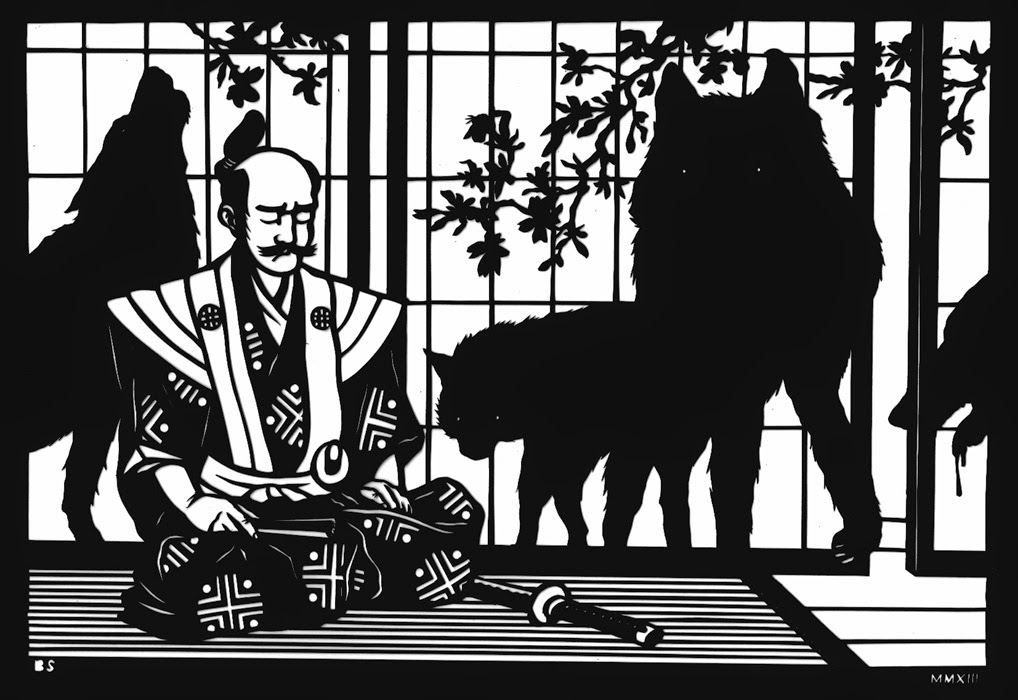
Art work by Ben Southan

Over the past months, I have been wrestling with all sorts of writing-related questions.  For me, at least, they never come one at a time, small and easily dealt with. 

Instead, they cluster around the door of my thoughts like wolves and go rushing in if I let them.  Fighting them off is tiring and usually an exercise in futility.


There are questions regarding my writing in general:

  • Is it good? (Pretty important, actually… )
  • Is it the best I can do? (See above)
  • I’m tired: how can I write anything good when I am exhausted? That requires a little extra thought.


Then come the questions regarding works in particular:

  • Will it sell? (Speaking strictly from the ‘art’ standpoint, this should not be so important a question, but we do tend to equate quality of writing with saleability, whether or not we recall our earlier sneers at various best-selling offerings that appear to have been cranked out on a conveyor belt by someone who, we say, has prostituted his or her talent to profitability)


Questions regarding the flow of my writing and the value of my current WIP:

  • Does this WIP follow well after its predecessor? Does it pick up the threads and weave them convincingly? 
  •  Is it bad? The predecessor was really good, so why does this one stink? (I’m getting ahead of myself, but if I were not – at the time I squall this to the heavens – really tired and off my game, I would admit that a story with three years of effort going into producing it is naturally better, at the moment, than one that is just underway. And I would also acknowledge that, this being a series, I am building on the structure that I hopefully perfected in Volume I and will bring to a thundering, triumphant conclusion in Volume III.)
  • …and why, oh why, is Volume III, nearly completely visualized, so much more seductive than Volume II, which I have had to insert between I and III?

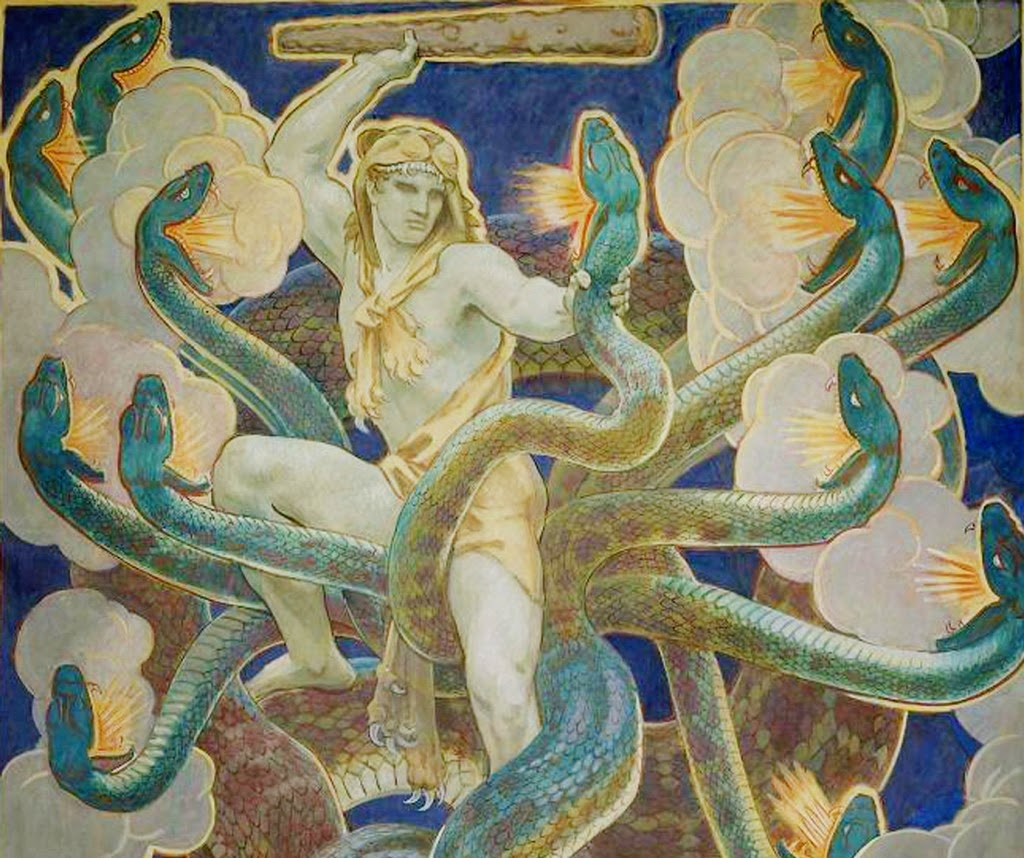
Hydra by John Singer Sargent

How do you cope?
As with all questions posted on this wonderful hop, these are nothing new. 

Like the Hydra in Greek Mythology, though, they  do tend to come back every time you think you have killed it.

It’s a condition peculiar to writers.
(I remember the story of a young actress telling the great Sarah Bernhardt that she never, ever had stage fright.  La Bernhardt said, ‘Well, ma petite, when you become a real actress you will!’)


What is the answer?

Well…
November is NaNoWriMo time. We are supposed to write, write, WRITE!!! for thirty days straight and come up with 50,000 words. I am not participating this year because I have committed to get Volume II (of The Orphan’s Tale) whacked into a shape where I will not die of embarrassment when I send it to my editors at month’s end and then, heaven help them, to anyone who volunteers to be a beta reader. Publication is tentatively slated for Spring 2015. But the concentration on writing itself swung my attention toward the answer to this and just about any angst-related, insecurity-generated question that a writer can face:

Just write. 

  • Write what comes out the ends of my fingers.
  • Close my eyes and write. 
  • Wake up and see what I have written and laugh hysterically and resolve NOT to do this at 11pm on a weeknight. 
  • Realize that I am not carving things into a block of marble. I am putting out words, and words can be tweaked (the part I personally love the most).


But I’ll write. That is what a writer does. 
And just producing the raw material, which I can squint at, groan over and ultimately fix, somehow, for me at least, smooths away the worries. 
When I an clicking into productivity and actually doing what it is that I live to do, I am invincible, at least in my own mind.

Then I’ll go over what I have written. Use my wordsmithing abilities and work on it. I’ll just do it. Mark things up, rewrite, groan.

I’ll be too busy to be insecure.  And I’ll be writing, which is, after all, what I live to do.

http://www.linkytools.com/basic_linky_include.aspx?id=103850

Celebrating… A Wonderful New Book: the Publication of Edith, Fair as a Swan


James Hockey, Author

Books, to me, are a source of joy.  One of the most wonderful emotions that a reader can experience is the feeling that comes when they have in their hands (or on their e-reader) a book by someone whose writing they love, whose tale-telling abilities they respect, and whose prior work sits on their shelves, sources of periodic reading and enjoyment.  And if the new book happens to be the latest in a series, so much the better.

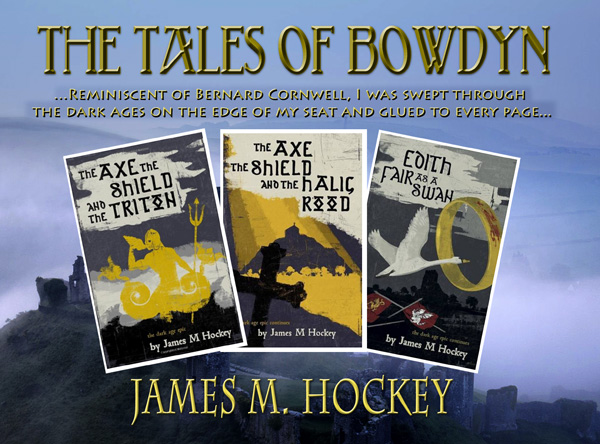
With those pleasures in mind, I am celebrating, today, the release of James M. Hockey’s newest book, Edith, Fair as a Swan.  A masterpiece by a master storyteller, the third in a series of stories that trace the origin of England in a most remarkable way.


But first, Edith:

                           England is Conquered
The King lies dead and mutilated.  Edith, the Queen, and her daughter, Gytha, have fled for their lives just ahead of their pursuers.  They can expect no mercy if they are captured.  By command of the victor, the Queen will be tortured and then burned at the stake and her daughter strangled in the public square.  It is 1066, and the cruel enemy hot on their heels is William the Bastard, Duke of Normandy, whom history now knows as ‘The Conqueror.’ Edith’s path lies from ravaged England to  Kiev, from defeat and despair through peril to hope and healing.

The story itself is gripping, and it is a true story in most of its particulars (for writers of historical fiction do know that sometimes they have to fill in the gaps or, as Hockey says, ‘Connect the dots’)  We know that Edith was here; we know William sought her life…and we know some other important things about her story. But how did they come about?  Characters cross the pages, scoundrels, villains, heroes, knights, peasants – all play their parts in Edith’s story.  And then there is Edith, herself, a queen – and a woman of courage and resolve.

In this sample, Edith and her daughter, accompanied by the narrator, are stopped by men with something less than honor in their hearts.  It is a deadly plight, until Edith steps forward:   

The hill stretched away to the east ahead of us. As we neared the top of the long, steady climb we stopped to catch our breath and rest our legs, for the walk uphill had tired us. It was a bad place to linger and we were foolish, but Asgar, the wisest of us was also the oldest and still weakened by his newly healed wounds. He was thus the most drained by the long climb and needed to rest.

I say foolish because as we topped the hill the road became flat, but also curved around a copse of trees standing out from the thick woods to our left. We were unsighted and could not see down the road ahead. If we could have seen what was around the curve we would have hidden off the road. But we could not see and thus did not hide, and what then happened happened and from that our journey was entirely changed.

As we moved on at a snail’s pace, still gathering our breath, so around the curve came a trio of Norman horsemen. From their arms and the shield of one I took them to be a miles and two serjeants-at-arms. They reined in when they saw us and stood watching us as we limped and shuffled along the road. Then at a word from the leader they spurred towards us.

They halted two horse lengths away. I grasped my quarterstaff, ready to fight, but a growl from Asgar told me to hold.

The horsemen leaned forward on their mounts’ necks to get a better look at us. There was a speedy passing of speech between them in their outlandish tongue. I did not need to understand their meaning. It was all too plain as they gazed steadily at Edith and Gytha.

Edith also understood only too well. To my horror she walked up to the leader and smiled at him, laying her hand on his thigh.

He exchanged a look with his serjeants and laughed then swinging his leg over his horse’s back dropped to the ground, walked around the beast’s head and stood grinning at Edith. The two serjeants, their harness and saddles creaking, also dismounted and stood holding the horses whilst their master sauntered towards the woman and her child. He stopped by Gytha and placed his hand under her chin, lifting her face and smiling down at her. As he put his arm around her shoulder and drew her to him he turned, spoke to the two serjeants and waved towards Asgar and me. They laughed and drew their swords.

Asgar was shuffling forward towards the serjeants, whining, ‘Please sirs, they are my son’s wife and daughter, have pity I beg you,’ edging closer to them all the while.

Edith was the entire mistress of the occasion. She placed her hand on the shoulder of the miles, drawing his attention away from the child. Sinking to her knees in front of him, causing his serjeants to pause, watching and smirking, she lifted the hem of his mail coat with her left hand. He thrust his hips at her and leered a look of pride and scorn.

Everything that followed happened so quickly I barely remember it. As Edith bent forward to perform her shameful task so her mantle caught beneath her knees. With an apologetic smile she reached behind her to free it and tugged at the mantle. Then, faster than I had ever seen a hand move, her right hand shot up under the mail coat with the speed and spite of a striking viper. The miles gave a shriek of pain as the bodkin dagger she had concealed in the waist of her mantle bit deep into his groin. His legs folded and he fell, to lie screaming, legs twitching and trembling, blood pooling under him. She leapt to her feet the dagger poised to strike at the serjeants.


The three novels are tied together by their narrator, a Gleeman, or Storyteller, named Bowdyn, who lives in the 1600’s during a time of upheaval.  He came to the village battered, wounded, a victim of ruffians. Bowdyn is descended from an unbroken line of Gleemen, akin to the Seannachies or the Bards, those who kept the old, true stories, and told them in truth and with skill.

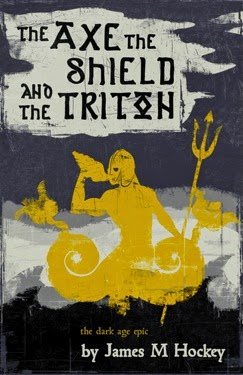
The Axe the Shield and the Triton

It is a time of hardship, upheaval and poverty.  On a fine, misty morning, a young man sees a small, horse-drawn cart making its slow way along the road, apparently without guidance.  What did it contain?  Treasure?  Possibly.  The young man hurries to the cart, looks inside and finds – not gold, but a man. 

This man, battered, robbed, near death, is a treasure, indeed.  The village learns that he is Bowdyn, a gleeman, a storyteller that recounts history.  One evening, the town gathers.  He is healed, it is time for him to tell a story.  Bowdyn begins to speak…

 `This story,’ he said, `is old. It begins in a country east across the sea, nigh on five hundred years after the birth of Our Lord Jesus Christ. To Africa it goes and back, and crossing the sea, ends up close by here. It begins with Creoda’s grim tale’

And then something startling happened. The Gleeman sank back in his chair and by some cunning art of positioning, as he did so his face disappeared into the shadow. From the dark a voice spoke and I, for my part, felt the hair stand up on the back of my neck, for it was not the voice of Bowdyn that we heard, but that of a young boy, younger than I, for his voice had not yet deepened into manhood.

In the voice of the young man, Creoda, Bowdyn tells the tale of a people, adrift in the waning days of the Roman Empire, seeking safety from the Huns, gathering to make their way to a life together.  And in the course of the story, you return to the Gleeman.
I was not sure what to expect with this story. I was so pleased with what I got.  The sheer skill with which Hockey draws you into a story from the Dark Ages of Europe is impressive.  The story itself is excellent.
And here is a link to My Review

In the second book, Bowdyn again tells the tale of Creoda’s people:

                       The Axe, the Shield, and The Halig Rood

Bowdyn the Gleeman holds court before the townsfolk. He speaks again of Creoda and the arrival of his people in Britain. In Creoda’s calm voice, he moves through legend and history and tells of the forging of a strong people that steps into familiar legend.

Because the ford was narrow, Gewis shortened our line and put more of the doughties on the right flank. The century of the Second held our left. The Belgics were so slow in forming that he had the time to do this. And so we waited while our enemy formed up.


…They halted perhaps a man length away. We had brought no drum but showed our discipline with the unity of the beat of our spears and our billhooks against our shields, the measured rat-tat-tat we had used at Moridunum. More than that, our women did something that even now to think of it makes my blood run cold and goose bumps rise on my flesh. It was a trick they said they had learned from Sefu, using their voices and their tongues, which gave out a high-pitched warbling note from one hundred throats. It was a note like that of some great wyrm, of such godlike triumph that I could see the Belgics flinching and their eyes widening with fear. At that point, following Lothar, we took two quick paces forward and our shields clashed as our spears flashed. For a while the lines locked, but we had the advantage: the billhooks arced overhead and their pointed blades sliced into faces, arms and shoulders, drawing attention and guard away from our flashing spears.

Here is a link to The Axe, the Shield and The Halig Rood
And a link to my review

I have spent a longer time with this post than I usually do.  It is a mark of my enjoyment of these stories.  They have substance, wisdom, adventure and truth to them.  They are, truly, historical fiction that keeps its ties to history.

I am pasting links to James Hockey’s website.  There is more there to read and enjoy, including information about the Master Mariner, himself.  Not a dull paragraph there:

http://wyrdsisterspublishing.co.uk/

http://www.linkytools.com/basic_linky_include.aspx?id=179014