A Gallery of My Kindle Book Covers


Since Kindle covers are hard to see at the best of times, I’m setting up a gallery of mine in the order of their appearance in my story line:
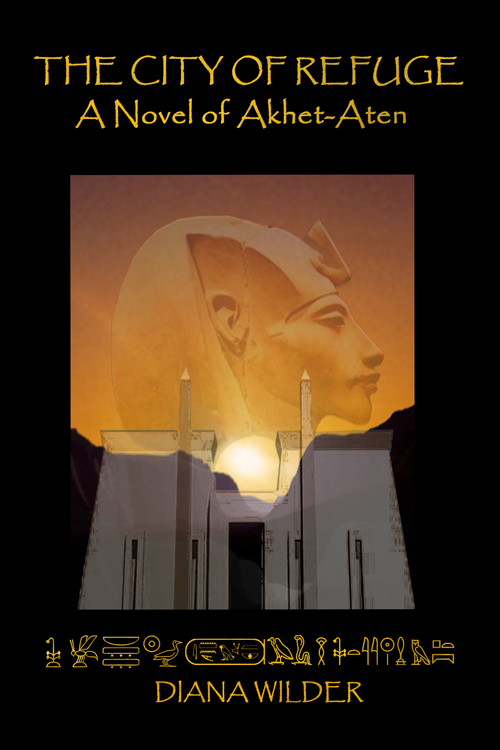
The City of Refuge,  

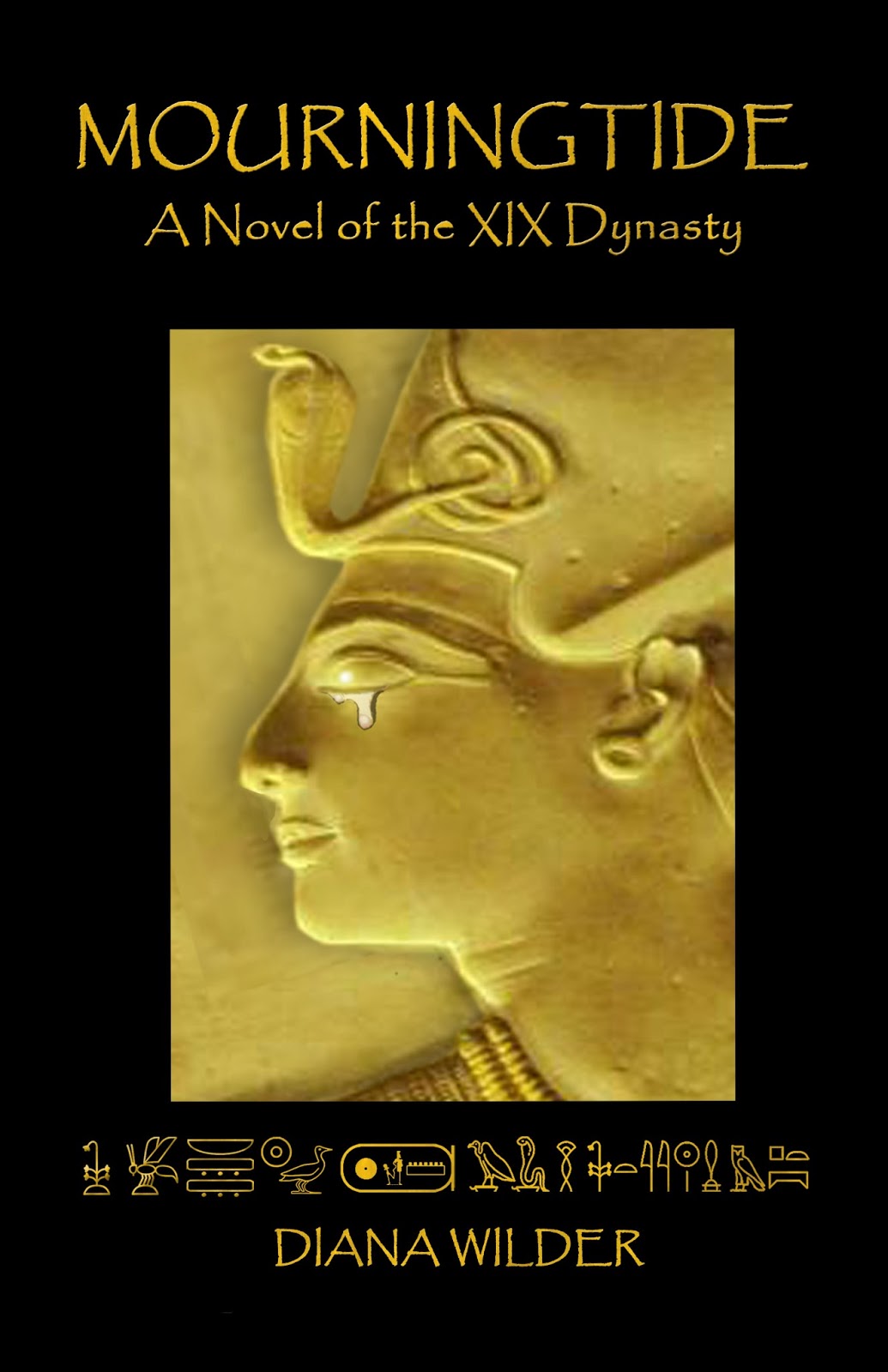
the second uploaded was, actually the third one I wrote but the first in the cycle, chronologically.  I recently located its very first appearance in my imagination when I was going through some old notebooks.  I had a notation about an idea for a story – and it grew into The City of Refuge.  One of the main heroes, Lord Nebamun, is one of my all-time favorite characters to write about, and I was delighted to be working with him again in Mourningtide, which was published June 1, 2013.
Mourningtide
Pharaoh’s Son

I hung on to Pharaoh’s Son, the third in the cycle (soon to be the fourth, with its ‘prequel’ set to come out in about a year) for a long time.  It is a lively story, the one I enjoyed writing most, and I had wanted to consider what to do with it.  I concluded that Kindle and paperback were best for it, as for my others.  I ran into my first experience of the delicacy required to handle historical fiction involving characters that actually lived.  In the case of Pharaoh’s Son, the names are real, the characters are my own – though I arrived at some insights into the character of Ramesses II during the course of writing about him.  I now have a strong disclaimer at the beginning of my historical novels.

A Killing Among the Dead

Chronologically, this is the last in the Egyptian cycle – and the first one I wrote.  Egypt was rocked by a scandal of tomb-robbing and desecration in the Valley of the Kings.  It happened toward the end of the XXth Dynasty (the last of the Ramesside dynasties) when Egypt was going into eclipse.  The scandal was far-reaching and implicated some of the great mortuary temples along the Nile.  The story came to life for me, and its main character, Wenatef, is the closest I have come to a true tragic hero in the Greek sense.

The Safeguard 

I have another Civil War novel with the tentative title of Crowfut Gap underway.  Another, The Bones, has its roots in the Civil War and involves events set in motion then, but it is set in the present.  The Safeguard features two of my ancestors, who appear as Union foragers…

The Orphan’s Tale

 Set in Paris in the autumn of 1834, The Orphan’s Tale is my newest book. 

‘Autumn is beautiful in 1834 Paris. But to Chief Inspector Paul Malet,   raised in a prison by the greatest master criminal in French history  the season’s splendor is overlaid by a sense of gathering danger: something is afoot.

‘When Malet learns that Victoria, England’s young Heiress Apparent, will be traveling to Paris at Christmas for a state visit, all  becomes clear. Her assassination on French soil would shatter the accord between France and England. And war can be a profitable business for those criminals daring enough to mold events to suit their own purposes.’

 This is a trilogy, with the second book set to be released next year.  While the cover for #2 is problematic (do I use the hero’s portrait – in which case I have to find it or the villain’s?  I don’t like the villain.  Decisions, decisions…)  I do have a projected cover for book #3:

NaNoWriMo – Roller Coaster


I was reading some emails and came across one from Flylady (an excellent, motivating group for those who need to organize and get their houses in order). She was talking about something called NaNoWriMo, a group endeavor (I can’t call it a competition, exactly, because you’re competing with yourself) that takes place in November. From November 1 through November 30 the participants buckle down and write a 50,000 word novel.
After looking into it further, I signed up for NaNoWriMo – National Novel Writing Month just for fun.  The premise was interesting:  the novel didn’t have to be finished or polished, it just had to be fiction and have at least 50,000 words.  (50,000 words equals about 150 pages in a standard, smaller paperback.)
Considering the length of fiction that I’ve written (admittedly not within thirty days) I thought it would be easy.
Rules were simple: you could not start writing your novel until November 1.  You could:
jot down character information
jot down plot thoughts
do research and make notes
do a lot of thinking
The actual composition started only on November 1.
I’d had an idea for a story arising out of my Egyptian cycle.  It involved an uprising in Nubia and the way several people handled the matter.  I had an array of interesting characters:
Maya, a master artist
His young apprentice
Merneptah, an Egyptian prince, in Nubia under training by the Crown Prince
some other folks, bad and good
I had my research set out, character notes, lots of thinking…  But I didn’t write it.  It didn’t seem right.
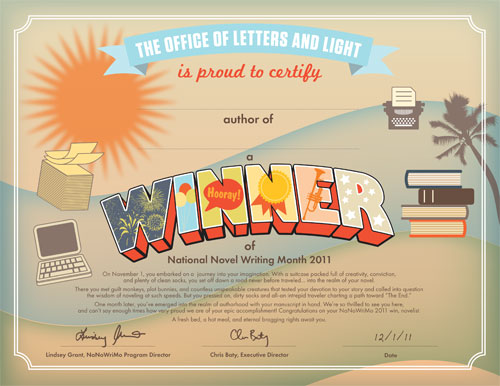
I did no writing on November 1, or not much.  I was visiting family, and the great snow catastrophe of 2011 slammed my area.  No power for a week, Not a lot of writing done.   The folks at the Office of Letters and Light (which holds NaNoWriMo) have a handy little calendar that shows a writer’s output during that month: 
The red spaces show no writing.  Orange is very low.  Green is cooking right along.  Yellow is so-so.
I scrapped the Nubian story and went with one that popped, like Athena, fully armed into my head.  It has the working title of Mourningtide.  It flowed nicely, though I really had to push to get any momentum after the disruption of the blizzard and the forest of broken trees.
But – I finished!  
It’s a wonderful thing to work under pressure and discover that if you don’t have the opportunity to laze around and write a bit here and a bit there you can nevertheless produce the bones of a very good story within thirty days.
But Mourningtide is another post…

The Author’s Pet


I read a book a while back that had me puzzled.  It was well crafted, colorful, moved at a good pace, but there was something skewed…  I put my finger on it when I reread the description of the hero.  He was just fabulous.  His name consisted of four luscious, historical names strung together.  He was a duke, the king’s best friend.  But the thing that brought everything into focus was his physical description, right down to his blond sideburns, in lingering detail.  Gosh, he was handsome, with that bloom of golden hairs that bordered those sideburns. 

Yep,  I thought.  An author’s pet.

You run into them fairly often in detective series.  The characters who set foot in a messy situation and you just know that things will be straightened out at once.  They’re always fabulously handsome or beautiful, unbelievably accomplished.

A recent series of mysteries had as its main sleuth a woman who was, among other things, an Olympic Equestrian, a (top winning) competitive ballroom dancer in addition to being young, beautiful, and a top-ranking forensic anthropologist.  I wasn’t sure when she slept.  Another story featured a female sleuth, fresh out of college, who happened to be visiting the UK when a bad situation came up.  She was summoned to Scotland Yard and had an interview with one of the top-ranking people there.

“I want you to assist us with this,” he says to her.  “We need your trained mind.”

Trained mind?  I thought.  In a kid that age?  Well, to be fair, it was the writer’s first book, and from what I could see he/she was trading on the fact that his/her mother was a best-selling author.  And the writer had quite an author’s pet.

Writers do have them.  I have a character who could be one.  I love writing about him.  He’s a lot of fun, lends a lot of color to his stories (I’m working on a sequel).  He’s my own invention – except for his name, which is historical.  Who is he?  An Egyptian crown prince.  Named for the eldest son of Ramesses II, but I went off on a tangent with his story.

I don’t think he is quite the ‘ta-DA!’ sort.  I worked very hard to keep him from being one.  He has his own reality.

I think what lies at the heart of ‘Authors’ Pets’ is the author imposing his or her own desires on the character without taking into account the personality of the character as developed through the author’s writing.  The moment you put words on paper they become real.  If you have something happen in your story, it is fact.  So, if in the course of a story you have a character that behaves in a certain way and has (at least in your mind) certain characteristics, then everything he does must be in conformity with his reality as you have given it.

My Crown Prince character (his name is ‘Hori’) started out as a villain of sorts.  About twenty years ago I started writing various vignettes based on books I was working on at the time.  This was before I had a computer and electronic storage ability.  These vignettes (I called them ‘fragments’ or ‘blips’) occurred to me and I typed them out.  I had several stories based on the character of Khaemwaset, the fourth son of Ramesses and, at one point, his crown prince.  We know a fair amount about him.  In the course of weaving stories around him, I jotted an account of a jubilee festival that he hosted for his father when he was High Priest at Memphis.

His older brother, Amunhorkhepechef, the Crown Prince, makes an appearance and says something nasty. 

The jottings sit in a three-ring binder, but Pharaoh’s Son owes some of its substance to them.  In that novel a colossal statue falls in the middle of a festival throng, causing havoc.  Khaemwaset (from now on ‘Khay’) looks into matters; it happened in his own backyard, since he is the Vizier, or Prime Minister, of Northern Egypt, and the High Priest of the temple where it occurred.  He asks for assistance from Pharaoh, who sends his Crown Prince, Amunhorkhepechef (from now on ‘Hori’) to oversee things with his brother.

Hori was not a happy fellow.  He was arrogant, had a sharp tongue, and did not suffer fools gladly.  He strode into the story…

When you write about someone, you work both forward (in time) and backward (in history).  Going forward the character might do something…but that may have arisen out of something that happened before.  So it was with Hori.  His history developed – soldier who is happiest overseeing the military concerns of the realm, called back to court against his wishes and angry and unhappy.  So why did Khay ask for him?  Hm…  Because they had renewed their friendship and Khay knew that Hori was unhappy.

The story moved from there.  A character that was supposed to be, if not a villain, certainly an unpleasant sort of person with humorous involvement, became one of the two heroes of the story.  I guess I let him grow up.

I’ve read books where the characters appear to have been stamped out and maneuvered like puppets.  I’ve read scenes that, given the characters’ personalities and histories as developed in the course of the story, should never have happened.  Well…

Georgette Heyer, in Sylvester, or The Wicked Uncle, expresses things nicely:

These naïve words struck Phoebe dumb for several moments.  It had not previously occurred to her that Ianthe might identify herself with The Lost Heir‘s golden-haired sister.  Having very little interest in mere heroes and heroines she had done no more than depict two staggeringly beautiful puppets, endow them with every known virtue, and cast them into a series of hair-raising adventures from which, she privately considered, it was extremely improbable they would ever have extricated themselves.

It’s all part of letting go, letting the thing you love – in this case the story and the character – be true to itself.
Writing Tools


Look familiar?

I like tools.  Any type of tools.  I can easily spend a month’s salary in a hardware store.  Or an office supply store.  Pens, pencils, screwdrivers, notebooks of all sizes, post-it notes, three-ring binders – I love them all.

But there are different types of tools, and each trade has its own.  For a writer the most important, I would imagine, are the writer’s imagination followed by his or her command of words, then grammar…  You get my drift.  I could get very philosophical and talk about writers with fabulous imaginations, but without the ability to write.  I’d love to cite Edgar Rice Burroughs, for example – except that I enjoy his writing.  But having read this passage, I can only chuckle:

“Your time shall come, then, I-Gos”, Gahan assured the other,
“and if you have any party that thinks as you do, prepare them
for the eventuality that will succeed O-Tar’s presumptuous attempt
to wed the daughter of the Warlord.  Where shall I see you again,
and when?  I go now to speak with Tara, Princess of Helium.”
    (From The Chessmen of Mars (c) 1922 by Edgar Rice Burroughs)
To be a writer, you need to have a writer’s abilities, so we can set that to one side.  But what of the tools that help the writer to write?
Something to write with, I’d imagine.  Nowadays if you don’t have a good word processing system, you’re in trouble.  I remember buying my first computer, put out by Epson.  I don’t know what its memory capacity was. I do know that if I wanted to use my word processing system (a very, very distant version of Word Perfect called ‘Professional Word’, as I recall) I had to fire up my computer (inserting the start-up disk, which was the size of a 45 record), then insert my program disk in the lower drive.  Then I could start writing.
I was resistant, initially.  What’s wrong with typing things?  I type well and quickly (110 wpm at last testing).  I was converted the first time I decided to change a character’s name and used Global Search to do so.  I never looked back.
That computer performed valiantly but was replaced in due time with one that had maybe one gigabyte of memory.  It took the diskettes that were a lot smaller and sturdier than the originals.  I converted most of them as quickly as I could.
Some place to store what you’ve written – like a diskette.  Hard copies are nice enough – except that you end up having to retype them which I now do not feel is quite so easy as I did.  Writers are always fiddling with things.  I’d make changes and save the changes – on a new diskette.  If you check out the photo, you’ll see that I have lots and lots of those diskettes – and the only machine I have that can read them is a Dell desktop that is getting old and crotchety.  (I’m writing this on an ACER Aspire that has a 300 gb hard drive, takes flash drives and CDS, and works beautifully.  But it doesn’t read my old diskettes.
Diskettes are not the only storage venues.  If you look at the photo, you’ll see a slice of my storage means: three-ring binders (the big, fat one sitting atop the bottom manuscript contains jottings on four different stories, none of which were ever saved to electronic media.  Salvageable?  Maybe.  I’m looking through them.
Then there are the notebooks.  I have lots of them.  I keep one in my purse and if something occurs to me, I jot it down.  How many times have I had a great idea for tweaking a scene, thought “Oh, I’ll remember it!” and then discovered that I couldn’t.  I came up with quite a system for jotting down, transcribing, and then marking what I transcribed.  But I hung on to the notebooks.  Lately, I was interested to see the absolute first notation on one of my books, The City of Refuge.  I had noted an idea for the story – and it was fairly well-developed – around 1984.  It sat in limbo for a time, then came into full blossom around 1994.
Pens.  Can you have enough?  I used to say that something like White-Out was a must. I don’t think so any more.
Most recently, I bought a stack of steno pads and four college-ruled 8 1/2 x 11  spiral bound notebooks.  I might need them.
In fact, I think I need to go through what I have and figure out what I need.
…and convert those old diskettes to CDS before I lose something crucial.