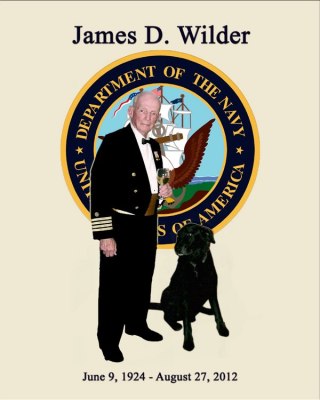
My mother phoned me, disgusted. She had been talking with someone and my late father’s name came up. Dad was a career Naval officer. He was in the JAG (‘Judge Advocate General’) corps and retired as a judge running one of the Navy’s districts. He went into the civilian practice of law after he retired, and rose in that arena.
“So,” the man said, “He was just an attorney.”
Mom set him straight. Dad was a combat veteran. Not that he bragged about it. There was a job to do and he did it, like many other veterans the world over.
Dad was an amazing man, and I could not have asked for a better father. But when he retired, Dad decided to sit down and write his memoirs. It was a double-spaced typewritten tome called Now I Come To Think Of It. It contained some surprises.
Dad entered the Navy in 1942 as they were rolling out the top secret radio program. He became, essentially, an Air Traffic Controller “MIGs coming in at nine o’clock high!”. He saw fighting in the Pacific Theater of the war, participating in the battle of Midway and the big fight involving supply ships. He was on a Destroyer, his ship was hit by Kamikaze fighters and he, himself, was hurled to the deck by a wad of shrapnel.
He didn’t talk about it much. Not that it haunted or horrified him, but because like a lot of WWII veterans, Dad did what he had to and came back to live the life of a citizen. My first inkling was that memoir. (I promised Dad, as he was dying, that I would type it up and publish it for him. I’m working on that.)
Dad had ideas of duty and honor and I will never forget what he said once about something I witnessed.
I served as a docent for the Civil War Library and Museum in Philadelphia in the late ‘nineties. I was interested, and I was able to do some research for a book I wrote set in the Georgia Theater. (‘The Safeguard’) I came back from a day there and told Dad what had happened. It was told me by another docent.
“Hah! You should have seen the idiot! He came in all puffed up about his great-great grandfather who served in the Union navy! He had the name of the ship, and he was going on about how great his grandfather was!”
I asked what he had found.
“The ship was docked in Philadelphia through the whole war. The man spent the entire American Civil War shoreside. I told him so!”
I thought that was bad form, and I expressed that, Then I told Dad. His reply was characteristic.
“Why did he say that? The man went where he was told to go and did what he was ordered. So he didn’t go into battle – was that his fault? He served where he was needed, and the fact that he was not discharged dishonorably says a lot. He had the right to wear the campaign ribbon. He was a war veteran, something to be proud of.”
He fulminated for a moment. “What sort of fool was that fellow? I imagine he never served!”
No, probably not.
I found myself remembering Milton’s poem:
WHEN I consider how my light is spent
E’re half my days, in this dark world and wide,
And that one Talent which is death to hide,
Lodg’d with me useless, though my Soul more bent
To serve therewith my Maker, and present
My true account, least he returning chide,
Doth God exact day-labour, light deny’d,
I fondly ask; But patience to prevent
That murmur, soon replies, God doth not need
Either man’s work or his own gifts, who best
Bear his milde yoke, they serve him best, his State
Is Kingly. Thousands at his bidding speed
And post o’re Land and Ocean without rest:
They also serve who only stand and waite.
On Memorial day we honor those who served, men and women. Some gave their lives, some gave their hearts. All deserve our respect, admiration and gratitude.
Thanks, Dad (and Uncle Dick).


 dianawilderjottings