NaNoWriMo 2012


NaNoWriMo is taking place right now.  I’m participating. 

 
And I am an idiot:  I have a whole lot going on. 
 
I’m polishing Mourningtide, I am doing a once-over on a (Civil War) novel that will be on KDP Select as a freebie later this month, and I signed up to write a minimum of 1700 words a day to produce 50,000 words in 30 days.  (1700 words works out to about six printed pages).  It’s do-able if you work steadily, but in this case I am also working at a day job. 
 
I’m giving it my best shot, and I think I can do it, but if one thing or another has to go Kadesh will be the casualty.
 
Which reminds me: Kadesh is a working title.  Fans of Egyptian history will know that it was the battle that Ramesses II touted as his greatest triumph.  The Hittites, whom he fought, were equally emphatic about their ‘successs’.  My read is that two superpowers met and mauled each other, though Ramesses probably had the shock of his life in the process.  (There’s a strong indication that his father, Seti I, died of a heart condition, and I’ve used that supposition in my own ‘family history’ to account for some deaths.  It would appear, though, based on what happened at Kadesh, that Ramesses did not have a weak heart.  He survived the shock of seeing the Hittite army breaking through the palisades of his camp.)
 
I’m telling this story from the point of view of lesser characters.  Hori (Amunhorkhepechef) as a nineteen-year-old Crown Prince is given nominal command of one of the armies.  Others of his brothers (Ramses and Montuhirkhopechef, who died prior to the opening of Pharaoh’s Son) are in high command in other armies.  Khaemwaset (‘Khay’ in Pharaoh’s son, and the most well known,  historically, of Ramesses’ sons) is with his father, being all of fifteen years old.
 
It’s important to understand strategy, but this event shaped Ramesses’ reign and world history.  It turned him from being a ‘warrior king’ (though he tried) to being a true statesman, where his greatness lay.
 
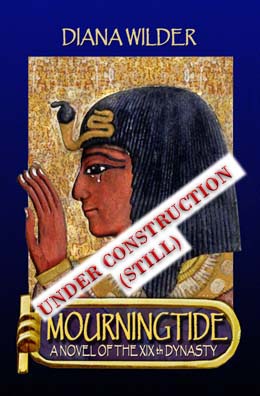
So I’m writing Kadesh.  I truly must redo the temporary cover, but it’s a decent placeholder for now.
 
My website has sample chapters that I’ve whacked out.  Hori seems to be taking center stage just at the moment.  (I know him rather well).  Check them out here:


Hurry up!


Ever had a itch between your shoulder-blades? The sort that is driving you nearly mad, but which you know can’t be scratched because the act of scratching will only make matters worse and you will end up itching for the rest of your life?
 
Or, perhaps, wanted to treat yourself to some forbidden dainty – and known – just knownthat you won’t be able to stop eating?
 
That’s a little like my current position with Mourningtide.  The story is nearly finished, it’s almost ready to go – but it just is not quite ready.  There are things to do, things that mustbe done if I don’t want to release a book that is not my best effort.
 
Well, as with any itch, if you ignore it, it will go away.  The story will be finished, people will like it, I’ll like putting it out to be read, the cover will look good and I’ll smile.  It’s happened before, but I’m one of those people who likes to show folks their gifts before the proper date. 

In the mean time, I can laugh at myself, plug in my laptop, fire up Scrivener (did I mention that I love it?), and make corrections, and add scenes that occur to me.

And I can commune with my editor.
 
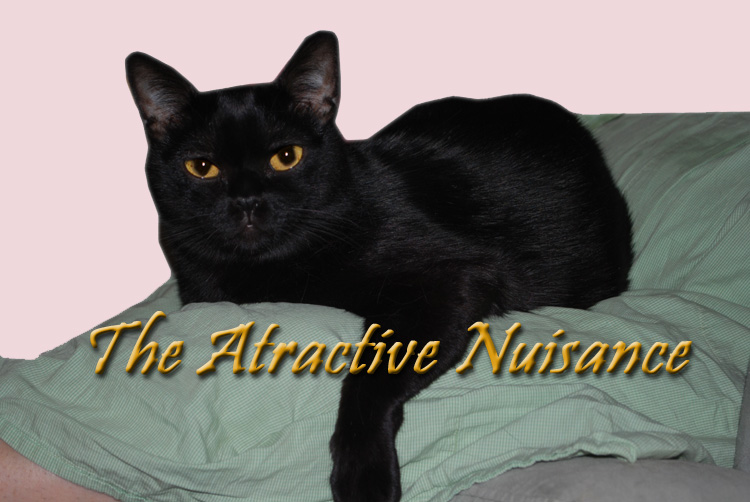
Have I mentioned my editor?  Everyone needs one, especially one like her.  Even if she is a pain in the neck, she’s about as charming as they come.  …and here she is!
 
I call her my ‘attractive nuisance’.  (Interesting legal concept: something that can cause a lot of annoyance, rage, damage, you name it, while being simply irresistible.)  Notice the position of her posterior?  Yes, on the pile of manuscript.  That is her clever way of keeping me from hurrying too much.

Sydney’s Song – Now available!


I am delighted to announce the debut of a wonderful book that will have you smiling, weeping – and then smiling widely through your tears. 


The book?

   
Sydney’s Song by Ia Uaro

It is wonderfully written, will hold your interest – a true joy to read.


Watch the trailer, below, enjoy the images and the story – and then consider reading it.  You won’t regret it.

…and while you’re at it, visit her wonderful website at

http://www.sydneyssong.net/

And her Author’s page (this one is Amazon’s):

http://www.amazon.com/Ia-Uaro/e/B009ELCYKU/ref=sr_ntt_srch_lnk_1?qid=1348706542&sr=8-1

Polishing a Draft


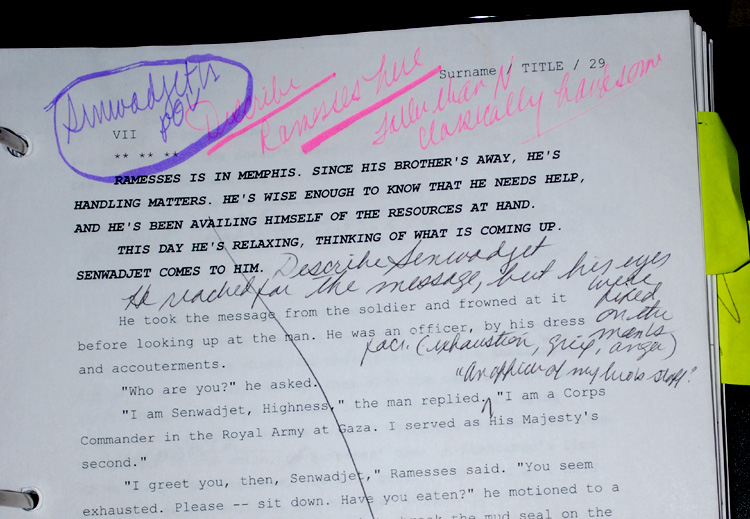
So, you have finished your story.  It is complete.  The tale has been told and was done rather well, if you say so yourself.  You ‘compile’ the manuscript (for, after all, you are using Scrivener) and you then print the thing.  The result is a two-inch thick pile of bright white paper with printing on it.  The manuscript.  Finished!  Hurrah!


Wordsmithing as I do it.  The logic is hidden by the lack of prettiness…
The delight lasts only as long as it takes you to flip to a random page, and read…
“Did I say that?  What a passive construction!  What was I thinking?
You seize a pencil/pen/whatever, circle the offending phrase, write in what you should have written if you had not been under-caffeinated, and then sit back, scowling, and look at the rest of the manuscript.
…And now you are in ‘polish’ mode.
It’s been a while since I did this, and I had forgotten how enjoyable it is.   Wordsmithing, pure and simple, is a pleasure in itself.  It is, however, annoying when you have been envisioning a finished manuscript and, looking down at it, pen in hand, realized that the thing is anything but.
So you sigh, assemble the things you will need, and go to it.
What do you need?

Just the basics, ma’am, but in all available colors…
Pens.  Lots of them.  They tend to grow legs and walk.  I have one that was made by an artisan using chestnut wood salvaged from an colonial-era house on the seacoast.  Chestnut isn’t seen any more since the blight destroyed most of the chestnut trees.  That’s a pity because the wood is very rot-resistant and has a wonderful color.  Then there are the gel pens that are a delight to write with and have thick, visible ink.  The problem is that the ink tends to sink into paper and go through the other side.  Not pretty. 

Authentic Marvin
the Martian Pen

I also have a special Marvin the Martian pen I bought years ago at a Warner Brothers store and carried to various meetings over the years.
You need highlighters in various colors.  Why?  Well, what if you highlight something in pink and then think of something else that needs to be done with the highlighted passage, but is different?  Pink won’t work, it’ll be confusing.  Besides, hot pink is something of which I can only stand so much.  Purple, I think.  Or maybe blue…
Post-it notes, or reasonable facsimiles thereof, are very useful for marking places (‘Oh – that’s right!  I edited to here!’), marking thoughts (make sure you don’t get cheap imitations because they’ll fall off, and you will face your greatest fear: that your inspired edit will be lost forever and your powerful intellect, having decayed rather badly, will not be able to retrieve the perfect word in the perfect location.)
But you go cooking along, making corrections – until it suddenly occurs to you that the reason that the beginning of the novel seems to plod just a wee bit, with lots of information being made available rather quickly is that you have been going about it the wrong way, and it would work out better if you start in with the third chapter, scrap the first and second chapters, and then adjust as necessary.  You greet this revelation with a cry torn from your very entrails as you realize that the entire beginning of the @#$%! story has to be reworked.

Is it a disaster if it makes the whole story better but drives the writer mad?
You brew another cup of tea (did you read my post about tea?), get out the materials, and go to work, muttering under your breath even as you see that it truly will do better.  You bid farewell to the end of year release, the editor’s feedback, the new story that has been nudging at your elbow and presenting lusciously tempting scenes…  You buckle down –

Will pester for catnip…
And pray that your work is not interrupted by the dreaded ‘attractive nuisance’ that likes to grab your hand as you mouse…

Dad


I’m not sure when I realized how lucky I was.  I think maybe I just assumed that everyone had parents like mine – stern when they had to be, always kind, straight-shooters  when it came to right and wrong, but who liked to laugh.  Maybe it was when I entered my early teens and saw other parents that were not like mine, that got me started thinking.

Dad was in the United States Navy.  He entered the (very new) Radar program in World War II and was a radar officer in the Pacific theater of that war.  He left the Navy after the war and attended law school on the GI Bill before he was called up for the Korean War in 1950 (right after marrying my mother).  He went back to war and stayed in the Navy for nearly thirty years, retiring as a Captain and the Judge Advocate General of the Fourth Naval District. 

Dad went into civilian law practice and finally retired for good around 1996.

We lived all over the place, from Newport (RI) to Aiea Heights (Hawaii) and a few places in between.  We were always piling into the car and going for drives, to museums (‘You have to understand, Diana – admission on Sunday mornings was generally free…)

Health care is free to Military dependants – or it was when I was growing up – but while Mom and Dad had their children to the the local military dispensary for their inoculations, the first thing they did when they went to a new location was to look up the finest pediatrician in the area and take us kids there.

Children grow up, and so did I.  My Dad (and Mom) somehow made the cross-over from Respected Parent to Greatly Enjoyed Friend. 

Dad lived to be 88 years old and he died this past Monday.  His family was close by.  I will miss him.


On hold…


So… Manuscript is at nearly 90K words. Filling in and expanding where necessary will bring it in target. I’m sold on the story, like the characterization – In other words, I seem(ed) to be clicking along on all cylinders, allowing for flexibility in polishing.

But still, while the projected release date of November 1 is gone by the way (I decided to retain a cover artist whose credentials and work I really love, and to hire a line editor for this one, so that pushes things back…) I thought a 2012 release was not out of the question. Just in time for Christmas.

And the story was heartwarming (I thought, at least).

But then…

I was pushing on with the initial polished (draft=> first finished draft=> polished draft=> final MS => OMIGOSH ICAN’TBELIEVE IFOULEDITUP SOBADLY!!!

=> final polished manuscript [friends and relatives having tied the author to a chair and taken matters into their own hands. “It’s FINISHED, Diana! You CAN’T edit any more!!!”] )


I was, as I said, pushing things along, but I wasn’t happy with the setting of the first chapter. Father leaving for a protracted journey, leaving eldest son in charge. Eldest son voices dissatisfaction with this state of affairs. Father gives good speech. and leaves.

The story is about the eldest son’s decision to get out of there and leave his brother to run the family business. He gets killed, and his family and loved ones pick up the pieces… It actually is a bright story.

I was scowling at the first chapter, which seemed lifeless –  I sat back with a mingled groan and wail.

Start the story with the son out of the country progressing toward his death, which happens within the first chapter – second at most. Backstory can be put in there easily. THEN switch back to the threads of the younger son and the father.

Groan! A rewrite. Admittedly, it doesn’t alter the true meat of the story, which kicks in around chapter three, but still…

Well… I could still retain the cover artist, I suppose…

*sigh* And I said I LIKE writing…

Historical Romance


I have been giving a lot of thought lately to what some people scornfully call ‘Bodice Rippers’.  You know the sort of story I mean.  Sometimes they are called ‘Historical Fiction’, to the dismay of people like me who actually write historical fiction.     
I do not like to use the term ‘bodice ripper’ because while there are two types of stories that fit that slot, the word for, or title of, the second type of ‘bodice ripper’ does not exist, and the first term is a little too sexual.  I will be using the term ‘Historical Romance’ for both in this post because I think it fits the guidelines given by Webster Dictionary for the noun ‘Romance’: 
prose narrative treating imaginary characters involved in events remote in time or place and usually heroic, adventurous, or mysterious    


The books are always set against a backdrop of a period of history.  The period is not important; it fluctuates from year to year depending on what is in fashion.  Medieval history is a perennial favorite, though the Scottish Wars for Independence are in the ascendant.  Dark ages Europe is also gaining popularity.  Another dependable standby is the ‘Napoleonic era’ – from about 1790 through about 1816.  The American Civil War also makes an appearance.


The background research varies from nearly nonexistent to substantial.  And there may be a story line found inside the pages.  (In my opinion) what makes these stories ‘bodice rippers’ – or, rather, Historical Romances – is their focus, which is to titillate, to satisfy a hunger or a fancy, with the story line taking second place to that purpose.  To avoid a trip into semantics, here is Webster’s list of synonyms: 
charge, electrify, excite, exhilarate, galvanize, intoxicate, pump up, thrill, turn on
These stories’ descriptions are fairly similar.  The protagonists/antagonists are set forth and the basis for the story.  The dangers that lie along the path are hinted at.  You can choose to read or to pass:


The (band of heroes)  have itchy feet. Battle-hungry and tired of keeping the homestead fires burning, they are restless for action. And… action is what they get. When their homestead is attacked … the (band of heroes) promise bloody revenge. … Packed with epic adventure and bloody action…

and:


“A rollicking, dangerous and often very gory gallop through the largest land empire the world has ever known.”

Contrast that with:


For Gunnar, vengeance is all that matters. He seeks the ultimate price from his enemy’s beautiful young daughter, claiming Raina as his hostage. But the proud beauty defies him at every turn, tempting him like no other. Setting out to break Raina’s glorious spirit, Gunnar instead finds himself bewitched by her goodness, her strength. Can he seize the justice he is due without losing Raina forever. 
 It is obvious that they are different sides of the same coin.

The covers of Historical Romances tend to hint at the items of attraction that will be delivered by the book:


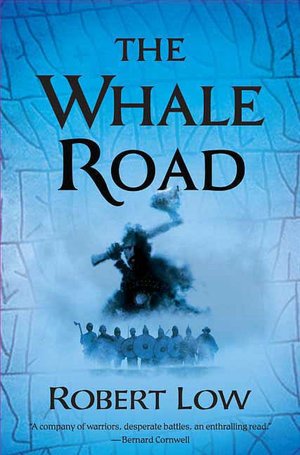
There is no black and white in this life.  Some of the Historical Romances   of either type are close to excellent fiction – The ones whose covers I have shown have been written by people described as ‘award-winning authors’ and have received good reviews from a good many people averaging 4.5 stars.  I remember one series of romances, set in the time of the conflict between Stephen and Matilda (England) that had wonderful plot and excellent research.  The stories did involve men and women and their relationships, but they were secondary to the plot. 
Someone, speaking against his/her notion of ‘Historical ‘Romance’ of one sort expressed it in an interesting fashion.  This is a paraphrase:  


There is the man who loves his woman and longs to see her once more before he is killed on the field of battle.  Or there is the fighter who lives for war, whose love is battle and whose mistress is his sword, who satisfies his physical urges by patronizing the whores that follow in the tail of every army. 

I think both types share a distortion of history or, more accurately, the ‘historical norm’ of the period that they concern.  Human nature and inclination has not changed appreciably over the millennia.  Most people lived at home and interacted with their families.  They had their tiresome tasks, their moments of delight, their festivals and their tragedies.  Not everyone in the Northlands  went i-Viking.  They knew about sex – that is why we are here today – and loving relationships existed as did attachments based solely on monetary payment for physical need.  A love affair between two people or a rousing fight scene does not necessarily make a novel an ‘Historical Romance’.  It all depends on the purpose and focus of the book.

First Final Draft Finished….


    I  have just (this morning) finished the First Final Draft of my latest, Mourningtide.  That means I’ve filled in holes, the narrative flows, I’ve found most basic mistakes, and I’m satisfied with it as it stands at this moment.
    It also means that I’ll be doing a beta read (and perhaps inflicting it on associates to do the same) and will be tweaking and deepening and possibly, coming up with another title.
    My earlier works were over ten years in the making.  That is to say, I finished them, copyrighted them, sent them around and then went into a dry spell.  During the time I tried to decide what to do with them I picked at them, re-edited them, deepened them…  They are  in good shape.

But I don’t have ten years to spend on this one.  Actually, it came together more quickly than the others (thank you, plotting-by-the-seat-of-my-pants) and I think it will be a year’s project, since it started November 1.

It will be available in Kindle, but I’m also thinking of Smashwords (and the others), and I’ll have it available in paperback, too.

Whew!  I’ll be missing these characters, but I am finding it easier to move on now.

Reviews


        …We all get them.  Sometimes good, sometimes bad.  Always helpful, whether good or bad.
        Reviews are what you get when a reader is nice enough to give feedback and a rating on something he or she purchased and took the time to read.  They are difficult to formulate, since the reviewer is trying to distill his impressions and reactions into word that express clearly just what they are.
        A good review is very nice.  But I’ve found that the critical reviews are a lot more helpful, highlighting what might be ‘off’ to the reader, what might need to be changed, what might be perceived as a weakness.
The way to deal with a review is to look it over, think about it carefully, and draw conclusions.
        If it’s a good review, is it a genuinely good one?  If someone gushes over something that you think doesn’t deserve the gush, you can shrug, smile and move on.  (Why you would publish something that isn’t perfect in your eyes is a little troublesome, I must say…) 
        Critical reviews are handled differently.  What is the reviewer saying?  Pacing is off for him or her?  Description?  Weakness in development?  Just didn’t like?
        Once you understand what has been said and have thought things through, you have a few options:
1.  Conclude that the criticism is objectively valid and highlights something that needs to be addressed in future work.  (This can be hard to do properly: most people have to take a deep breath before they take criticism.) It is a good idea to check other reactions: if a number of critics point to the same issue, then it is necessary to address the problem.
2.  Conclude that the criticism is subjective and does not pertain to an actual weakness in the work.  Wishful thinking is very dangerous here.  No one writes a perfect story; you need to keep an open mind.
3.  Take the criticism under advisement and solicit feedback from others whose judgment you trust.
4.  Conclude that the reviewer would not or could not give any basis for the unfavorable review.  At this point, all you can do is shrug, move on, and dismiss the whole thing from your mind, even if you found the review insulting or hurtful. 
        One thing that an author absolutely must not do is to argue with the reviewer or whine about the review online.   Most authors, myself included, follow the steps above and move on. 
When you write a review, it is important to express clearly what it was that you liked or did not like, and make certain that those items actually have some bearing on the writing. 
        As an example, the fact that a printed book with the standard format of full-justified margins has some extra spaces between the words is not really an issue pertaining to the writing and probably should not be in the review. Specific pros and cons are appropriate: ‘I just couldn’t get into it’ is valid, but it is a good idea to expand on why you could not ‘get into it’.   ‘It just did not seem to be about anything’ is another nebulous comment that needs clarification to be valid. If the story supposedly concerns organized crime, ghosts, and the death of the main character, it would seem that a lot should be going on. Why does the reader have a sense of nothing?  Was it a flaw in the writing?  Or simply a case of indigestion?
        If a book is described as being in one category – erotica, let us say – and you read it and decide that it fits more properly into the cozy mystery category, is that a basis to downgrade the story?  It may be poor erotica (“None of the characters so much as winked at the others!”) but is it a poor Cozy Mystery?  And what if the book claims more than one category?  One of my books has  the following tags in an online listing: historical fiction, adventure, mystery, good vs evil, mystical, supernatural.  It fits all of them, being set in an extensively researched era, involving some mysticism, with supernatural overtones, with the hero fighting evil.  Should it be marked down for having one or another of these features?  It is something to think through when you are reviewing.
        Finally, honesty demands that the rating accurately reflect the reviewer’s assessment of the work being reviewed. Giving a very poor verbal review a higher star rating (and telling the author privately that this is being done, as though it is some sort of favor), and finishing the review with the statement that the reader should not pay attention to the review, but give the work a try since they just might end up loving it, is simply sloppy work.
        For those who have reviewed my books honestly: thank you very much!   Bad or good, I promise I won’t gush or attack.  I never do.