New Cover


I am a graphic designer in a small way.  My family has always been artistic, with painters and sketchers and designers of jewelry and knitted garments.  That is not my gift, unfortunately.  I wish it was.  I took a class in watercolor and did decently for a neophyte, but the spark wasn’t there.  That isn’t going to stop me from practicing at some point (it’s been a few years), but the urge is not there.
I discovered graphic design, though.  Taking images and arranging them harmoniously.  I bought a version of Photoshop and taught myself, and had a lot of fun along the way.  Now I take commissions and work on people’s websites.
…and I design my own book covers. 
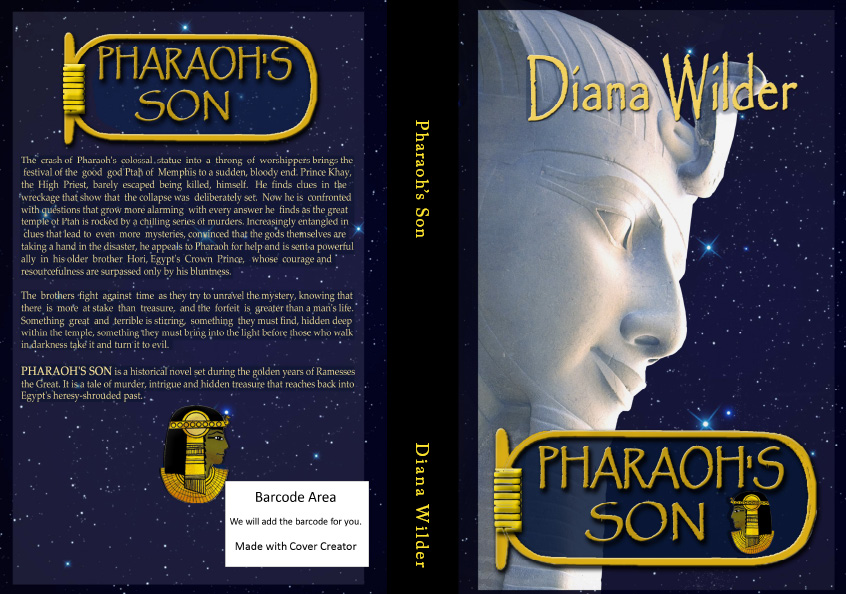
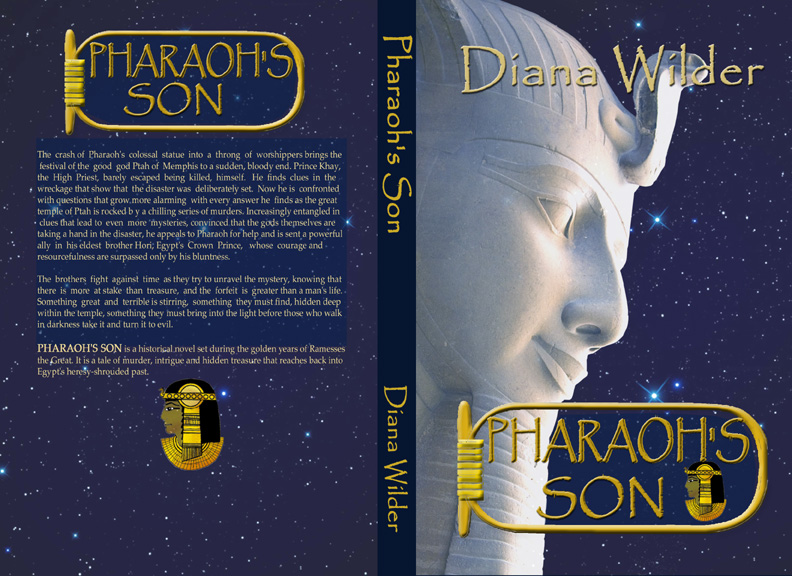
It takes a while to formulate an idea into a whole.  I’m not going to post photos following my path of designing a book cover.  I will say, though, that I have redesigned the cover for Pharaoh’s Son
and am posting it here.  It will take some time to be put on the listings, but it’s in the works.
If you look at my posts on Kindle covers as well as the one on old and new covers, you’ll see the development.  My first cover for Pharaoh’s Son was a redo of the wretched one.  It wasn’t bad, but I got the idea of using the colossus that inspired the story in the first place and the design took off from there.
I deleted the pyramid (it was on the back of the book for a while).  The nighttime sky made sense because the climactic scenes take place at night.  It fit.  I did make adjustments, but the cover is what is listed on my ‘Kindle covers’ post.
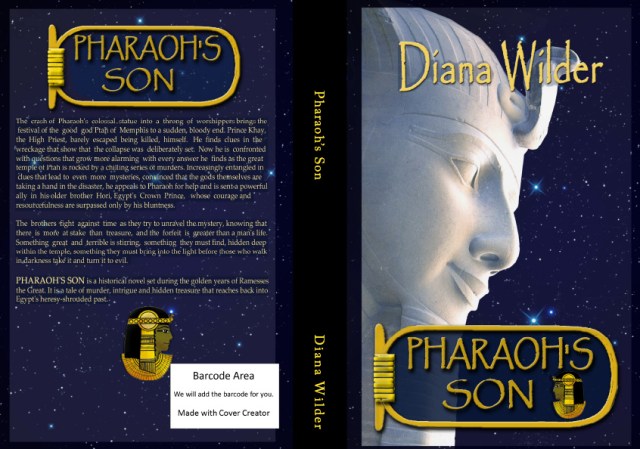
I will be working a free giveaway for Pharaoh’s Son, City of Refuge and A Killing Among the Dead, and I’d been dissatisfied with my designs recently.  They were OK, but amateurish (well…  I am an amateur, after all…) and I’d had a notion…
The design incorporates two additions, a cartouche and a line drawing.  The ‘Cartouche’ is the oval element that contains the title and, on the front, the line drawing.  The line drawing itself is a depiction of an Egyptian prince.  The headdress is composed of a headband of gold with, on the side, the pendant element including some sort of circular stone?  Enamel?  We haven’t found one of those in the round, but we have various depictions. 
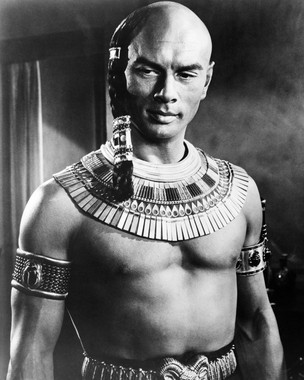
Young boys, prior to puberty, are depicted as having shaved heads and a braid on one side of their heads. It’s called the ‘Horus lock’.  Yul Brynner as Ramesses in The Ten Commandments, wears one of these.  Based on his behavior, Yul’s character was long past puberty, and I enjoyed a good snicker, but this is a good depiction.
A mature man who was acting in the role of someone’s son (or a prince) would have worn something like the headdress in the line drawing.  You’ll see them shown on depictions of various pharaohs’ sons assisting in storming cities and other such activities.  The cobra at the front of the line drawing is my invention to show that the wearer of this particular headdress  is ‘His Royal Highness’ – the Crown Prince.  In my story, other princes might wear that arrangement, but without the cobra, since they were not in the direct line of succession.
The Cartouche is on its side.  Egyptians used that feature when their text was on the long side and couldn’t be fit vertically, or else when the horizontal arrangement was more satisfactory.
All in all, I like the difference.

So, Who’s the Gatekeeper?


I was participating in an online discussion regarding publishing.  The participants were expressing general dissatisfaction with the quality of things being published and some blame was being assigned the publishing companies and the agents. 
One of the things a writer hears – and gets sick of hearing – is the earnestly voiced sentence:  They’re publishing so much junk nowadays, I don’t understand why you aren’t being published!  I don’t think my nearest and dearest are saying that I am producing junk and should fit right in…
I’d given a lot of thought to the question.  We always want to think of who’s at fault.  Who can we point a finger at if we think that the (name one) a. music, b. books, c. fashions are not to our personal taste.

I posted some thoughts.  I’m repeating the post in an expanded state:
We live in a world where (just about) everyone needs to be busy. Occupied. Heaven forbid that they listen to silence, or sit down alone to think. I held on the phone once for twenty minutes and was treated to hold muzak composed of a tinkly music box recording of one of my favorite tunes (Greensleeves). I complained when the receptionist finally came on again and she said, “Well, it’s better than listening to silence.” I said that it was not.  (Is irritating, repetitive noise preferable to your own thoughts?  Or silence?  It can cause hearing loss, I know, from my work.)
This society seems to require immediate engagement.  People need to be instantly amused, instantly caught.  There is no delay while something is being thought over.  Writers are always being drilled on the necessity for a ‘hook’ to draw people in to a movie, a book, whatever. Flashing lights, so to speak. Society as a whole is not encouraged to think for itself, but instead is to be kept amused.
I happen to think that people have not changed over the millennia, it’s just that there are more ways now to spoon feed people on flashy, substanceless garbage. I love A Tale of Two Cities: would it sell if it were published for the fist time in this era? Would an agent take it? (I know a couple who would, actually…)

But what does that have to do with the publishing industry?  We have to remember that the publishing industry is not a charitable concern supported by donations.  It exists to sell books; it has to make a profit by pleasing the public and giving the public what it wants. And let us remember, also, that the economy, globally, is not so good at the moment.  Is this a good time for financial risk-taking?  As I said, human nature likes to find someone at whom it can point fingers and say ‘They’re  the reason we’re –‘ (name the problem.)  We’re all struggling.  No one’s the bad guy.

I have a novel that starts with a longish chapter telling of a man’s suicide. He is trying to save his son from a course of mad folly, and he has concluded that the threat of his own death is the final step that will keep his son  safe. The story then moves forward twenty-five years to follow events that tie to that first scene. The scene is longish, and I will be re-editing it a little, but it needs to be there. (The book is The City of Refuge)

Would a publisher want it since it doesn’t start out with the kind of ‘bang’ they appear to be looking for? I don’t know.
(One of the people in the discussion commented that a suicide is certainly what she would consider a hook.)

My conclusion from this discussion is that I won’t buy junk.  And I will also try not to produce it.